2027 Chevrolet Bolt vs 2027 Volkswagen Atlas
Overview | |
MSRP$27,600 | MSRP$41,610 |
Listings6 | Listings64 |
Ratings & Reviews | |
User Reviews | User Reviews |
Expert reviews6.3 out of 10 | Expert reviews7.2 out of 10 |
Pros
Cons
| Pros
Cons
|
2027 Chevrolet Bolt Reviews SummaryWith more range, more power, and improved technology, the Chevrolet Bolt EV returns after a three-year hiatus. It also claims the title of the most affordable EV in the U.S., but is due to remain in production only until mid-2027. Verdict: The 2027 Chevrolet Bolt EV is an excellent choice for shoppers seeking an electric vehicle that won't break the bank. It may not be all that fancy or refined, but it gets the basics right when it comes to range and capabilities. | |
2027 Volkswagen Atlas Reviews SummaryNearly a decade after its debut, the 2027 Volkswagen Atlas is finally all-new. The second-generation model brings real wood trim, bigger screens, and a better ride. It also costs about $2,000 more, and its new face is a step backward. Still, the redesign gives one of Volkswagen’s best-selling models plenty of new reasons to shop it. Verdict: The 2027 Volkswagen Atlas fixes its predecessor’s biggest flaw and adds a lot of standard equipment for only a little more money. If buyers can live with a touch-heavy dashboard and a face that isn’t as handsome as the old one, it’s an easy SUV to recommend. | |
No video found | |
Popular Features & Specs | |
Seating Capacity5 | Seating Capacity7 |
EV Battery Capacity65 kWh | EV Battery Capacity |
Battery Charge Time (120V)64 hours | Battery Charge Time (120V) |
Battery Charge Time (240V)9.8 hours | Battery Charge Time (240V) |
Engine | |
Engine Name210 hp Electric | Engine Name |
Battery Charge Time (120V)64 hours | Battery Charge Time (120V) |
Battery Charge Time (240V)9.8 hours | Battery Charge Time (240V) |
DrivetrainFWD | Drivetrain |
Fuel Economy | |
EV Battery Capacity65 kWh | EV Battery Capacity |
Interior | |
Seating Capacity5 | Seating Capacity7 |
Key Features | |
Navigation SystemStandard | Navigation System |
Dimensions & Capacity | |
Cargo Space16.2 cu ft | Cargo Space21.2 cu ft |
Curb Weight3776 lbs | Curb Weight4420 lbs |
Height63.9 in | Height70.4 in |
Length169.6 in | Length203.1 in |
Width80.1 in | Width88.4 in |
Wheelbase105.3 in | Wheelbase117.3 in |
Maximum Payload873 lbs | Maximum Payload1102 lbs |
Number of doors4 | Number of doors4 |
Maximum Towing Capacity | Maximum Towing Capacity2000 lbs |
Overview | ||
MSRP | $27,600 | $41,610 |
Listings | ||
Ratings & Reviews | ||
User reviews | ||
Expert reviews | 6.3 out of 10Read full review | 7.2 out of 10Read full review |
Pros & cons | Pros
Cons
| Pros
Cons
|
Summary | With more range, more power, and improved technology, the Chevrolet Bolt EV returns after a three-year hiatus. It also claims the title of the most affordable EV in the U.S., but is due to remain in production only until mid-2027. Verdict: The 2027 Chevrolet Bolt EV is an excellent choice for shoppers seeking an electric vehicle that won't break the bank. It may not be all that fancy or refined, but it gets the basics right when it comes to range and capabilities. | Nearly a decade after its debut, the 2027 Volkswagen Atlas is finally all-new. The second-generation model brings real wood trim, bigger screens, and a better ride. It also costs about $2,000 more, and its new face is a step backward. Still, the redesign gives one of Volkswagen’s best-selling models plenty of new reasons to shop it. Verdict: The 2027 Volkswagen Atlas fixes its predecessor’s biggest flaw and adds a lot of standard equipment for only a little more money. If buyers can live with a touch-heavy dashboard and a face that isn’t as handsome as the old one, it’s an easy SUV to recommend. |
Video | No video found | |
Popular Features & Specs | ||
Seating Capacity | 5 | 7 |
EV Battery Capacity | 65 kWh | |
Battery Charge Time (120V) | 64 hours | |
Battery Charge Time (240V) | 9.8 hours | |
Engine | ||
Engine Name | 210 hp Electric | |
Battery Charge Time (120V) | 64 hours | |
Battery Charge Time (240V) | 9.8 hours | |
Drivetrain | FWD | |
Fuel Economy | ||
EV Battery Capacity | 65 kWh | |
Interior | ||
Seating Capacity | 5 | 7 |
Key Features | ||
Navigation System | Standard | |
Dimensions & Capacity | ||
Cargo Space | 16.2 cu ft | 21.2 cu ft |
Curb Weight | 3776 lbs | 4420 lbs |
Height | 63.9 in | 70.4 in |
Length | 169.6 in | 203.1 in |
Width | 80.1 in | 88.4 in |
Wheelbase | 105.3 in | 117.3 in |
Maximum Payload | 873 lbs | 1102 lbs |
Number of doors | 4 | 4 |
Maximum Towing Capacity | 2000 lbs | |
The 2027 Chevrolet Bolt retained a familiar appearance, with only slight styling changes that made its front end resemble a conventional gas-powered car more than an EV. The thin slot behind the Chevy Bowtie logo and the integrated grille insert into the bumper were among the few updates. The model continued to straddle the line between a large hatchback and a subcompact SUV, offering a single body style for 2027. Its tall and narrow design prioritized utility and interior space over a sporty stance, with the RS model adding minimal gloss black exterior trim for a touch of flair. Inside, the Bolt underwent a more dramatic makeover, featuring a larger digital instrument panel and infotainment touchscreen. The push-button gear selector was relocated to the steering column, freeing up storage space in the center console. Despite the hard plastic surfaces dominating the cabin, the Bolt maintained a budget feel with thin padding at elbow touch points and sturdy plastics, although the center console felt flimsy. The base LT trim offered cloth upholstery, while the RS trim upgraded to Evotex synthetic leather with red stitching.
The 2027 Volkswagen Atlas presented a challenge for its designers, as they updated an already beautiful vehicle. The redesign mostly succeeded, with a terrific profile featuring a crisp character line and flared wheel arches that gave the Atlas the robust shoulders expected of a big SUV. The rear boasted cascading taillights with selectable lighting animations, although the honeycomb lower diffuser appeared busy. The front, however, was less successful, with stacked headlights, dual light bars, and a VW badge placement that seemed off. Despite this, the Atlas maintained its appeal with wheel sizes ranging from 18 to 21 inches, depending on the trim. The interior saw significant improvements, with real wood on the dash and various leather options across trims. The Garnet Red Nappa leather in the SEL Premium R-Line created a warm and special cabin atmosphere. The Atlas also featured a light show with ambient lighting options, although some buyers might find it overwhelming. Overall, the cabin looked and felt more expensive than its price suggested, outshining competitors like the Honda Pilot and Toyota Grand Highlander.
The 2027 Chevrolet Bolt saw significant changes beneath the surface, with a new 65-kilowatt-hour lithium-iron phosphate battery pack that reduced costs and required fewer rare earth minerals. The new motor, borrowed from Chevy's Equinox EV, delivered 210 horsepower and 169 pound-feet of torque to the front wheels, achieving 0-60 mph in the low seven-second range. While this acceleration might seem slow by EV standards, it was quick compared to gas-powered subcompact SUVs. The Bolt offered one-pedal driving with medium or high brake regeneration levels, although the highest setting could be jumpy at low speeds. The ride was firm but not overly stiff, with road noise more noticeable due to the absence of an internal combustion engine. The Bolt's agility on curvy roads was surprising, thanks to its low center of gravity. On a full charge, the EPA estimated a range of up to 262 miles, a 15-mile improvement over its predecessor. The Bolt featured a Tesla-derived NACS charge port, with adapters for CCS and J1772 connectors, and increased charging speed from 55 kW to 150 kW, allowing a 10% to 80% recharge in 25 minutes.
The 2027 Volkswagen Atlas featured the latest version of its EA888 engine, producing 282 horsepower, a 13-horsepower increase from the previous year. However, torque decreased by 15 pound-feet to 258. Despite this, the Atlas remained quick, with a responsive accelerator. The engine's eagerness was both a strength and a drawback, as it felt busy and frantic, unlike the retired VR6 engine, which offered a smoother power delivery. The eight-speed automatic transmission provided smooth, well-timed shifts. Front-wheel drive was standard on the SE and SE w/Tech trims, with all-wheel drive available for an additional $2,000. The R-Line trims came with AWD as standard. The Atlas drove like a Volkswagen, with tight steering at highway speeds and a fun experience on curvy roads. The ride quality improved significantly, even on 21-inch wheels, and the cabin remained quiet until about 60 mph. Fuel economy improved, with the EPA rating the Atlas at 25 mpg combined with FWD and 23 mpg with AWD. The Atlas also offered a factory hitch and a 5,000-pound tow rating on all trims except the SE.
The 2027 Chevrolet Bolt offered an upright driving position, providing ample space for larger occupants. Taller drivers might have wished for more telescoping extension from the steering wheel, as they needed to move the seat forward to reach it comfortably. The rear seats were also upright, with plenty of headroom and adequate thigh support. The Bolt's floor was flat, reducing the penalty for center-seat passengers. It could hold up to 16.2 cubic feet of cargo behind the rear seats, which was small for the class but sufficient for most users. A large bin beneath the floor and easy-to-reach release latches for the rear seatbacks added to its practicality. Although there was no frunk, the Bolt provided ample storage for personal items, with a large bin, floor tray, deep center armrest bin, and additional pockets.
The 2027 Volkswagen Atlas remained one of the roomiest SUVs in its class, with minimal space loss in the new model. The front seats were firm and supportive, keeping occupants comfortable during long drives. The R-Line trims added memory and thigh support for the driver, while the SEL Premium R-Line included massage for both front occupants. The second row offered plenty of room, with rear climate controls and new B-pillar vents as standard. The R-Line trims added heated and ventilated outboard seats. The $695 captain’s chairs option reduced seating from seven to six, but the second row could flip and slide forward for third-row access. The third row provided genuine adult-friendly space, with 34.1 inches of legroom. The Atlas held 21.2 cubic feet of cargo behind the third row, expanding to 55.9 cubic feet with the third row folded and 95.4 cubic feet with all rear seats folded. A hands-free power liftgate, second-row sunshades, and dual cargo-area lights were standard.
The 2027 Chevrolet Bolt featured an 11-inch digital instrument panel and an 11.3-inch center touchscreen, both shared with the Chevy Colorado midsize truck. The infotainment system ran on a Google-based operating system, lacking support for Apple CarPlay and standalone Android Auto. Users had to pair their phones via Bluetooth to access personal music libraries. The optional Technology package added a surround-view camera system, digital rear-view mirror, additional safety features, and a wireless charging pad. The infotainment system was user-friendly, with logical menus, sharp graphics, and quick responses. Separate physical climate controls reduced distraction, and the navigation system helped locate charging stations and preconditioned the battery for optimal charging rates. The Bolt also offered vehicle-to-load charging, serving as a backup power source for a home.
The 2027 Volkswagen Atlas came with a 15-inch touchscreen on all trims except the base SE, which had a 12.9-inch unit. Both screens were sharp and responsive, with a 10.25-inch digital gauge cluster as standard. The R-Line trims added a head-up display. The screens handled most functions, with climate and volume sliders beneath the display now backlit. A new Driver Experience Dial brought back a real volume knob and cycled through drive modes and Atmospheres. Device charging was generous, with two Qi2 wireless pads and seven USB-C ports across all three rows. A nine-speaker stereo was standard, while the SEL Premium R-Line featured a 14-speaker Harman Kardon system. Some features required a subscription after a three-month trial, including Premium Navigation, Wi-Fi hotspot, AirConsole games, and a ChatGPT-powered voice assistant. Wireless Apple CarPlay and Android Auto were standard.
The 2027 Chevrolet Bolt had not yet been crash-tested by the NHTSA or IIHS, but it was expected to achieve high scores based on its platform. Standard safety features included forward collision warning with automatic emergency braking, adaptive cruise control, lane-keep assist, blind-spot monitors with active steering assist, and a safety alert seat. The optional Technology package added a surround-view camera system, digital rear-view mirror, automatic wipers, rear-pedestrian alert, and traffic-sign recognition. GM's Super Cruise hands-free automated highway driving system was available for an additional $3,255.
The 2027 Volkswagen Atlas had not been crash-tested by the IIHS or NHTSA at the time of writing. The outgoing model had earned high safety ratings, but those results did not carry over to the new vehicle. The Atlas featured VW’s IQ.Drive suite, including automatic emergency braking with pedestrian and cyclist detection, blind-spot monitors, rear cross-traffic alert, lane-keep assist, and adaptive cruise control with stop-and-go. Travel Assist allowed driver-initiated lane changes. Emergency Assist Plus could steer the Atlas to the side of the road if the driver became unresponsive. A new front center airbag brought the total to seven, and front and rear parking sensors, auto hold, and safe-exit assist were standard. The R-Line trims added predictive adaptive cruise control, and the SEL Premium R-Line included a surround-view camera and automatic parking.
CarGurus highlights
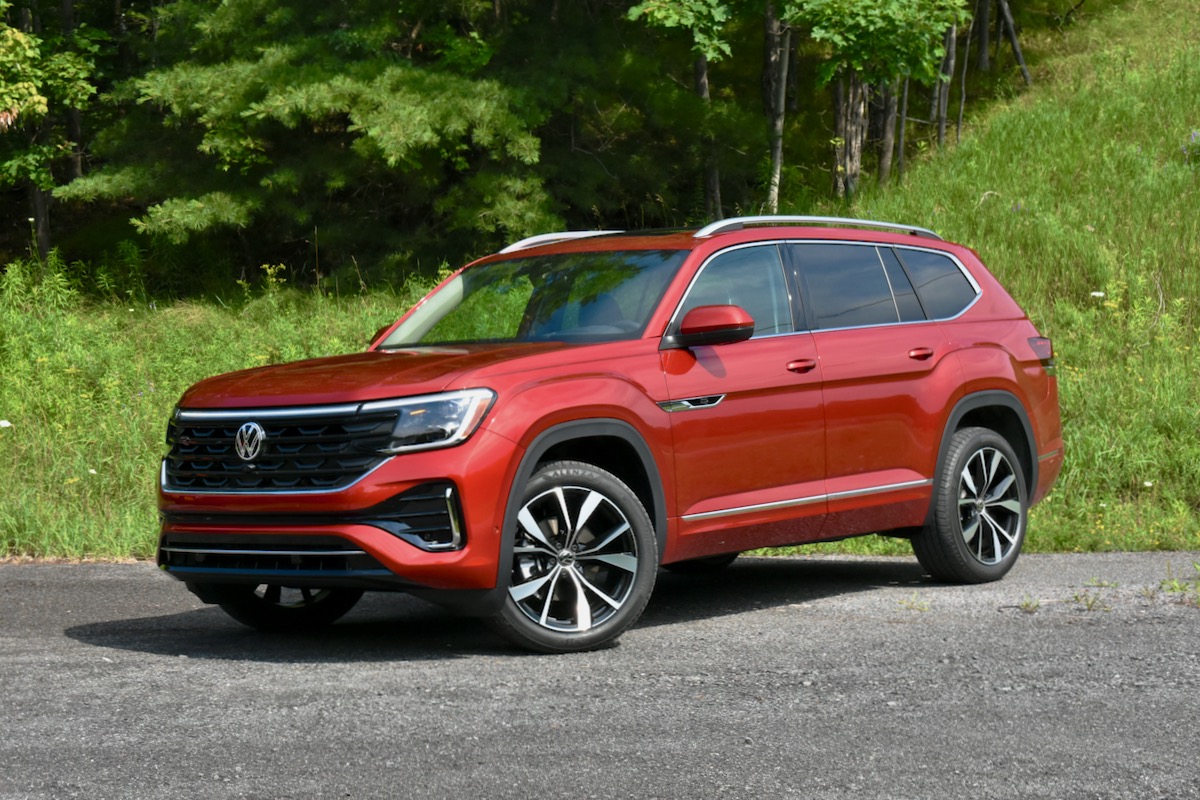
According to CarGurus experts, the overall rating for the 2027 Chevrolet Bolt is 6.3 out of 10, while the 2027 Volkswagen Atlas scores 7.2 out of 10. Based on these ratings, the Volkswagen Atlas is the recommended choice, offering a more spacious and luxurious experience with advanced technology and safety features.
Choose the 2027 Chevrolet Bolt if:
- You prioritize a budget-friendly EV with a respectable range of up to 262 miles.
- You value a user-friendly infotainment system with logical menus and quick responses.
- You seek a compact vehicle with ample interior storage and practical cargo solutions.


Choose the 2027 Volkswagen Atlas if:
- You need a spacious SUV with generous room for passengers and cargo.
- You appreciate a well-appointed interior with premium materials and ambient lighting options.
- You desire a vehicle with a comprehensive suite of advanced safety features and driver aids.


CarGurus highlights
According to CarGurus experts, the overall rating for the 2027 Chevrolet Bolt is 6.3 out of 10, while the 2027 Volkswagen Atlas scores 7.2 out of 10. Based on these ratings, the Volkswagen Atlas is the recommended choice, offering a more spacious and luxurious experience with advanced technology and safety features.
Choose the 2027 Chevrolet Bolt if:
Shop Now- You prioritize a budget-friendly EV with a respectable range of up to 262 miles.
- You value a user-friendly infotainment system with logical menus and quick responses.
- You seek a compact vehicle with ample interior storage and practical cargo solutions.
Choose the 2027 Volkswagen Atlas if:
Shop Now- You need a spacious SUV with generous room for passengers and cargo.
- You appreciate a well-appointed interior with premium materials and ambient lighting options.
- You desire a vehicle with a comprehensive suite of advanced safety features and driver aids.

By: CarGurus + AI
At CarGurus, our team of experienced automotive writers remain at the heart of our content operation, conducting hands-on car tests and writing insightful guides that are backed by years of industry experience. To complement this, we are harnessing AI to make our content offering more diverse and more helpful to shoppers than ever. To achieve this, our AI systems are based exclusively on CarGurus content, ratings and data, so that what we produce is both unique to CarGurus, and uniquely helpful to car shoppers.

