Toyota 4Runner vs Toyota Sequoia
Overview | |
MSRP$42,270 | MSRP$65,725 |
Listings812 | Listings243 |
Ratings & Reviews | |
User Reviews | User Reviews |
Expert reviews6.7 out of 10 | Expert reviews6.8 out of 10 |
Pros
Cons
| Pros
Cons
|
Reviews SummaryShoppers looking for an old-school SUV should be careful what they wish for, because the 4Runner makes compromises in passenger comfort and interior space to make it one of the better off-roaders on the market. It’s offered as a hybrid, but fuel economy is never as good as a typical crossover SUVs, which will be more comfortable and more affordable. That makes mainstream crossovers better choices for most, but for those who want adventure while carrying passengers, the 4Runner makes sense. Verdict: The 4Runner’s closest rivals are the Jeep Wrangler and the Ford Bronco. Compared to them, the 4Runner can carry more passengers and offers better fuel economy thanks to an available hybrid powertrain. If adventure is a priority, then the 4Runner is a great choice, but those who want a five- or seven-passenger SUV for daily family duty would be better off with a crossover. | |
Reviews SummaryThe Sequoia’s hybrid system offers great power and makes it the most efficient vehicle in the class outside of expensive diesels, but it provides only minor efficiency gains. The hybrid system also cuts into cargo space but doesn’t prevent the Sequoia from doing what a body-on-frame SUV is meant to do—carrying up to eight passengers while towing a heavy load. Verdict: The Sequoia suffers from the issues of all full-size body-on-frame SUVs—cumbersome handling, poor fuel economy, and hefty prices. However, its hybrid system makes it more efficient than gas-powered rivals, and it can still do all the work expected of these big brutes. It’s worth considering for anyone planning to tow a boat while carrying the family—they should just avoid the optional tow mirrors. | |
No video found | No video found |
Popular Features & Specs | |
Engine | Engine3.4L 437 hp V6 Hybrid |
Drivetrain | Drivetrain4X2 |
Seating Capacity7 | Seating Capacity8 |
Horsepower | Horsepower437 hp @ 5200 rpm |
EV Battery Capacity | EV Battery Capacity1.9 kWh |
MPG City | MPG City21 |
MPG Highway | MPG Highway24 |
Engine | |
Engine Name2.4L 278 hp I4 | Engine Name3.4L 437 hp V6 Hybrid |
Torque317 lb-ft @ 1700 rpm | Torque583 lb-ft @ 2400 rpm |
Horsepower278 hp @ 6000 rpm | Horsepower437 hp @ 5200 rpm |
Drivetrain4X2 | Drivetrain4X2 |
Fuel Economy | |
EV Battery Capacity | EV Battery Capacity1.9 kWh |
MPG City | MPG City21 |
MPG Highway | MPG Highway24 |
Interior | |
Seating Capacity7 | Seating Capacity8 |
Key Features | |
Sunroof/Moonroof | Sunroof/MoonroofStandard |
Safety | |
Front Crash Overall4 | Front Crash Overall |
Side Crash Overall5 | Side Crash Overall |
Dimensions & Capacity | |
Cargo Space48.4 cu ft | Cargo Space22.3 cu ft |
Curb Weight4455 lbs | Curb Weight5635 lbs |
Height72.6 in | Height74.5 in |
Length194.9 in | Length208.1 in |
Width78.0 in | Width79.6 in |
Wheelbase112.2 in | Wheelbase122.0 in |
Maximum Payload895 lbs | Maximum Payload1730 lbs |
Number of doors4 | Number of doors4 |
Maximum Towing Capacity6000 lbs | Maximum Towing Capacity9500 lbs |
Standard Towing Capacity6000 lbs | Standard Towing Capacity9500 lbs |
Overview | ||
MSRP | $42,270 | $65,725 |
Listings | ||
Ratings & Reviews | ||
User reviews | ||
Expert reviews | 6.7 out of 10Read full review | 6.8 out of 10Read full review |
Pros & cons | Pros
Cons
| Pros
Cons
|
Summary | Shoppers looking for an old-school SUV should be careful what they wish for, because the 4Runner makes compromises in passenger comfort and interior space to make it one of the better off-roaders on the market. It’s offered as a hybrid, but fuel economy is never as good as a typical crossover SUVs, which will be more comfortable and more affordable. That makes mainstream crossovers better choices for most, but for those who want adventure while carrying passengers, the 4Runner makes sense. Verdict: The 4Runner’s closest rivals are the Jeep Wrangler and the Ford Bronco. Compared to them, the 4Runner can carry more passengers and offers better fuel economy thanks to an available hybrid powertrain. If adventure is a priority, then the 4Runner is a great choice, but those who want a five- or seven-passenger SUV for daily family duty would be better off with a crossover. | The Sequoia’s hybrid system offers great power and makes it the most efficient vehicle in the class outside of expensive diesels, but it provides only minor efficiency gains. The hybrid system also cuts into cargo space but doesn’t prevent the Sequoia from doing what a body-on-frame SUV is meant to do—carrying up to eight passengers while towing a heavy load. Verdict: The Sequoia suffers from the issues of all full-size body-on-frame SUVs—cumbersome handling, poor fuel economy, and hefty prices. However, its hybrid system makes it more efficient than gas-powered rivals, and it can still do all the work expected of these big brutes. It’s worth considering for anyone planning to tow a boat while carrying the family—they should just avoid the optional tow mirrors. |
Video | No video found | No video found |
Popular Features & Specs | ||
Engine | 3.4L 437 hp V6 Hybrid | |
Drivetrain | 4X2 | |
Seating Capacity | 7 | 8 |
Horsepower | 437 hp @ 5200 rpm | |
EV Battery Capacity | 1.9 kWh | |
MPG City | 21 | |
MPG Highway | 24 | |
Engine | ||
Engine Name | 2.4L 278 hp I4 | 3.4L 437 hp V6 Hybrid |
Torque | 317 lb-ft @ 1700 rpm | 583 lb-ft @ 2400 rpm |
Horsepower | 278 hp @ 6000 rpm | 437 hp @ 5200 rpm |
Drivetrain | 4X2 | 4X2 |
Fuel Economy | ||
EV Battery Capacity | 1.9 kWh | |
MPG City | 21 | |
MPG Highway | 24 | |
Interior | ||
Seating Capacity | 7 | 8 |
Key Features | ||
Sunroof/Moonroof | Standard | |
Safety | ||
Front Crash Overall | 4 | |
Side Crash Overall | 5 | |
Dimensions & Capacity | ||
Cargo Space | 48.4 cu ft | 22.3 cu ft |
Curb Weight | 4455 lbs | 5635 lbs |
Height | 72.6 in | 74.5 in |
Length | 194.9 in | 208.1 in |
Width | 78.0 in | 79.6 in |
Wheelbase | 112.2 in | 122.0 in |
Maximum Payload | 895 lbs | 1730 lbs |
Number of doors | 4 | 4 |
Maximum Towing Capacity | 6000 lbs | 9500 lbs |
Standard Towing Capacity | 6000 lbs | 9500 lbs |
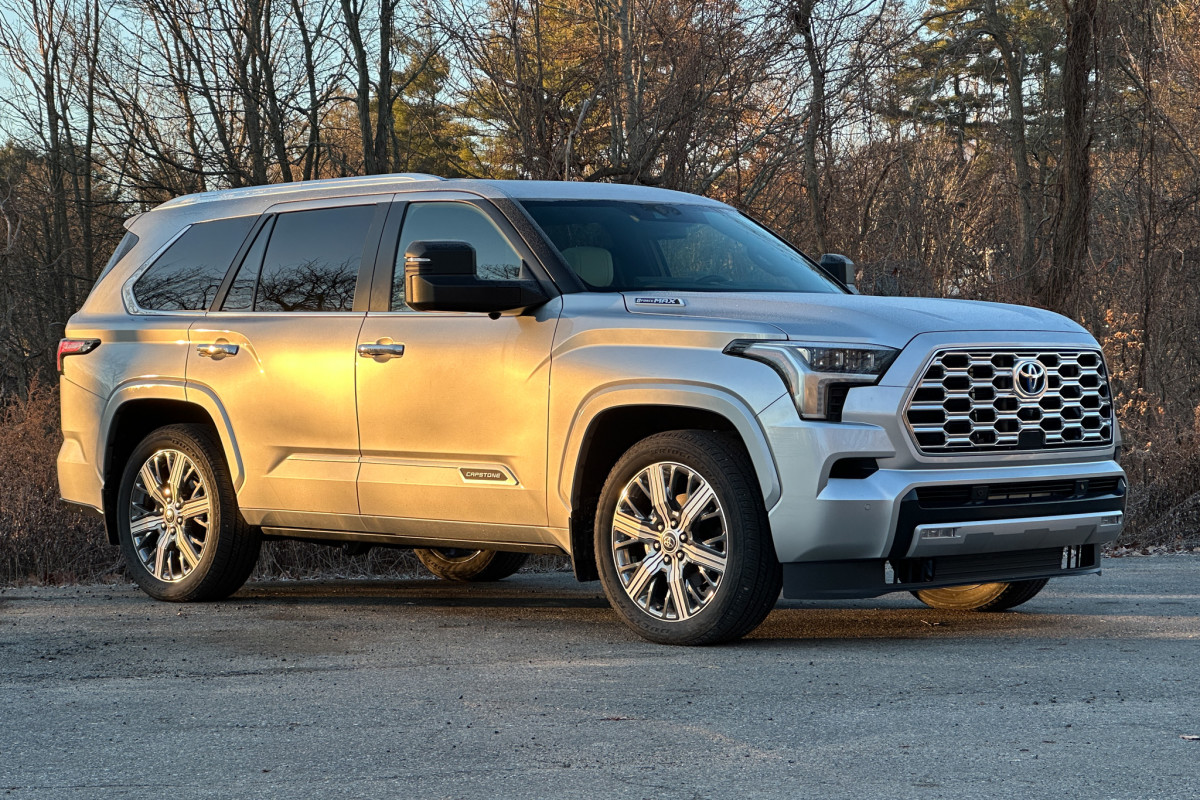
The 2026 Toyota Sequoia had a robust and imposing design, reminiscent of its sibling, the Tundra pickup. It featured a tall and wide stance with blocky characteristics, highlighted by a large black grille that was more contained than the Tundra's. The vehicle's sides showcased a stepped shoulder line from the hood to the front doors, with pronounced haunches over the wheels, giving it a chunky appearance. Black wheel flares were standard across all models except the top Capstone trim, which opted for body-colored flares. The Sequoia's rear was marked by a standard spoiler and tailgate lettering, and it rode on wheels ranging from 18 to 22 inches. Inside, the cabin continued the chunky theme with large dials suitable for gloved hands. The TRD Pro model featured black synthetic leather upholstery with a camouflage pattern, TRD Pro embroidery, and red contrast stitching, emphasizing its utilitarian nature over luxury. While soft-touch surfaces adorned parts of the interior, hard plastics were prevalent, especially in the TRD Pro trim.
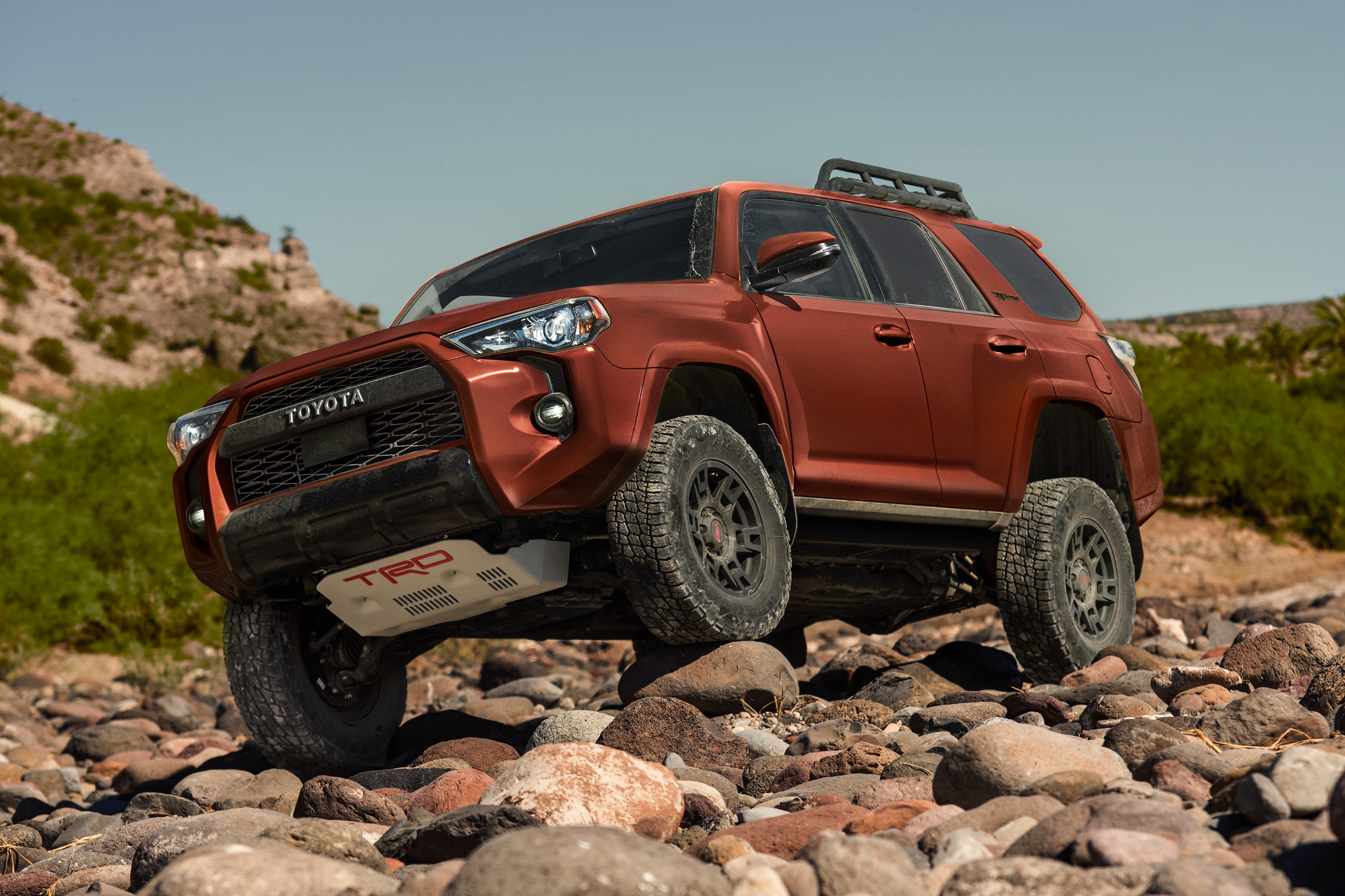
The 2026 Toyota 4Runner shared its design language with the Tacoma pickup, making it difficult to distinguish the two from the front. It boasted a muscular look with pronounced haunches and black wheel flares on off-road models. The sheet metal was heavily creased and angled, particularly along the sides. The grille sat high, with a lower intake underbite, especially on the TRD Pro and Trailhunter models, which featured heritage-inspired front ends with "Toyota" lettering and integrated light bars. The rear side windows extended into the roof, a nod to the original 4Runner of the 1980s. Wheel sizes ranged from 18 to 20 inches. Inside, the 4Runner's interior was simple and utilitarian, with chunky control dials and an abundance of hard plastic. Cloth upholstery was standard, with synthetic leather available on higher trims, including the TRD Pro and Trailhunter, while leather was reserved for the Limited and Platinum trims. Despite the leather, the cabin never exuded a high-end feel.

The 2026 Toyota Sequoia transitioned from a V8 to a hybrid powertrain, known as the i-Force Max, featuring a twin-turbocharged 3.4-liter V6 engine producing 437 horsepower and 583 pound-feet of torque. An electric motor added 48 hp and 184 lb-ft, drawing power from a 1.87-kWh battery pack. The engine delivered a V8-like experience, with strong acceleration and a 0–60 mph time of about six seconds. The Sequoia could tow up to 9,520 pounds, aided by a haul mode and an optional Tow Tech package. However, the large towing mirrors were cumbersome and obstructed views. Handling was typical for a body-on-frame SUV, with notable body lean and slow steering. The TRD Pro model featured an off-road-tuned suspension with Fox shocks and all-terrain tires, enhancing its off-road capabilities. The 4WD system offered low-range gearing and off-road drive modes, supported by a surround-view camera system for challenging terrains.
The 2026 Toyota 4Runner offered two powertrains: a turbocharged 2.4-liter four-cylinder engine with 278 horsepower and 317 pound-feet of torque, and the i-Force Max hybrid system, which increased output to 326 hp and 465 lb-ft. The hybrid powertrain, tested in the TRD Off-Road Premium model, delivered a mid-to-low seven-second 0–60 mph time. The eight-speed automatic transmission was well-matched to the engine, with a Sport drive mode for more aggressive performance. The 4Runner excelled in off-roading, with part-time or full-time 4WD systems, Multi-Terrain System drive modes, and features like a locking rear differential and Bilstein dampers. The TRD Pro and Trailhunter models offered additional off-road enhancements, including higher ground clearance, disconnecting sway bars, and unique bumpers. However, the off-road focus compromised on-road dynamics, with notable jiggle and bounding over bumps, and slow steering.
The 2026 Toyota Sequoia, a full-size SUV, accommodated seven or eight passengers. The first row featured eight-way power seat adjustments and two-way power lumbar adjustments, with heated front seats standard. The second row offered good comfort, especially with available captain’s chairs, and included USB-C ports and a 115-volt outlet. The third row provided adequate space for short trips, though low seat bottoms affected comfort. Cargo space was limited, with 11.5 cubic feet behind the third row, expanding to 86.9 cubic feet with seats folded. However, the load floor was not flat, and rivals offered more cargo space.
The 2026 Toyota 4Runner could seat five with two rows or seven with three rows. The front seats were the most comfortable, with power adjustments and a heated steering wheel on higher trims. The second row had decent space but lacked thigh support, and access was challenging due to short rear doors and high step-in height. The three-row version was less accommodating, with limited legroom and low seat bottoms. Cargo space was competitive with midsize rivals, offering up to 90.2 cubic feet in two-row models, but the hybrid powertrain reduced space due to a higher load floor.
The 2026 Toyota Sequoia came with a standard 12.3-inch digital instrument cluster and an 8-inch infotainment touchscreen, upgradeable to a 14-inch screen. The instrument cluster displayed trip information, fuel economy, and more, while the touchscreen offered wireless Apple CarPlay and Android Auto, navigation, and vehicle settings. Standard tech included satellite radio, an eight-speaker audio system, Wi-Fi Connect, Remote Connect, and Safety Connect. Higher trims offered a head-up display, wireless phone charger, and a JBL audio system.
The 2026 Toyota 4Runner featured a 7-inch digital instrument cluster and an 8-inch touchscreen, expandable to 12.3 and 14 inches, respectively. The 14-inch screen lacked a home screen but was easy to use, with quick access to navigation, phone, and entertainment functions. The 4Runner included Remote Connect, Safety Connect, and Service Connect, with a Wi-Fi hotspot available for a limited time. The digital instrument cluster provided customizable information, and standard tech included wireless Apple CarPlay and Android Auto, satellite radio, and a wireless phone charger on higher trims.
The 2026 Toyota Sequoia was equipped with Toyota's Safety Sense 2.5 suite, including forward-collision warning, adaptive cruise control, lane-departure warning, and more. Additional features included blind-spot monitors, rear cross-traffic alert, and a surround-view camera system. The Sequoia received mixed crash-test results, with a Good rating in some IIHS tests but a Marginal score in others. The safety systems performed well, but the large tow mirrors posed visibility challenges.
The 2026 Toyota 4Runner featured Safety Sense 3.0, with forward collision warning, adaptive cruise control, lane-departure warning, and more. It also included blind-spot monitors and traffic-jam assist. The 4Runner received four out of five stars from the NHTSA and mixed IIHS ratings, with Good scores in some tests but Marginal in others. The safety features worked effectively, but the 4Runner's crash-test scores were not as high as some competitors.
CarGurus highlights
According to CarGurus experts, the overall rating for the 2026 Toyota Sequoia is 6.8 out of 10, while the 2026 Toyota 4Runner scores 6.7 out of 10. Based on these ratings, the Sequoia edges out the 4Runner, offering a slightly better overall package with its powerful hybrid engine, spacious interior, and strong towing capabilities.
Choose the 2026 Toyota Sequoia if:
- You need a full-size SUV with strong towing capabilities and a powerful hybrid engine.
- You prioritize off-road features like the TRD Pro's suspension and all-terrain tires.
- You value a spacious interior with multiple seating configurations and tech options.


Choose the 2026 Toyota 4Runner if:
- You want a midsize SUV with versatile off-road capabilities and multiple powertrain options.
- You prefer a simpler, utilitarian interior with easy-to-use tech features.
- You need a vehicle with a variety of off-road enhancements for serious trail adventures.


CarGurus highlights
According to CarGurus experts, the overall rating for the 2026 Toyota Sequoia is 6.8 out of 10, while the 2026 Toyota 4Runner scores 6.7 out of 10. Based on these ratings, the Sequoia edges out the 4Runner, offering a slightly better overall package with its powerful hybrid engine, spacious interior, and strong towing capabilities.
Choose the 2026 Toyota Sequoia if:
Shop Now- You need a full-size SUV with strong towing capabilities and a powerful hybrid engine.
- You prioritize off-road features like the TRD Pro's suspension and all-terrain tires.
- You value a spacious interior with multiple seating configurations and tech options.
Choose the 2026 Toyota 4Runner if:
Shop Now- You want a midsize SUV with versatile off-road capabilities and multiple powertrain options.
- You prefer a simpler, utilitarian interior with easy-to-use tech features.
- You need a vehicle with a variety of off-road enhancements for serious trail adventures.

By: CarGurus + AI
At CarGurus, our team of experienced automotive writers remain at the heart of our content operation, conducting hands-on car tests and writing insightful guides that are backed by years of industry experience. To complement this, we are harnessing AI to make our content offering more diverse and more helpful to shoppers than ever. To achieve this, our AI systems are based exclusively on CarGurus content, ratings and data, so that what we produce is both unique to CarGurus, and uniquely helpful to car shoppers.

