2025 Hyundai Ioniq 5 vs 2025 Volkswagen Atlas
Overview | |
MSRP$42,600 | MSRP$38,200 |
Listings114 | Listings155 |
Ratings & Reviews | |
User Reviews | User Reviews |
Expert reviews8.7 out of 10 | Expert reviews6.7 out of 10 |
Pros
Cons
| Pros
Cons
|
2025 Hyundai Ioniq 5 Reviews SummaryIt would appear to be the calendar, not the competition, that has the Ioniq 5 due for a mid-cycle refresh. We liked it when it burst onto the scene as an angular oddball in a sea of soft-lined sameness, and it has only improved over the last few years. Verdict: Hyundai makes minor but welcome changes and avoids tweaking the many things that were working well, successfully making a good thing better. | |
2025 Volkswagen Atlas Reviews SummaryThe 2025 Atlas is Volkswagen’s midsize, three-row crossover SUV. It debuted for the 2018 model year, designed specifically for Americans and manufactured in VW’s Chattanooga, Tennessee, assembly plant. Over the years, it has received numerous updates to keep it fresh and technologically competitive, most recently for 2024, when styling, powertrain, and tech upgrades were introduced. The 2025 Atlas adds standard automatic high-beam headlights and wireless charging in addition to two new color choices. Verdict: This family-sized SUV has more interior space than most rivals, making the 2025 VW Atlas a great choice if passenger and cargo room are high on your list of requirements. However, unimpressive fuel economy, dissatisfying ride quality, and a sometimes-infuriating infotainment interface could have you mapping out alternatives to an Atlas. | |
No video found | No video found |
Popular Features & Specs | |
Engine168 hp Electric | Engine2.0L 269 hp I4 |
Drive TrainRWD | Drive TrainFWD |
Seating Capacity5 | Seating Capacity7 |
EV Battery Capacity63 kWh | EV Battery Capacity |
MPG City131 | MPG City20 |
MPG Highway100 | MPG Highway26 |
Battery Charge Time (120V)54 hours | Battery Charge Time (120V) |
Battery Charge Time (240V)5.7 hours | Battery Charge Time (240V) |
Engine | |
Engine Name168 hp Electric | Engine Name2.0L 269 hp I4 |
Battery Charge Time (120V)54 hours | Battery Charge Time (120V) |
Battery Charge Time (240V)5.7 hours | Battery Charge Time (240V) |
DrivetrainRWD | DrivetrainFWD |
Fuel Economy | |
EV Battery Capacity63 kWh | EV Battery Capacity |
MPG City131 | MPG City20 |
MPG Highway100 | MPG Highway26 |
Interior | |
Seating Capacity5 | Seating Capacity7 |
Key Features | |
Navigation SystemStandard | Navigation System |
Safety | |
Front Crash Overall | Front Crash Overall4 |
Side Crash Overall | Side Crash Overall5 |
Dimensions & Capacity | |
Cargo Space26.3 cu ft | Cargo Space20.6 cu ft |
Curb Weight4144 lbs | Curb Weight4343 lbs |
Height63.0 in | Height70.4 in |
Length183.3 in | Length200.7 in |
Width74.4 in | Width88.5 in |
Wheelbase118.1 in | Wheelbase117.3 in |
Maximum Payload1081 lbs | Maximum Payload1091 lbs |
Number of doors4 | Number of doors4 |
Maximum Towing Capacity | Maximum Towing Capacity2000 lbs |
Overview | ||
MSRP | $42,600 | $38,200 |
Listings | ||
Ratings & Reviews | ||
User reviews | ||
Expert reviews | 8.7 out of 10Read full review | 6.7 out of 10Read full review |
Pros & cons | Pros
Cons
| Pros
Cons
|
Summary | It would appear to be the calendar, not the competition, that has the Ioniq 5 due for a mid-cycle refresh. We liked it when it burst onto the scene as an angular oddball in a sea of soft-lined sameness, and it has only improved over the last few years. Verdict: Hyundai makes minor but welcome changes and avoids tweaking the many things that were working well, successfully making a good thing better. | The 2025 Atlas is Volkswagen’s midsize, three-row crossover SUV. It debuted for the 2018 model year, designed specifically for Americans and manufactured in VW’s Chattanooga, Tennessee, assembly plant. Over the years, it has received numerous updates to keep it fresh and technologically competitive, most recently for 2024, when styling, powertrain, and tech upgrades were introduced. The 2025 Atlas adds standard automatic high-beam headlights and wireless charging in addition to two new color choices. Verdict: This family-sized SUV has more interior space than most rivals, making the 2025 VW Atlas a great choice if passenger and cargo room are high on your list of requirements. However, unimpressive fuel economy, dissatisfying ride quality, and a sometimes-infuriating infotainment interface could have you mapping out alternatives to an Atlas. |
Video | No video found | No video found |
Popular Features & Specs | ||
Engine | 168 hp Electric | 2.0L 269 hp I4 |
Drive Train | RWD | FWD |
Seating Capacity | 5 | 7 |
EV Battery Capacity | 63 kWh | |
MPG City | 131 | 20 |
MPG Highway | 100 | 26 |
Battery Charge Time (120V) | 54 hours | |
Battery Charge Time (240V) | 5.7 hours | |
Engine | ||
Engine Name | 168 hp Electric | 2.0L 269 hp I4 |
Battery Charge Time (120V) | 54 hours | |
Battery Charge Time (240V) | 5.7 hours | |
Drivetrain | RWD | FWD |
Fuel Economy | ||
EV Battery Capacity | 63 kWh | |
MPG City | 131 | 20 |
MPG Highway | 100 | 26 |
Interior | ||
Seating Capacity | 5 | 7 |
Key Features | ||
Navigation System | Standard | |
Safety | ||
Front Crash Overall | 4 | |
Side Crash Overall | 5 | |
Dimensions & Capacity | ||
Cargo Space | 26.3 cu ft | 20.6 cu ft |
Curb Weight | 4144 lbs | 4343 lbs |
Height | 63.0 in | 70.4 in |
Length | 183.3 in | 200.7 in |
Width | 74.4 in | 88.5 in |
Wheelbase | 118.1 in | 117.3 in |
Maximum Payload | 1081 lbs | 1091 lbs |
Number of doors | 4 | 4 |
Maximum Towing Capacity | 2000 lbs | |
The 2025 Hyundai Ioniq 5 maintained its distinctive and retro-inspired design, reminiscent of the 1986-1991 Lancia Delta, particularly in its high-performance Ioniq 5 N variant. Hyundai's mid-cycle refresh introduced subtle changes, such as mild revisions to the lower front fascia, while retaining signature features like the "Parametric Pixel" headlights and taillights, round wheel arches, and a high rear spoiler. The new XRT trim stood out with red tow hooks and black plastic bumper cladding, featuring a unique "digital camouflage" pattern. Exclusive colors like Ultimate Red and Cosmic Blue Pearl were introduced for the XRT, along with new wheel designs across trims. The interior remained largely unchanged, maintaining its open and modern feel, with minor updates to the center console for improved functionality. The XRT trim added a rugged touch with its dark interior and all-weather floor mats.
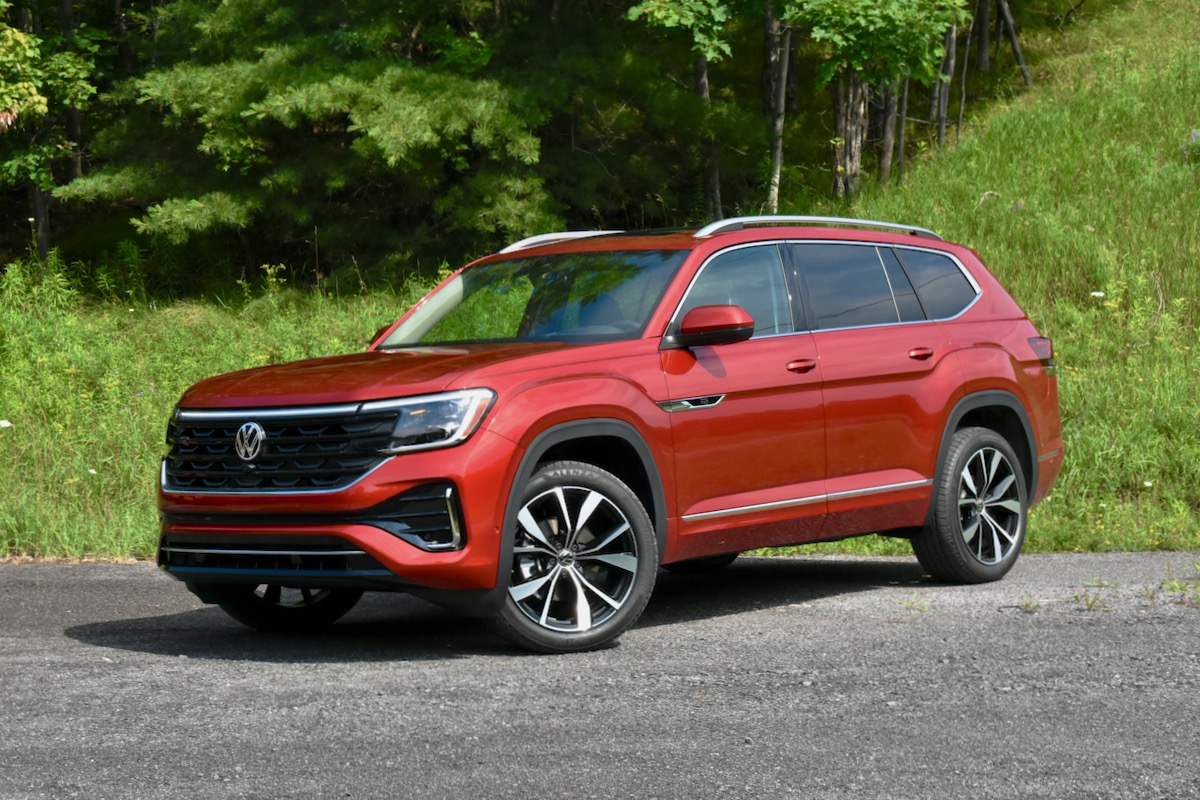
The 2025 Volkswagen Atlas offered a range of five trim levels, with the Peak Edition designed for off-roading and the SEL Premium R-Line boasting a sporty appearance and extensive standard equipment. The Atlas Cross Sport variant provided a more rakish design while retaining similarities to the three-row Atlas. The Atlas SEL Premium R-Line, tested in Mountain Lake Blue with a Shetland Beige leather interior, featured polished aluminum detailing, front and rear light bars, and 21-inch wheels with a machined finish. Its chiseled and upscale appearance aged well, and the Mountain Lake Blue color effectively concealed dirt. Inside, the Atlas exuded a premium feel with diamond-stitched leather, metallic accents, and artificial wood, creating a warm and inviting environment. The digital instrumentation and large infotainment touchscreen promised a high-tech experience, although the touch-sensitive controls for temperature and stereo volume were less satisfying to use.
The 2025 Hyundai Ioniq 5 XRT was designed with off-road aesthetics in mind, featuring etched badging, extra cladding, and a solid front fascia. However, it lacked skid plates or armor, indicating Hyundai's expectation that it wouldn't be used for rock crawling. The XRT introduced a Terrain Mode button on the steering wheel, offering Snow, Mud, and Sand modes that adjusted throttle mapping, wheel slip, power distribution, and regenerative braking. The XRT performed admirably on loose sand, allowing controlled slippage for an enjoyable off-road experience. On-road performance was expected to be similar to the Limited trim, with potential for increased road noise from all-terrain tires. The Ioniq 5 offered various powertrain options, with RWD models producing 168 to 225 horsepower and AWD models delivering 320 horsepower. The 2025 model year saw increased battery capacity, resulting in longer ranges, with most trims achieving up to 318 miles in RWD configuration.
The 2025 Volkswagen Atlas featured a turbocharged 2.0-liter four-cylinder engine, replacing the previous V6 option. With 269 horsepower and 273 pound-feet of torque, the engine initially seemed underpowered for the Atlas's size and towing capacity. However, it proved refined and satisfying for daily driving tasks, especially when utilizing the engine's torque curve and Sport mode. The Atlas returned 15.5 mpg in urban conditions and 19.2 mpg overall during testing, slightly below its EPA ratings. Ride quality was a concern, with the suspension feeling brittle over road imperfections and excessive body motions at highway speeds. Despite these issues, the Atlas handled predictably on mountain roads, with responsive brakes and steering. The Bridgestone Alenza all-season tires were identified as the weakest link in its dynamic performance.
The 2025 Hyundai Ioniq 5 addressed previous complaints by adding a rear windshield wiper as standard. Inside, the movable center console featured fore-and-aft cupholders, a wireless charging pad, and conveniently located controls for seat and steering wheel heating. Heated front seats were standard, with additional features like a heated steering wheel and front seat ventilation available on higher trims. Interior dimensions remained unchanged, offering ample headroom and legroom for both front and rear passengers. Cargo space measured 26.3 cubic feet with rear seats up and 58.5 cubic feet with them folded down, plus an additional 0.85 cubic feet in the "frunk." The Ioniq 5 transitioned to the North American Charging System (NACS), allowing access to Tesla's Supercharger network, and included a Combined Charging System (CCS) adapter for broader charging options.
The 2025 Volkswagen Atlas excelled in form and function, offering a spacious and comfortable interior. The third-row seat was particularly accommodating, making it ideal for carrying passengers and cargo. The SEL Premium R-Line model featured heated, ventilated, and massaging front seats, although the leather felt slightly stiff. Visibility was excellent, aided by large side mirrors and a surround-view camera system. The second-row bench seat provided ample space for three adults, with a climate-control panel and air vents for added comfort. Access to the third row was easy, and the seat offered adequate leg support. Storage space was commendable across all rows, with well-designed compartments and cupholders. The Atlas offered 20.6 cubic feet of cargo space behind the third row, expanding to 55.5 cubic feet with the third row folded and 96.6 cubic feet with the second row down.
The 2025 Hyundai Ioniq 5 retained its dual 12.3-inch screens for infotainment and digital instrumentation, with improved functionality and faster processing speeds. Wireless Apple CarPlay and Android Auto became standard, enhancing smartphone connectivity. The Bose Premium Audio system was available on the XRT and Limited trims, while SE and SEL trims featured a six-speaker sound system. Standard tech features included navigation, dynamic voice recognition, Bluetooth connectivity for two devices, and five USB-C ports. The Ioniq 5 also offered a head-up display on the Limited trim and a wireless charging pad starting at the SEL trim level.
The 2025 Volkswagen Atlas utilized the VW Group's MIB3 operating system, accessible through a 12-inch touchscreen display. While the system offered three Car-Net connected service plans, it lacked traditional stereo and climate controls, relying on touch-sensing buttons and a touch-and-slide volume control. The absence of a reliable native digital voice assistant was a drawback, with the system struggling to recognize commands. However, wireless Apple CarPlay and Android Auto provided a more user-friendly experience, offering navigation and music streaming. The Atlas SEL Premium R-Line featured a Harman Kardon audio system, delivering excellent sound quality. Despite some user-experience glitches, pairing a smartphone improved the overall infotainment experience.
The 2025 Hyundai Ioniq 5 continued to receive high safety ratings, earning a Top Safety Pick+ award from the IIHS and a five-star rating from the NHTSA. New standard safety features included an enhanced driver attention system with haptic steering wheel feedback, forward attention warning, and reverse and forward parking-distance warning. The XRT trim added a surround-view monitor and blind-spot view monitor. Highway Driving Assist 1 and 2 were available, with HDA 2 offering lane-changing capability and machine learning for improved performance.
The 2025 Volkswagen Atlas featured the IQ.Drive suite of standard driver-assistance features, including Front Assist, Active Side Assist, Lane Assist, Emergency Assist, and Travel Assist. Adaptive cruise control with stop-and-go capability and a rear cross-traffic alert system were also standard. The Atlas earned a five-star overall safety rating from the NHTSA and was a 2024 IIHS Top Safety Pick. The IQ.Drive systems were reliable and accurate, with minimal false warnings or issues during testing.
CarGurus highlights

According to CarGurus experts, the overall rating for the 2025 Hyundai Ioniq 5 is 8.7 out of 10, while the 2025 Volkswagen Atlas scores 6.7 out of 10. Based on these ratings, the Hyundai Ioniq 5 is the recommended choice, offering a blend of distinctive design, advanced technology, and comprehensive safety features that make it a standout option in its class.
Choose the 2025 Hyundai Ioniq 5 if:
- You prioritize a distinctive design with retro-inspired styling and modern features.
- You value a comprehensive safety suite with high safety ratings from IIHS and NHTSA.
- You want access to Tesla's Supercharger network and versatile charging options.


Choose the 2025 Volkswagen Atlas if:
- You need a spacious SUV with comfortable seating for passengers, including a roomy third row.
- You appreciate a premium interior with high-quality materials and advanced tech features.
- You require a vehicle with a strong suite of driver-assistance features for added safety.


CarGurus highlights
According to CarGurus experts, the overall rating for the 2025 Hyundai Ioniq 5 is 8.7 out of 10, while the 2025 Volkswagen Atlas scores 6.7 out of 10. Based on these ratings, the Hyundai Ioniq 5 is the recommended choice, offering a blend of distinctive design, advanced technology, and comprehensive safety features that make it a standout option in its class.
Choose the 2025 Hyundai Ioniq 5 if:
Shop Now- You prioritize a distinctive design with retro-inspired styling and modern features.
- You value a comprehensive safety suite with high safety ratings from IIHS and NHTSA.
- You want access to Tesla's Supercharger network and versatile charging options.
Choose the 2025 Volkswagen Atlas if:
Shop Now- You need a spacious SUV with comfortable seating for passengers, including a roomy third row.
- You appreciate a premium interior with high-quality materials and advanced tech features.
- You require a vehicle with a strong suite of driver-assistance features for added safety.

By: CarGurus + AI
At CarGurus, our team of experienced automotive writers remain at the heart of our content operation, conducting hands-on car tests and writing insightful guides that are backed by years of industry experience. To complement this, we are harnessing AI to make our content offering more diverse and more helpful to shoppers than ever. To achieve this, our AI systems are based exclusively on CarGurus content, ratings and data, so that what we produce is both unique to CarGurus, and uniquely helpful to car shoppers.

