2021 Toyota Sequoia vs 2021 Honda CR-V

Overview | |
MSRP$50,400 | MSRP$25,350 |
Listings60 | Listings1218 |
Ratings & Reviews | |
User Reviews | User Reviews |
Expert reviews7.0 out of 10 | Expert reviews7.8 out of 10 |
Pros
Cons
| Pros
Cons
|
2021 Toyota Sequoia Reviews SummaryLook around on the road today, and you are bound to see SUVs of all shapes and sizes. From three-row family haulers to subcompact runabouts. There is an SUV for nearly every need and every budget. The 2021 Toyota Sequoia might feel like it's from an earlier wave of the SUV craze, and that’s because it is. Born out of the 1990s SUV-excess-fest, the Sequoia has evolved into a niche vehicle for those who need serious space and truck-like capability. The current generation of the Sequoia has been around for almost 15 years, and while Toyota has updated it in several ways, there’s no avoiding its age. Even with modern tech and safety features, this is still an aging beast. Can such a dated vehicle still be relevant in the modern car market? And is age really that important to buyers who are looking for tons of space and standard V8 power? Read on to find out. | |
2021 Honda CR-V Reviews SummaryEven in a grim year, Honda is selling a staggering number of CR-Vs. The CR-V is the best-selling Honda by far. It’s also the second best-selling compact SUV, just behind the Toyota RAV4. And it's the fifth best-selling vehicle in the U.S., and if you take out all the commercial sales of full-size pickups it’s one of the two best-selling vehicles year in and year out. So it’s hard to argue against the CR-V formula. Honda’s been at this almost as long as crossovers have been a thing, launching the CR-V in 1997—a year after the RAV4 debuted. The funny thing is, aside from sales volume, there’s only one thing the CR-V particularly excels at. Aesthetics are subjective, but it would be hard to argue the CR-V is the best looking vehicle in its class. It’s not the cheapest. It’s not the best equipped, especially at the middle to lower trim levels. It’s not the fastest, nor is it the quietest, or the most fuel efficient. It’s not even the most reliable, showing up nowhere in J.D. Power's Most Reliable list. So what makes it so appealing to American consumers? Let’s see if we can figure that out. | |
No video found | No video found |
Popular Features & Specs | |
Engine5.7L 381 hp V8 | Engine1.5L 190 hp I4 |
Drivetrain4X2 | DrivetrainFWD |
Seating Capacity8 | Seating Capacity5 |
Horsepower381 hp @ 5600 rpm | Horsepower190 hp @ 5600 rpm |
MPG City13 | MPG City28 |
MPG Highway17 | MPG Highway34 |
Engine | |
Engine Name5.7L 381 hp V8 | Engine Name1.5L 190 hp I4 |
Torque401 lb-ft @ 3600 rpm | Torque179 lb-ft @ 2000 rpm |
Horsepower381 hp @ 5600 rpm | Horsepower190 hp @ 5600 rpm |
Drivetrain4X2 | DrivetrainFWD |
Fuel Economy | |
MPG City13 | MPG City28 |
MPG Highway17 | MPG Highway34 |
Interior | |
Seating Capacity8 | Seating Capacity5 |
Key Features | |
Sunroof/MoonroofStandard | Sunroof/Moonroof |
Safety | |
Front Crash Overall | Front Crash Overall5 |
Side Crash Overall | Side Crash Overall5 |
Dimensions & Capacity | |
Cargo Space18.9 cu ft | Cargo Space39.2 cu ft |
Curb Weight5730 lbs | Curb Weight3337 lbs |
Height77.0 in | Height66.1 in |
Length205.1 in | Length182.1 in |
Width79.9 in | Width73.0 in |
Wheelbase122.0 in | Wheelbase104.8 in |
Maximum Payload1405 lbs | Maximum Payload1358 lbs |
Number of doors4 | Number of doors4 |
Maximum Towing Capacity7400 lbs | Maximum Towing Capacity1500 lbs |
Standard Towing Capacity7400 lbs | Standard Towing Capacity |
Overview | ||
MSRP | $50,400 | $25,350 |
Listings | ||
Ratings & Reviews | ||
User reviews | ||
Expert reviews | 7.0 out of 10Read full review | 7.8 out of 10Read full review |
Pros & cons | Pros
Cons
| Pros
Cons
|
Summary | Look around on the road today, and you are bound to see SUVs of all shapes and sizes. From three-row family haulers to subcompact runabouts. There is an SUV for nearly every need and every budget. The 2021 Toyota Sequoia might feel like it's from an earlier wave of the SUV craze, and that’s because it is. Born out of the 1990s SUV-excess-fest, the Sequoia has evolved into a niche vehicle for those who need serious space and truck-like capability. The current generation of the Sequoia has been around for almost 15 years, and while Toyota has updated it in several ways, there’s no avoiding its age. Even with modern tech and safety features, this is still an aging beast. Can such a dated vehicle still be relevant in the modern car market? And is age really that important to buyers who are looking for tons of space and standard V8 power? Read on to find out. | Even in a grim year, Honda is selling a staggering number of CR-Vs. The CR-V is the best-selling Honda by far. It’s also the second best-selling compact SUV, just behind the Toyota RAV4. And it's the fifth best-selling vehicle in the U.S., and if you take out all the commercial sales of full-size pickups it’s one of the two best-selling vehicles year in and year out. So it’s hard to argue against the CR-V formula. Honda’s been at this almost as long as crossovers have been a thing, launching the CR-V in 1997—a year after the RAV4 debuted. The funny thing is, aside from sales volume, there’s only one thing the CR-V particularly excels at. Aesthetics are subjective, but it would be hard to argue the CR-V is the best looking vehicle in its class. It’s not the cheapest. It’s not the best equipped, especially at the middle to lower trim levels. It’s not the fastest, nor is it the quietest, or the most fuel efficient. It’s not even the most reliable, showing up nowhere in J.D. Power's Most Reliable list. So what makes it so appealing to American consumers? Let’s see if we can figure that out. |
Video | No video found | No video found |
Popular Features & Specs | ||
Engine | 5.7L 381 hp V8 | 1.5L 190 hp I4 |
Drivetrain | 4X2 | FWD |
Seating Capacity | 8 | 5 |
Horsepower | 381 hp @ 5600 rpm | 190 hp @ 5600 rpm |
MPG City | 13 | 28 |
MPG Highway | 17 | 34 |
Engine | ||
Engine Name | 5.7L 381 hp V8 | 1.5L 190 hp I4 |
Torque | 401 lb-ft @ 3600 rpm | 179 lb-ft @ 2000 rpm |
Horsepower | 381 hp @ 5600 rpm | 190 hp @ 5600 rpm |
Drivetrain | 4X2 | FWD |
Fuel Economy | ||
MPG City | 13 | 28 |
MPG Highway | 17 | 34 |
Interior | ||
Seating Capacity | 8 | 5 |
Key Features | ||
Sunroof/Moonroof | Standard | |
Safety | ||
Front Crash Overall | 5 | |
Side Crash Overall | 5 | |
Dimensions & Capacity | ||
Cargo Space | 18.9 cu ft | 39.2 cu ft |
Curb Weight | 5730 lbs | 3337 lbs |
Height | 77.0 in | 66.1 in |
Length | 205.1 in | 182.1 in |
Width | 79.9 in | 73.0 in |
Wheelbase | 122.0 in | 104.8 in |
Maximum Payload | 1405 lbs | 1358 lbs |
Number of doors | 4 | 4 |
Maximum Towing Capacity | 7400 lbs | 1500 lbs |
Standard Towing Capacity | 7400 lbs | |
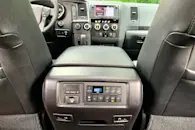
The 2021 Toyota Sequoia, despite its attempts to stay modern with a facelift in 2018, still showed its age. The subtle updates to the headlights and grille were overshadowed by its large, imposing silhouette. Inside, the Sequoia's design felt dated, with a massive, multi-tiered center dash reminiscent of the mid-2000s. The standard 7-inch touchscreen appeared small against the expansive dash, and while the cabin offered ample space, the front seats were bulky, limiting headroom for taller drivers. However, the second-row seats provided generous headroom and legroom, and all seats were comfortable and supportive. The Sequoia was available in several trims, including the SR5, TRD Sport, Limited, Nightshade Edition, TRD Pro, and Platinum, each offering various features and enhancements.
In contrast, the 2021 Honda CR-V's design was typical of compact crossovers, with styling that blended into the competitive market. While the exterior didn't stand out, the CR-V offered a few distinguishing details like its grille and chromed plastic features. The color palette was limited, with more vibrant options reserved for higher trims. Inside, the CR-V provided a modern look with angular seats and upscale touches like wood panels and chrome accents in higher trims. The CR-V's interior was practical, offering 102.9 cubic feet of passenger volume and 75.8 cubic feet of cargo space with the rear seats folded. The tailgate options varied by trim, with the Touring trim featuring a hands-free power tailgate. Roof rails were standard only on the top-tier Touring trim.
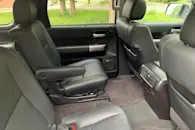



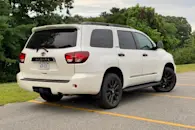




The 2021 Toyota Sequoia was powered by a robust 5.7-liter V8 engine, delivering 381 horsepower and 401 pound-feet of torque. This engine, paired with a six-speed automatic transmission, provided strong acceleration, even for an SUV weighing up to 6,000 pounds. The Sequoia's driving dynamics were reminiscent of a truck, with a soft suspension and powerful brakes. It could tow up to 7,400 pounds, which was less than some competitors like the Ford Expedition and Chevrolet Tahoe. The Sequoia's wide stance helped manage body roll in corners, but its older platform and transmission limited its fuel efficiency.
The 2021 Honda CR-V, on the other hand, featured a 190-horsepower turbocharged four-cylinder engine across all trims. It offered smooth and steady acceleration, with a 0-60 mph time of about 7.8 seconds. The CR-V's continuously variable transmission (CVT) provided a less engaging driving experience compared to competitors with conventional automatic transmissions. Front-wheel drive was standard, with all-wheel drive available as an option. The CR-V's suspension setup included a MacPherson strut front and multi-link rear, offering decent handling and ride quality. While not the most thrilling to drive, the CR-V was reliable and predictable.
The 2021 Toyota Sequoia boasted a spacious cabin, with nearly 19 cubic feet of cargo space behind the third row and 120 cubic feet with all rear seats folded. This was slightly less than some competitors but still impressive. The Sequoia featured a power-retractable rear window, a unique and practical feature for accessing the cargo area. While the front-row space could have been better utilized, the Sequoia offered ample storage options, including deep door pockets and a large center console.
The 2021 Honda CR-V prioritized functionality, offering 102.9 cubic feet of passenger volume and 75.8 cubic feet of cargo space with the rear seats folded. The tailgate options varied by trim, with the Touring trim featuring a hands-free power tailgate. The CR-V's interior was practical, with charging ports throughout the cabin and roof rails standard only on the top-tier Touring trim. The CR-V's design focused on comfort and convenience, making it a practical choice for families.
The 2021 Toyota Sequoia came standard with a 7-inch touchscreen infotainment system, featuring Apple CarPlay, Android Auto, Amazon Alexa, and a WiFi hotspot. The system was user-friendly, with simple menus and large hard buttons. Our test model included a larger 9-inch screen, which still felt small on the large dash. The Sequoia's technology was dated but straightforward, offering essential connectivity features.
The 2021 Honda CR-V's base LX trim had a basic 5-inch color screen with Bluetooth connectivity. However, other trims featured a 7-inch high-definition touchscreen with Apple CarPlay and Android Auto integration. The audio system varied by trim, with the Touring trim offering a 300-watt system with a subwoofer. The CR-V also included multiple charging ports and a wireless phone charger in the Touring trim. The Touring trim was the only one with a satellite navigation system.
The 2021 Toyota Sequoia was equipped with the Toyota Safety Sense-P suite, including forward-collision warning, automatic emergency braking, pedestrian detection, adaptive cruise control, lane-departure warning, and automatic high beams. It also featured blind-spot monitoring, rear cross-traffic alert, and parking sensors. However, it lacked more advanced tech like lane-keeping assist. The Sequoia scored four out of five stars in the NHTSA rollover test but was not rated in other crash tests.
The 2021 Honda CR-V excelled in safety, earning a five-star NHTSA overall crash test rating and an IIHS Top Safety Pick award. It featured the Honda Sensing system, with standard safety features like a multi-angle rearview camera, forward collision warning, lane departure warning, automatic emergency braking, lane keeping assist, adaptive cruise control, and auto high-beam headlamps. The blind spot monitoring system was standard from the EX trim upwards.
CarGurus highlights

According to CarGurus experts, the overall rating for the 2021 Toyota Sequoia is 7.0 out of 10, while the 2021 Honda CR-V scores 7.8 out of 10. Based on these ratings, the 2021 Honda CR-V is the recommended choice, offering better safety features, a more modern interior, and a higher overall rating.
Choose the 2021 Toyota Sequoia if:
- You need a powerful V8 engine for towing and hauling.
- You prioritize a spacious interior with ample cargo capacity.
- You appreciate straightforward technology and user-friendly controls.


Choose the 2021 Honda CR-V if:
- You value top-tier safety ratings and comprehensive standard safety features.
- You prefer a practical and functional interior with modern design elements.
- You seek a reliable and efficient compact crossover for everyday use.


CarGurus highlights
According to CarGurus experts, the overall rating for the 2021 Toyota Sequoia is 7.0 out of 10, while the 2021 Honda CR-V scores 7.8 out of 10. Based on these ratings, the 2021 Honda CR-V is the recommended choice, offering better safety features, a more modern interior, and a higher overall rating.
Choose the 2021 Toyota Sequoia if:
Shop Now- You need a powerful V8 engine for towing and hauling.
- You prioritize a spacious interior with ample cargo capacity.
- You appreciate straightforward technology and user-friendly controls.
Choose the 2021 Honda CR-V if:
Shop Now- You value top-tier safety ratings and comprehensive standard safety features.
- You prefer a practical and functional interior with modern design elements.
- You seek a reliable and efficient compact crossover for everyday use.

By: CarGurus + AI
At CarGurus, our team of experienced automotive writers remain at the heart of our content operation, conducting hands-on car tests and writing insightful guides that are backed by years of industry experience. To complement this, we are harnessing AI to make our content offering more diverse and more helpful to shoppers than ever. To achieve this, our AI systems are based exclusively on CarGurus content, ratings and data, so that what we produce is both unique to CarGurus, and uniquely helpful to car shoppers.

