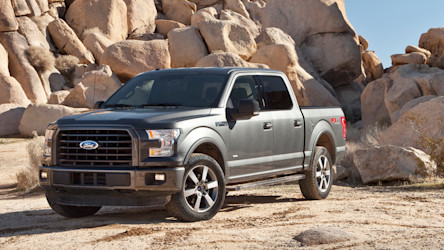
The Ford F-150 Hybrid might just be one of the most debated trucks in America. If you're considering the PowerBoost hybrid over a traditional gas-powered F-150, you've probably run into headlines and forums calling it the 'least reliable vehicle' you can buy as far as used trucks go. You've probably also heard some F-150 enthusiasts swear they'd never go back to a regular engine.
Of course, the full story is a bit more nuanced than team gas vs team hybrid suggests, and it's changed significantly in the past year. Below, we'll talk about what you actually need to know before deciding which F-150 is right for you.
- How Does the Ford PowerBoost Hybrid System Work?
- F-150 Hybrid vs. Gas Powertrain Reliability
- What About the Battery?
- The Pros and Cons of F-150 Hybrid Reliability
- What F-150 Hybrid Owners Are Actually Saying
- Is an F-150 Hybrid Right for You?
F-150 Hybrid vs. Gas Trucks at a Glance
| PowerBoost Setup | 3.5L twin-turbo V6 + 35kW electric motor; 430 hp and 570 lb-ft of torque — most torque of any F-150 engine |
| Not a Plug-In | The PowerBoost charges itself through regenerative braking; no outlet required |
| Fuel Economy | EPA-rated 23 mpg combined vs. 19 mpg for the 5.0L V8 and 3.5L EcoBoost |
| Key Risk | Higher potential for complex electrical faults and software glitches that are harder to diagnose than mechanical issues |
| Battery Warranty | Ford covers the hybrid battery and electric drivetrain for 8 years or 100,000 miles |
| Hybrid Wins For | Maximum low-end torque for quick acceleration and superior fuel economy in city/stop-and-go traffic & Mobile power (Pro Power Onboard) to run a job site or home appliances during a blackout |
| Gas Wins For | High-mileage highway towing, buyers keeping trucks 15+ years, and those prioritizing the lowest long-term complexity |

How Does the Ford PowerBoost Hybrid System Work?
The Ford PowerBoost is a full hybrid pairing a 3.5L twin-turbo V6 with a self-charging electric motor to boost torque and MPG without needing a plug.
This is a question worth answering clearly, because the PowerBoost is not what most people picture when they hear "hybrid truck." It doesn't plug in, it doesn't have a massive battery like an EV, and it doesn't sacrifice any of the capability that F-150 buyers expect.
Here's what you need to know about the Ford F-150 hybrid:
The PowerBoost Setup
At its core, the PowerBoost pairs Ford's 3.5-liter twin-turbocharged V6 with a 35-kilowatt electric motor. That motor is sandwiched between the engine and the 10-speed automatic transmission, powered by a 1.5-kWh lithium-ion battery pack. The combined output is 430 hp and 570 lb-ft of torque—more torque than any other engine in the F-150 lineup, including the 5.0L V8.
In other words, the PowerBoost drives like a high-performance V8 but with the fuel efficiency of a smaller engine. It gives you massive pulling power the second you hit the gas without the "lag" typical of turbo trucks, all while using the electric motor to save you money in heavy traffic.
It Charges Itself
The PowerBoost is a full hybrid, which means the battery charges itself through regenerative braking. This means every time you slow down or lift off the accelerator, the system captures energy that would otherwise be wasted and stores it in the battery.
There's no charging cable, no special outlet required, and no range anxiety. You fill it up at any gas station like any other old F-150.
The Electric Motor Fills In the Gaps
The electric motor's job is to provide instant torque from zero rpm—something turbocharged engines take a little time to build. This is what gives the PowerBoost its characteristically quick, smooth acceleration off the line.
At low speeds and light throttle, the truck can run on electric power alone, which is where most of the fuel savings come from in stop-and-go driving. On the highway, the gas engine does most of the work, and the efficiency advantage over a standard EcoBoost gas-powered engine narrows considerably.
Pro Power Onboard: The Generator Capability
The feature that genuinely sets the PowerBoost apart from every other F-150—and every other half-ton truck on the market—is the Pro Power Onboard. This hybrid system can be used as a mobile generator, with available outputs of 2.4kW or 7.2kW through outlets in the truck bed.
The 7.2kW option can run serious power tools, a full job site, or even critical circuits in a home during a power outage. It's a capability that gas-only F-150s simply don't offer.

F-150 Hybrid vs. Gas Powertrain Reliability
The Ford F-150's 5.0L V8 and 3.5L EcoBoost (the non-hybrid engines, in other words) are the industry benchmarks for reliability, backed by decades of service data. However, they aren't flawless; owners still face traditional mechanical hurdles like cam phaser wear, carbon buildup, and early 10-speed transmission shifting glitches.
While the gas models deal primarily with these predictable wear-and-tear items, the PowerBoost adds a layer of high-voltage electronics and software. This creates a trade-off: you get superior power and efficiency, but you risk complex electrical faults that are much harder for a local shop to troubleshoot than a standard mechanical repair.
The PowerBoost: A Rough Start, a Meaningful Turnaround
The PowerBoost launched in 2021 and immediately struggled with "growing pains," ranging from shifting glitches and software freezes to auxiliary battery faults. These early 2021–2023 models earned a reputation for being a high-risk work-in-progress, often landing at the bottom of reliability rankings.
The trade-off here is stability: while the 2026 model has transitioned into a "recommended" pick with significantly improved hardware and software, the older versions remain a gamble. If you buy a used 2021–2023 PowerBoost, you are trading a lower purchase price for the "early adopter" bugs that Ford spent three years fixing.
Related Reading: For a full breakdown of F-150 reliability by engine and model year, see the Ford F-150 Reliability Guide on CarGurus.
What About the Battery?
Battery longevity is arguably the question most buyers are really asking when they wonder whether a hybrid is reliable. Ford covers the PowerBoost's high-voltage battery and electric drivetrain components for 8 years or 100,000 miles. Within that window, if the battery fails due to a defect, it's Ford's problem to fix, provided you've had the vehicle serviced and maintained according to Ford's guidelines.
Outside that window, the picture is less predictable. There are documented cases of battery failures just past the 100,000-mile mark on 2021–2023 models, with replacement quotes ranging from $5,000 to over $9,000. This is the most important out-of-warranty risk to understand before buying a used PowerBoost.

The Pros and Cons of F-150 Hybrid Reliability
| Feature | The Pros | The Cons |
|---|---|---|
| Mechanical Longevity | The gas engine runs fewer hours by shutting off at stops, and regenerative braking preserves pads and rotors for less wear and tear | Adding an electric motor, battery, and extra cooling circuits increases the number of potential failure points out of warranty |
| Everyday Utility | The Pro Power Onboard (up to 7.2kW) provides a built-in generator for job sites, camping, or home backup | High parasitic draw from onboard electronics can drain the standard battery if the truck sits unused for several days |
| Performance | 570 lb-ft of (instant) torque allows for quick acceleration (0–60 in 5.8s) and high towing capacity | Integrated hybrid components require specialized high-voltage technicians and can lead to longer dealership wait times |
| Model Maturity | Recent models (2024–2026) benefit from hardware refinements and software patches that ironed out early bugs | Early adopter years (2021–2023) are frequently flagged for higher rates of electrical and transmission glitches |
What F-150 Hybrid Owners Are Actually Saying
Forum communities are often the best place to look for real-world ownership insights once the press reviews and warranty periods are in the rearview mirror. The consensus across the subreddit r/f150 and the F150Forum reflects a polarized but increasingly positive picture.
The Owners Who Love It
The most consistent theme among satisfied PowerBoost owners is the driving experience. Owners across both communities describe the instant torque as genuinely surprising for a truck this size. One of the biggest mentions in these community forums is the feeling of the electric motor making the truck feel 'zippier' and more responsive than the V8.
Multiple owners with 40,000 to 80,000 miles report zero hybrid-related issues and say they wouldn't go back to a conventional powertrain. Forum members who own the 7.2kW Pro Power system are particularly enthusiastic, describing it as a feature that changed how they use the truck on job sites and camping trips.
The Recurring Complaints
The 12V auxiliary battery drain comes up repeatedly in these communities, particularly among owners who don't drive daily. While the fix here is simple (drive it regularly or put a battery maintainer on it), owners note it's an unexpected quirk for a truck at this price point.
A subset of owners on F150Forum also describes frustration with the SYNC infotainment system, including CarPlay connectivity issues and occasional software glitches. The key context here, as several knowledgeable forum members have pointed out, is that many of the reliability complaints attributed to the PowerBoost in Consumer Reports surveys were actually general F-150 electronics issues—not hybrid-specific failures.
The 2023 model year, for example, had a software issue that took Ford several months to patch, and the volume of complaints it generated affected the PowerBoost's Consumer Reports score disproportionately.
The 'Long-Haul' Debate
The most substantial ongoing debate in both communities centers on long-term ownership. Owners who plan to keep their trucks for 200,000-plus miles are more cautious, with the prevailing advice being to stick with a conventional 2.7L or 5.0L if longevity is the primary goal.
For buyers who keep their trucks for five to eight years and stay within warranty coverage, the general consensus is considerably more optimistic, as owners of newer models (2024+) seem to be much happier than those with older models.
Related Reading: Thinking about buying a used PowerBoost? See the Used Ford F-150 Buyer's Checklist on CarGurus for what to inspect before you buy any used F-150.

Is an F-150 Hybrid Right for You?
The most honest answer here depends on where you spend your time. If your day-to-day involves stop-and-go commuting or suburban errands, the PowerBoost is the strongest tool in the F-150 shed. It thrives in traffic where gas engines struggle, using its electric motor to save fuel and provide instant torque. However, if you're a long-distance highway hauler, the "hybrid tax" loses its value; the electric motor contributes less under sustained loads, and you lose roughly 1,300 lbs of max towing capacity compared to a properly equipped 3.5L EcoBoost.
The "horror stories" from the PowerBoost's early years are essentially behind us. While the 2021–2023 models earned their reputation as high-risk "early adopters," the 2026 version has matured into a recommended, average-reliability pick.
With that said, if you're buying new or targeting a 2024+ model, you are getting a refined, high-performance machine. But if you're shopping used F-150 hybrids, the year matters more than the mileage.
Related Reading: Want to know how the F-150's safety features and recalls compare across model years? See the Ford F-150 Safety Guide on CarGurus.
Ready to compare your options? Browse Ford F-150 listings on CarGurus—including PowerBoost and gas models—and use the Deal Rating and Instant Market Value tools to find a well-maintained truck at a fair price.