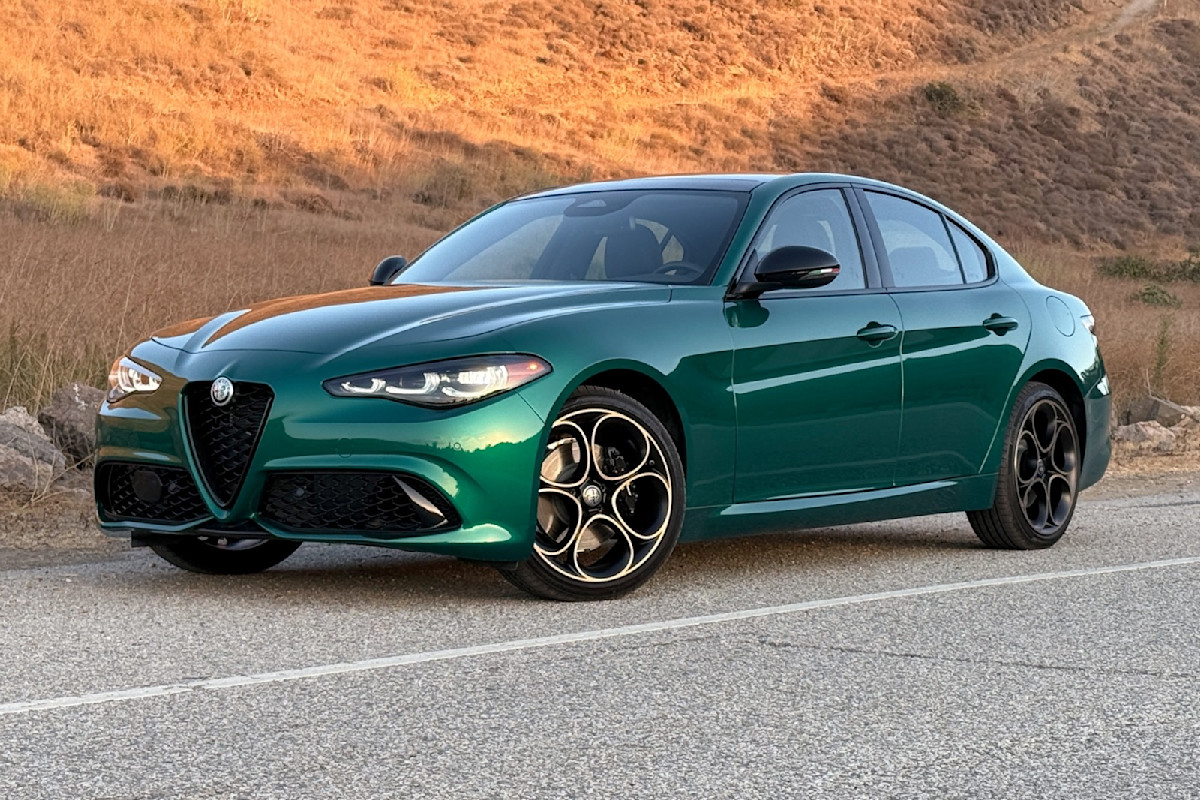
The Alfa Romeo Giulia sits in the compact luxury sports sedan segment, and competes directly with the Audi A4, the BMW 3 Series, and the Mercedes-Benz C-Class. Other competitors include the Cadillac CT4, the Genesis G70, and the Lexus IS.
The Giulia nameplate first appeared in 1962, and the original sedan was sold between 1962 and 1978. It helped to establish Alfa Romeo’s reputation for creating sporty, driver-focused vehicles, but Alfa Romeo itself disappeared from the U.S. in 1995. Here, our focus is exclusively on the modern-day Giulia, which was introduced in Europe in 2015 and arrived in the U.S. for the 2017 model year. This first-generation model remains on sale and has changed little over the years. While the standard Giulia competes with regular Audi, BMW and Mercedes-Benz models, the high-performance Quadrifoglio model (discontinued in 2024 in the U.S.) goes head-to-head with the German brands' rarefied M, RS and AMG variants.
Earlier cars don’t have a great reputation for reliability, and the Giulia depreciates faster than its competitors. It has a devoted following, though, and can be a bargain for the right buyer who accepts its quirks and is willing to put in the time to find a well-maintained example.
Our buying guide covers the history and specs of the latest Giulia, including how much shoppers can expect to pay for one and which are the best and worst versions to buy.
Alfa Romeo Giulia Buying Guide: Cost, Reliability, and the Best Years to Buy
Frequently Asked Questions
Which Alfa Romeo Giulia years are the best?
We’d recommend used buyers concentrate on post-2020 models. In addition to a tech upgrade and a mid-cycle refresh in 2020, the 2021 model year is where overall reliability starts to increase and recalls tail off. Because the Giulia is such a low-volume seller, neither Consumer Reports nor J.D. Power have much accumulated reliability data. Anecdotally, dealers report that warranty claims dropped significantly after 2020, while the 2022 to 2024 model years are likely to be more reliable and have more standard features.
Which Alfa Romeo Giulia years are the worst?
We recommend steering clear of the first three years, because the Giulia was not only an all-new vehicle but also only the second vehicle from Alfa Romeo to make it back to the U.S. Needless to say, there were some growing pains, and these first three years were marked by a high number of recalls, including a fuel pump failure, air bag deployment failures, and the inability to deactivate adaptive cruise control. The 2017 model year was marked by software instability and infotainment problems, as well as electrical warning light issues and quality concerns. Other than adding Apple CarPlay and Android Auto, the 2018 model year didn’t get much better, and had a high number of complaints from owners. While 2019 was a slight improvement, owners still reported warning-light issues and intermittent electrical failures.
How much does a late-model Alfa Romeo Giulia cost?
On the used market, a three-year-old 2023 Giulia averages about $27,692, while a five-year-old 2021 model comes in around $20,436, according to CarGurus pricing data.
Research Alfa Romeo Giulia Price Trends on CarGurus
Is a used Alfa Romeo Giulia a good deal?
The first three model years of the Alfa Romeo Giulia are often for sale at a third of the price of the original MSRP, and that can be a good deal as long as recall work has been carried out and the car itself has been properly maintained. It's often possible to find non-Quadrifoglio 2022-2024 examples for less than 50% of the original price, which still seems like a pretty good deal. However, because the Giulia is a low-volume seller and Alfa is a European brand, it can be more expensive to maintain and parts may be harder to come by. Additionally, CarEdge.com states that the average cost of insurance for the Giulia is $3,293 a year, which was about $1,000 more than the national average at the time of writing.
Pros and Cons
Pros:
- Stylish design
- Fun to drive
- Strong performance
Cons:
- Poor reliability
- Outdated technology
- Very high depreciation
Alfa Romeo Giulia Generations
Alfa Romeo Giulia First Generation (2017-Present)
When the Alfa Romeo Giulia made it to American shores as a 2017 model, it was the second vehicle from the Italian brand to be sold here after a 20-year hiatus. In 2015, the 4C sports car marked the brand’s official return, and the Giulia compact sedan helped to open up the brand to a more mainstream audience.
At launch, the first-generation Giulia offered two powertrains: one bred for the track with 50:50 weight distribution and the other made for a commute. The halo Quadrifoglio model started at $72,000 and was equipped with rear-wheel drive (RWD) and a Ferrari-sourced 2.9-liter twin-turbo V6 that delivered 505 horsepower and 443 pound-feet of torque. But if that’s too rich, then the workaday model started at $38,000 and got a 2.0-liter turbocharged inline-four that produced 280 hp and 306 lb-ft of torque.
The 2017 model year offered three trims: the base sedan, the Ti, and the Quadrifoglio. The base model and the Ti were standard with RWD, but all-wheel drive was available. Trim availability changes pretty much every year for the Giulia. In the early years, standard features included a 6.5-inch infotainment screen, Brembo brakes, 17-inch alloy wheels, leather seats, dual-zone climate controls, a rear-view camera, parking sensors, advanced brake assist, bi-xenon headlights, and power-adjustable front seats. Available features included heated front seats and steering wheel, blind-spot monitors, a premium Harman Kardon audio system, dual-pane sunroof, and navigation. The Quadrifoglio had 19-inch wheels, high-performance tires, 12-way power adjustable front sport seats, carbon fiber accents, LED daytime running lights, and a carbon-fiber rear spoiler. It offered carbon-ceramic brakes and high-performance sports seats as options.
Apple CarPlay and Android Auto weren’t available for 2017 models, but were added as an option in 2018 and became standard in 2019. The Giulia got a mid-cycle interior refresh in 2020, which meant infotainment, material, and safety upgrades. These included a new standard 8.8-inch infotainment touchscreen, improved software reliability, better console materials, standard forward-collision alert with emergency braking, larger cup holders, and an available wireless phone charger. At this time, more comprehensive safety features became available, including active blind-spot monitors, lane-keep assist, traffic-sign recognition, and a driver attention monitor.
The first-gen Giulia got another refresh in 2024, with new LED headlights and taillights as well as a standard 12.3-inch digital cluster with customizable layouts. The Quadrifoglio's last year was 2024, when four variants of the high-performance trim were offered: Quadrifoglio, Quadrifoglio Carbon Edition, Quadrifoglio Super Sport, and Quadrifoglio 100th Anniversary Edition.
As the Quadrifoglio was only available from 2017 to 2024, those models are generally considered the most desirable from a collector's standpoint, especially the post-refresh examples. For buyers who want something truly special, only 100 of the 100th Anniversary Edition models were produced globally, and the U.S. only received a handful. With the Quadrifoglio being dropped after 2024, the only powertrain option from 2025 was the 2.0-liter turbo. For 2026, the Giulia carries over largely unchanged as a single-trim model, and the Tributo Italiano trim and Intensa package offered for 2025 are no longer available; a Veloce Package ($1,625) adds performance and visual upgrades such as a limited-slip differential, aluminum paddle shifters, gloss-red brake calipers, and 19-inch wheels.
Though the National Highway Traffic Safety Administration has never crash tested the Giulia, the Insurance Institute for Highway Safety generally gave it “Good” ratings from 2017 to 2023, and it got Top Safety Pick designations in its first two model years. However, crash-test ratings are incomplete from the 2024 model year. Buyers should be sure to dig into the specs and features of the specific car they’re interested in, because most of the more recent models still only come standard with automatic emergency braking, blind-spot monitors, rear cross-traffic alert, and adaptive cruise control, and the more advanced safety features are or were optional.
As previously noted, the later years of the Alfa Romeo Giulia tend to be more reliable, and there are several known issues and recalls for the earlier years. The 2017 to 2018 models with the 2.0-liter turbo were recalled for the engine overheating due to a software glitch in the engine control module, which created a potential fire hazard. The 2017 to 2020 models were recalled for coolant and fuel leaks and there was another for rear brake disc fractures on 2017 to 2018 Quadrifoglio models. Chronic issues with early examples include the vehicle ending up in limp mode when the battery drops below optimal thresholds, radiator and coolant hose degradation, and fuel gauge inaccuracy. Some problems that have cropped up in later model years include rear camera defects and air bag deployment failures.
The average price for a used Alfa Romeo Giulia is about $22,077, according to the CarGurus pricing data. Prices are typically below $20,000 for the 2017 to 2020 models, with the 2017 Giulias averaging around $14,088 and the 2020 models about $18,518. Prices jump to $25,614 for 2022 models, and the 2024 Giulias average about $32,229.
Related Topics