2027 Audi Q9 Reviews, Pricing & Specs

Pros & cons
What we like
Plenty of power
Roomy interior for people and cargo
Lots of great technology
What to consider
Pricey
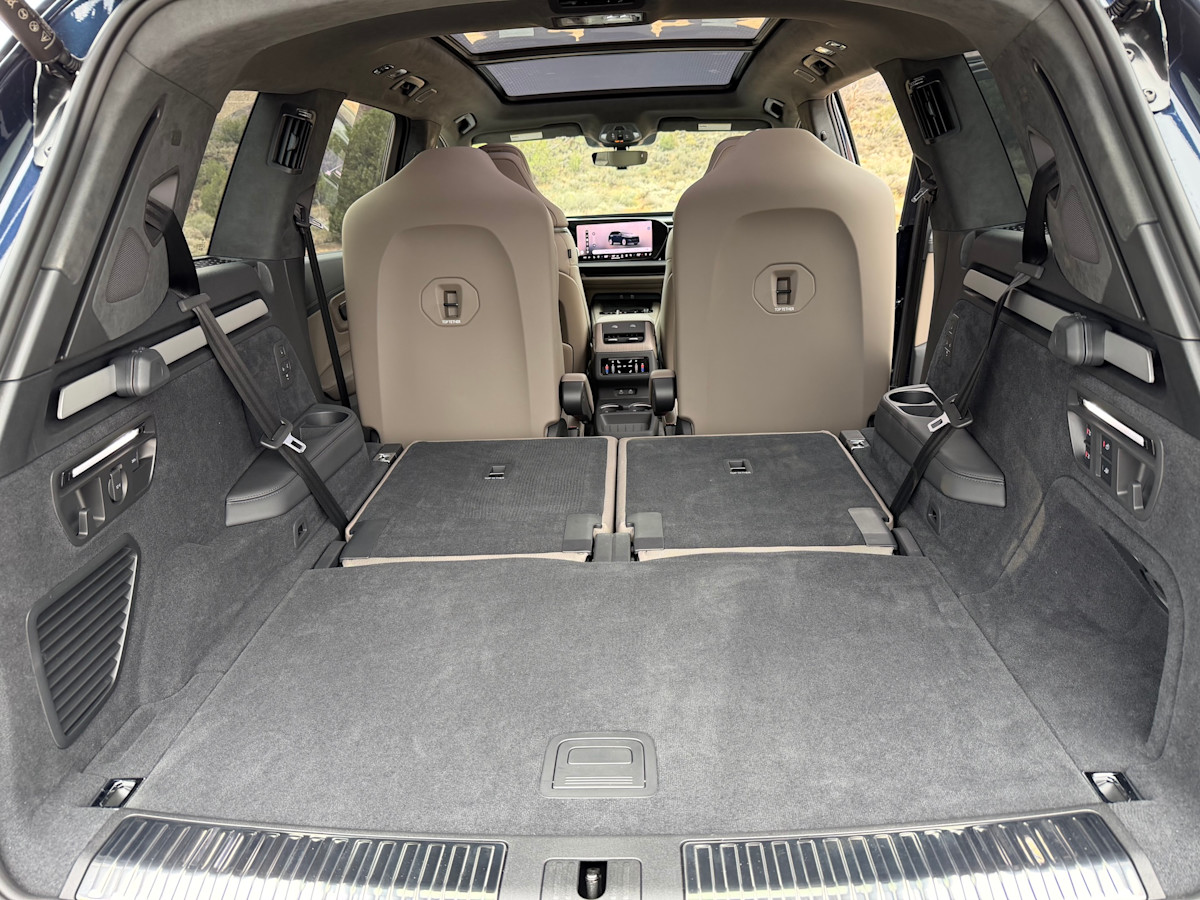
Captain’s chairs cut into cargo space
Hands-free driving tech behind the leaders
Expert review
For some families, luxury and capability are more important than budget consciousness. The 2027 Audi Q9 is arriving now to fill that need.
The new Q9 hits the market to take on such heavy-hitting competitors as the Mercedes-Benz GLS, Cadillac Escalade, and Land Rover Range Rover. Like those vehicles, it can tow a trailer and carry a lot of passengers thanks to three rows of seats. It does it all with Audi style, handling that feels smaller than its size, and some unique interior, lighting, and safety technology.
Verdict: Want to carry the family and tow the trailer in comfort, luxury, and style? The 2027 Audi Q9 offers an appealing alternative to the truck-like body-on-frame competitors and even to the carlike luxury rivals from BMW, Mercedes, and Range Rover. It drives smaller than its size and offers more space than its main competition.
out of 10 expert review
Look & feel
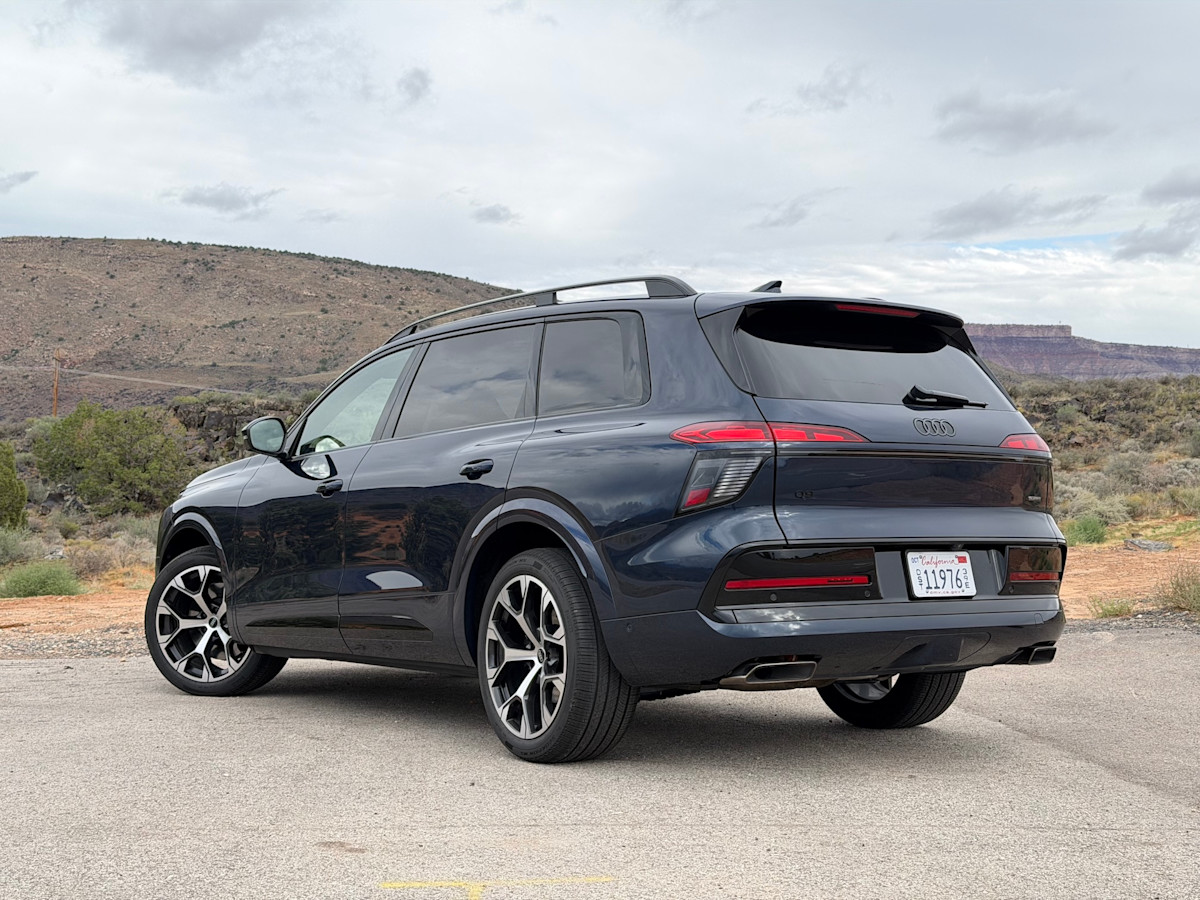
The Audi Q9 plants its flag firmly in the full-size crossover SUV class with big dimensions. It’s 209 inches long, 71.4 inches tall, and 79.2 inches wide, making it 9.9 inches longer than Audi’s Q7, which had been the brand’s largest SUV, and 2.3 inches shorter than the Chevrolet Tahoe (it sits 4.4 inches lower than that beast, though).
The Q9 looks much sportier than body-on-frame brutes like the Tahoe and Ford Expedition, though. Up front, it has a large and upright version of the Audi singleframe grille with metallic vertical slats that give way to black in the Black Optic package. The grille is set within a black mask on the front end that ropes in the standard LED headlights and optional Digital Matrix LED headlights. Above the headlights sit thin LED daytime running lights that can project eight different patterns when the Digital Matrix LED lighting is chosen.
The flanks of the Q9 are marked by notable wheel haunches that give the SUV an athletic look like a big cat stalking its prey. Also along the sides, a character line rises along the lower body to suggest motion. At the rear, LED or OLED taillights are joined by a full-width LED light strip, and those OLEDs can also be arranged in eight patterns. It all looks planted and substantial on the standard 21-inch alloy wheels, and it starts to look more sinister on the available 22s and 23s.
The aforementioned Black Optic package also darkens the design with Anthracite Audi rings, dark chrome exhaust tips, and black exterior trim, roof rails, wheels, and exterior mirror housings.
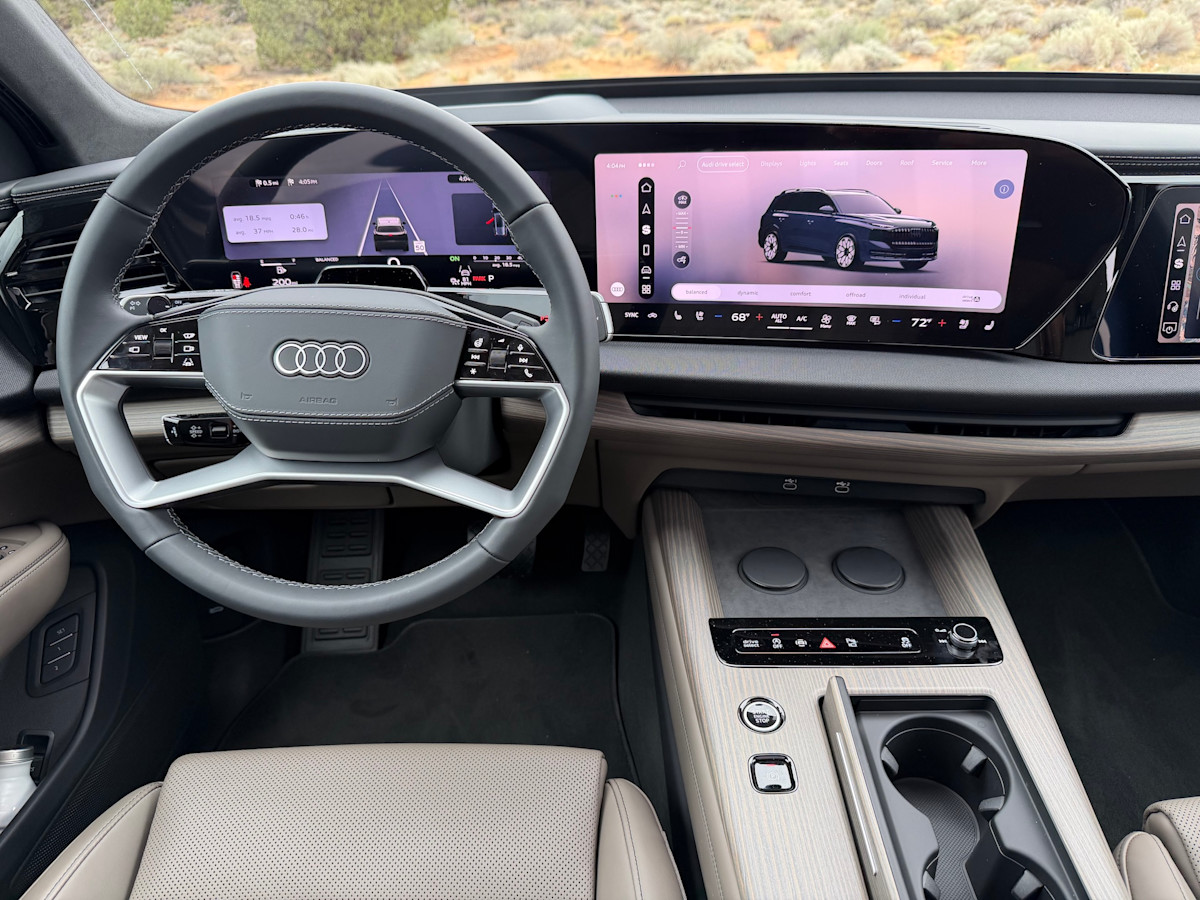
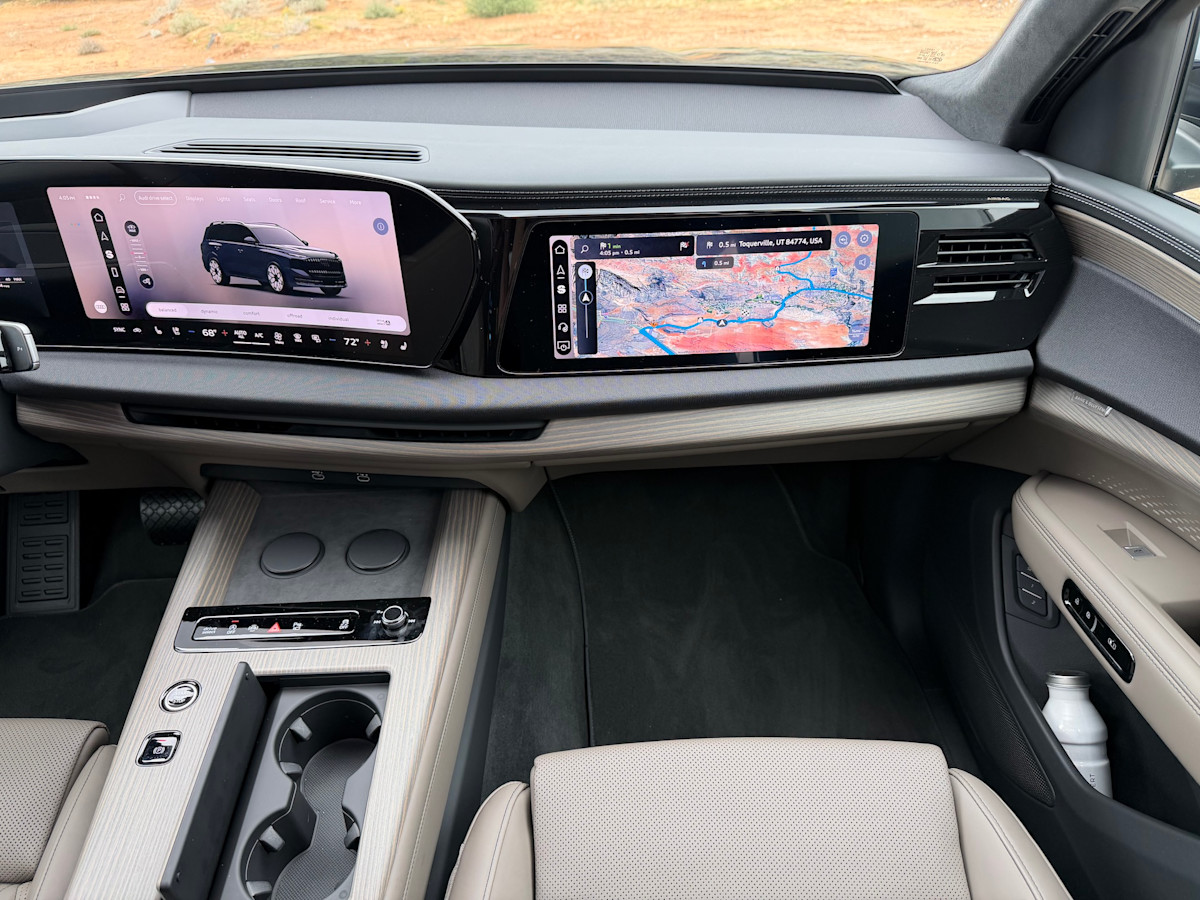
The cabin blends luxury with technology. Immediately notable upon entry is the bank of screens across the dash. Rather than being connected under a single piece of glass, the instrument cluster and center screen are connected, while the passenger screen is separate, allowing the center screen to angle toward the driver.
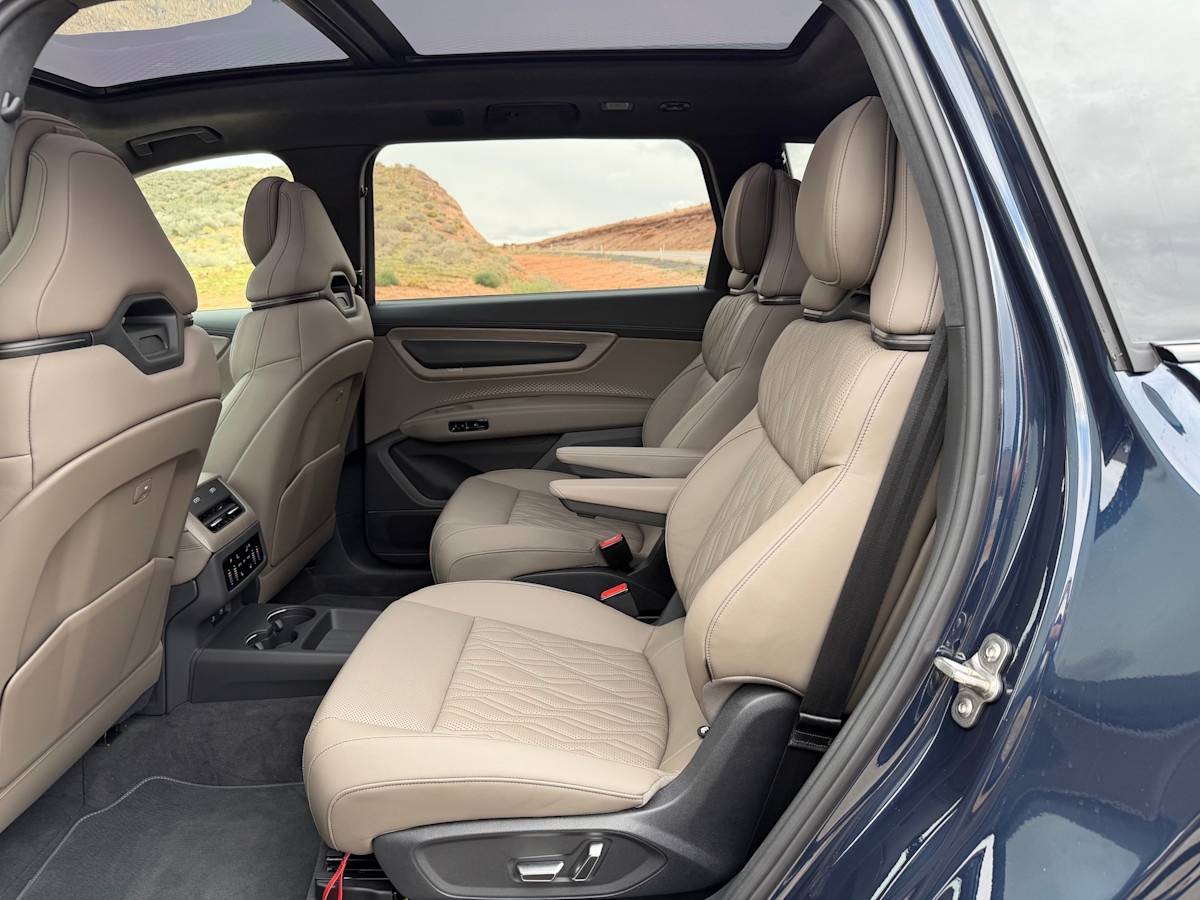
The luxury is also immediately apparent. Leather upholstery is standard. It’s available in black, brown, or Stone Beige with wood inlays in the bottom two trims. The top Prestige gets softer nappa leather with diamond stitching, and it can be had in Almond Beige or a combination of Almond and Stone Beige in the Audi Exclusive Design package that also extends the leather to several more surfaces. Ambient lighting adds a touch of high-end nightclub class after dark.
It’s notable that the gear and turn-signal controls are different in the Q9. They’re part of a collar behind the steering wheel that will take some getting used to when selecting gears, using blinkers, activating windshield washers, and other functions. It’ll become second nature soon enough.
Performance
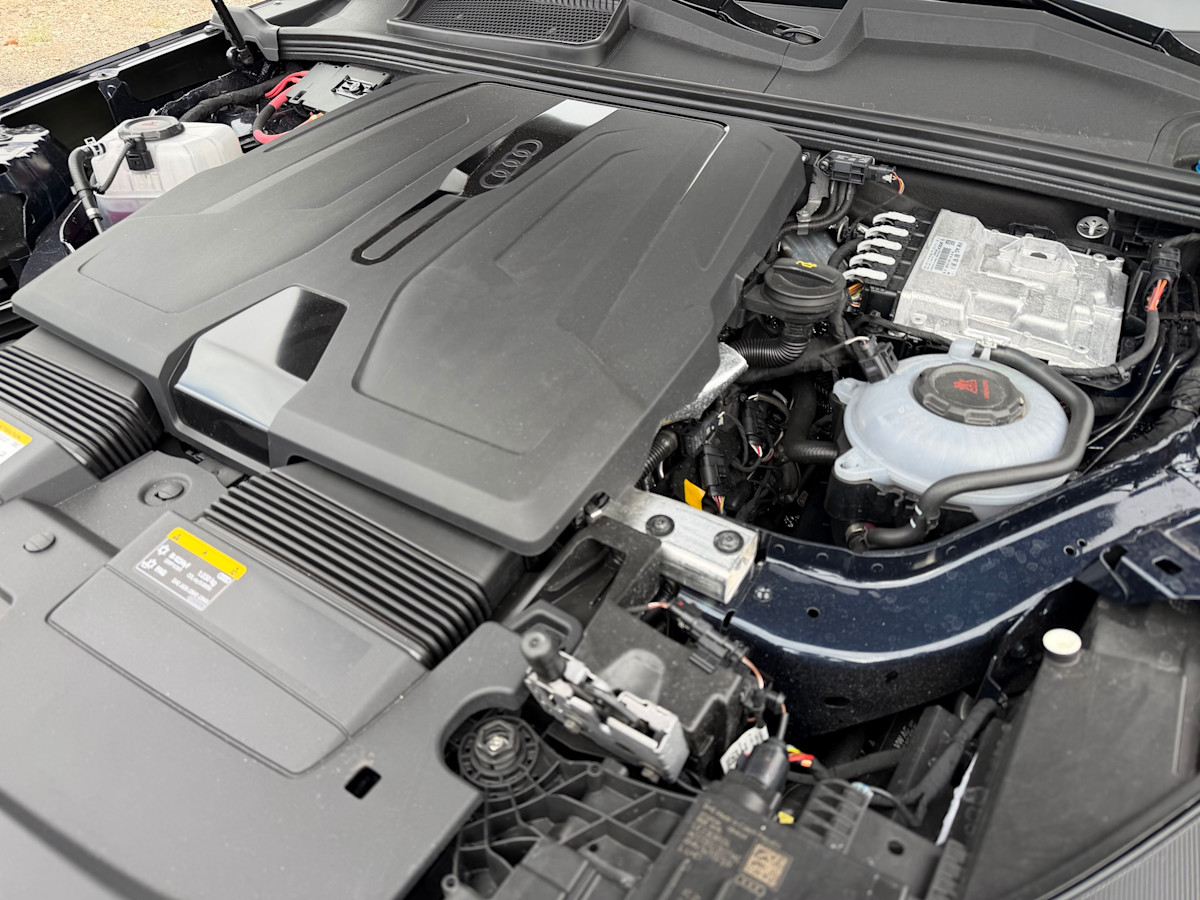
The Q9 isn’t nearly as powerful as its SQ9 performance edition, but it makes no apologies for that difference. It’s powered by a twin-turbocharged 2.9-liter V6 borrowed from the Porsche parts bin. It spins out 429 horsepower and 442 pound-feet of torque. The power flows to all four wheels via Audi’s Quattro all-wheel-drive system through an eight-speed automatic transmission.
The Q9 has plenty of punch. Without any form of hybrid assist system to provide additional power or torque fill from a stop, it has a bit of turbo lag off the line. However, it then gets the Q9 moving with gusto, providing plentiful passing power and launching the Q9 from 0–60 mph in just 4.9 seconds thanks in part to the tenacious all-wheel-drive traction. That’s pretty darn quick for a 5,302-pound SUV that can tow 7,700 pounds. The engine works well with the transmission. The eight-speed executes smooth shifts and only becomes noticeable in Dynamic mode, which holds gears longer to keep the power at the ready.
The engine sounds good, too. It’s not as authoritative as a rumbling V8, but it has a pleasing midrange tone that fades into the background when the driver is off the throttle. The cabin is well insulated to keep it calm and quiet the majority of the time.
From behind the wheel, the Q9 feels smaller than its size, and it drives far better than any body-on-frame SUV thanks to its unibody construction. It comes standard with air springs and adaptive dampers, and it’s actually tuned the same as the standard version of the SQ9 because that model’s sport suspension is an option.
Charge into a corner and the Q9 will lean but not excessively, and it gathers itself to change directions more like a midsize SUV. The standard progressive electromechanical power steering turns more quickly the farther the steering wheel is turned and adds more weight at speed. Sharp and predictable, it’s a bit light at lower speeds but more weighty and therefore stable at higher speeds. The brakes have a natural feel, too, and they’re sturdy, thanks to big 15.7-inch front rotors with six-piston calipers and 13.8-inch rear discs with single-piston calipers.
The Q9 comes standard with 285/45R21 tires that offer good grip. Those tires smother bumps quite well, even when the wheels grow to 23s. Overall, it has an excellent balance of ride and handling.
Without locking differentials, skid plates, or all-terrain tires, the Q9 isn’t an off-roader, but its air suspension has an Off-Road mode that increases ground clearance from the standard 8.2 inches in Balanced mode and 7.6 inches in Comfort mode up to nine inches. That will help get you to the campsite on a dirt road, but don’t look to conquer rocks, mud, or sand.
Form & function
The Q9 comes standard with three seating rows for seven-passenger capacity. The front seats get standard power controls and heating, and they have room for larger drivers balanced with enough bolstering to keep occupants in place when the road turns twisty. A standard power tilt/telescoping steering wheel works with the driver’s seat adjustments to make a comfortable seating position easy to tailor to just about any body type. Even more comfort is available in the form of ventilation and massage functions for the first row, as well as heated door and center armrests. Buyers can add even more convenience with power-closing doors that close automatically when a seat belt is buckled in the first or second row or the driver hits the brake pedal.
Standard four-zone automatic climate control and an available five-zone version both ensure that second- and third-row passengers can choose their temperatures. Both rear rows are available with seat heaters. Available second-row captain’s chairs cut capacity to six while making those second-row occupants much happier. However, these seats are so well bolstered (they’re basically a copy of the fronts) that they don’t fold down, severely limiting cargo capacity.
The third row is hospitable for adults, with enough headroom and legroom for a pair of six-footers as long as they can convince second-row riders to move their seats forward a bit. However, the third-row seat bottoms sit low like they do in many three-row SUVs, causing a knees-up seating position that intrudes on comfort for trips over 20 or 30 minutes.
The second-row seats tilt and slide forward to clear access to the third row, and the third row folds down with power controls in the cargo area. With those seats up, the Q9 has 19.3 cubic feet of cargo space, more than the BMW X7 and Mercedes-Benz GLS. Fold them down and that expands to 43.8–50 cubes depending on the position of the sliding second row. That’s as much space as the Q9 offers when you choose the captain’s chairs, but it expands to 87.7 cubic feet behind the first row with the rear two rows folded flat for buyers who stick with the standard second-row bench seat. A hands-free power tailgate eases access to the cargo hold.
Technology
The Q9 comes standard with three large screens. They consist of an 11.9-inch digital instrument cluster that Audi dubs the Virtual Cockpit, a 14.5-inch infotainment touchscreen, and a 12.3-inch passenger touchscreen.
Powered by the Android Automotive operating system, the infotainment system comes with a trial of the Audi Connect Nav and Plus subscription that provides connected navigation, audio and video streaming, gaming, and a ChatGPT-powered Audi Assistant that answers questions and can control some in-vehicle functions.
Audi angles the center touchscreen toward the driver, making it easy to reach. It responds quickly to touch controls, and a vertical line of controls slightly indented from the left side of the screen (to clear the steering wheel) provides quick access to submenus that can access numerous types of connectivity functions.
Other standard features include a head-up display, three months of satellite radio, dual wireless charging pads, and a Bang & Olufsen audio system. Buyers can also get a dashcam and a 22-speaker, 1,360-watt Bang & Olufsen 4D audio system. The sound system’s fourth dimension is actuators in the front seats that provide physical pulses on the bass beat. The actuators are adjustable so you can set them to feel the groove more or less. It’s a party trick you can show your friends, but it’s not necessary to enjoy the sound.
The Q9’s available Digital Matrix LED lighting is also high-tech. Offered on higher trims, it includes programmable front daytime running lights and OLED taillights with eight different patterns. They also project turn signals on the road to help inform other drivers, and they incorporate warning symbols in the taillights, as well as warnings for proximity and people exiting the vehicle. This lighting is fun to play with once or maybe every so often, but most owners will pick a design and stick with it. However, its warning properties hold value that can be further explored by the auto industry.
Safety
The 2027 Audi Q9 gets a full suite of standard safety features, including forward collision warning with intersection assist, automatic emergency braking, lane-departure warning, blind-spot monitors, rear cross-traffic alert, an exit warning system, traffic sign recognition, automatic high-beams, automatic parking, a surround-view camera system, and front, rear, and side parking sensors.
Buyers can also get rear automatic braking, a dashcam, a driver-attention monitor, remote parking, trailer assist that steers when backing up a trailer, and a hands-free highway driving system.
The hands-free system, Audi’s first in the U.S., is a Level 2+ system that can drive the vehicle on its own on mapped divided highways but requires the driver to pay attention and be ready to take over. We had issues getting it to work on southwestern Utah freeways. It rarely wanted to engage in a sparsely populated area. When it did work, it disengaged when it lost the freeway in a mapped area, when we passed off-ramps, and when the left lane ended while we were driving in the center lane. Rival systems, such as Ford’s BlueCruise and GM’s Super Cruise, have no issues with these situations and seem to work in more areas. Expect the system to improve as Audis get more miles on U.S. highways, but it’s behind the curve for now.
Audi is a leader in headlight technology. The Q9’s available Digital Matrix LED headlights each consist of 25,600 pixels. They allow drivers to use the high beams’ automatic mode to keep them on all the time at night. That’s because the pixels pointed toward a car ahead, an oncoming vehicle, or a road sign dim to prevent them from blinding other drivers or creating harsh reflections off road signs. We’d like to see this type of lighting available for more vehicles.
As a new vehicle, the Q9 has no crash-test data yet.
Cost-effectiveness
Audi offers the Q9 in Premium, Premium Plus, and Prestige trim levels. At launch in November, the Premium is priced at $89,095, including a mandatory $1,395 destination fee, while the Premium Plus goes for $94,695 and the Prestige costs $103,795.
The Premium Plus adds adaptive cruise control, the hands-free highway driving system, a dashcam, the Digital Matrix LED headlights, power soft-closing doors, and five-zone automatic climate control. The Prestige gets rear-wheel steering, advanced ambient interior lighting, the Bang & Olufsen 4D audio system, nappa leather upholstery, massaging front seats, turn signals that project on the ground, and Digital OLED taillights.
The Q9 has just one powertrain, so it offers no choice for those who want something more efficient. Fuel economy ratings are not yet available, but don’t expect it to exceed 20 mpg in the combined EPA cycle. Over 103 miles of mixed highway and low-speed driving, we averaged 19 mpg.
The Q9 is immediately competitive in the growing luxury three-row SUV segment. It offers more standard space than its unibody rivals, though the rear captain’s chairs give it less maximum space, and it is competitive in terms of power and luxury. It offers far better driving dynamics than the body-on-frame choices like the Cadillac Escalade and Lincoln Navigator, and yet it still tows a hefty 7,700 pounds. It’s definitely worth adding to your luxury family vehicle shopping list.

What owners say
Trims & specs
Base MSRP $93,300 | Seating 7 |
Engine N/A | Cargo Capacity 19.3 cu ft |
Combined MPG N/A | Drivetrain N/A |
Base MSRP $87,700 | Seating 7 |
Engine N/A | Cargo Capacity 19.3 cu ft |
Combined MPG N/A | Drivetrain N/A |
Base MSRP $102,400 | Seating 7 |
Engine N/A | Cargo Capacity 19.3 cu ft |
Combined MPG N/A | Drivetrain N/A |


