2026 Toyota Grand Highlander Hybrid Reviews, Pricing & Specs


Pros & cons
What we like
Comfortable seats
Plenty of cargo space
Impressive technology
What to consider
Dull to drive
Interior materials feel cheap
Not a Top Safety Pick
Expert review
Need a minivan but want a crossover? Get a 2026 Toyota Grand Highlander.
As its name implies, the 2026 Grand Highlander is bigger than the regular Highlander. It’s also just plain huge inside. With three available powertrains and trim levels ranging from budget-friendly to legitimately upscale, there is a Grand Highlander for anyone shopping in the $40,000 to $60,000 range. The current version launched as a 2024 model and carries over essentially unchanged for 2026.
Verdict: Do super-functional appliances that promise to save money in the long run make buyers smile? If they do, drivers will probably be very happy with a 2026 Toyota Grand Highlander.
out of 10 expert review
Look & feel
Toyota sells the 2026 Grand Highlander with a standard turbocharged gas engine, a thrifty hybrid powertrain good for up to 36 mpg in combined driving, and a powerful turbocharged Hybrid Max configuration with full-time all-wheel drive (AWD) and 362 horsepower. Depending on the powertrain, trim levels include LE, XLE, Limited, Nightshade, and Platinum. Prices range from $43,855 to $61,770, including the destination charge.
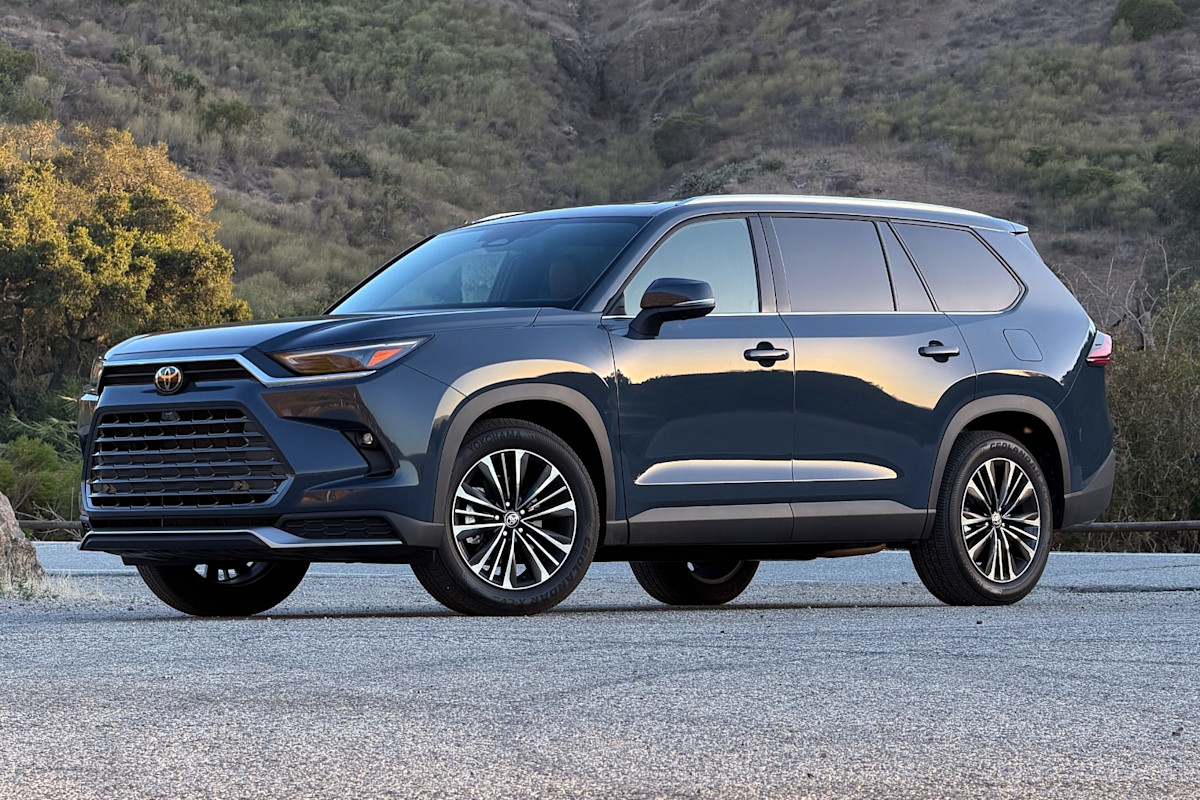
We evaluated the top trim level for this review, and our Grand Highlander Hybrid Max Platinum arrived in Storm Cloud paint, a flat grayish blue that resembles the leaden clouds of an approaching cold front. It had no options, so the manufacturer’s suggested retail price (MSRP) came to $61,770.
Kindly put, Toyota styling is hit and miss. With the 2026 Grand Highlander, the manufacturer pursued a conservative and familiar path, apparently drawing inspiration from the previous-generation RAV4. Considering the smaller RAV4's popularity, the decision to emulate it on a grander scale makes sense. The result looks and feels like a gigantic RAV4 with seating for up to eight and cargo space that clobbers most rivals.
Like the RAV4, the Grand Highlander’s interior emphasizes function over form. It gets a layer of luxury in Platinum trim, but glossy hard plastic and unlined storage surfaces explain how the base Grand Highlander LE can offer such impressive value. Fortunately, the controls are logically laid out, with matte black surfaces and white iconography and lettering. Overall material quality is decent, too.
The climate system is a model of simplicity, equipped with large temperature-adjustment knobs that drivers can twist while wearing gloves. Unfortunately, the team that designed the infotainment interface didn’t get the same memo, because the volume knob is a tiny, stubby thing, and there’s no tuning knob.
Performance
Where the Grand Highlander Hybrid emphasizes efficiency with the characteristic drone of Toyota’s regular hybrid system, the Grand Highlander Hybrid Max focuses on performance with a side of efficiency. It is a satisfying setup.
Based on a turbocharged 2.4-liter four-cylinder engine and electronic full-time AWD with two electric motors, the Hybrid Max powertrain makes 362 net horsepower. That scoots the sizable Grand Highlander to speed in short order, and its traditional six-speed automatic transmission avoids the Highlander Hybrid's droning, which is common from CVTs.
In addition to the higher price Toyota charges for the more powerful Hybrid Max, there’s a fuel economy trade-off. The soul-crushing Grand Highlander Hybrid can get up to 36 mpg combined, while the speedy Grand Highlander Hybrid Max is rated at just 27 mpg. However, it also tows up to 5,000 pounds—1,500 more than the Grand Highlander Hybrid.
During testing, we observed 26 mpg on a relatively level 50:50 city and highway fuel-economy driving route. On our mountainous Southern California evaluation loop, the Hybrid Max averaged 23.3 mpg. We think buyers should get 24-25 mpg without any trouble.
The Hybrid Max powertrain’s rewarding acceleration means it's easy to get up to speed before merging onto a freeway or entering a multi-lane boulevard from the local shopping mall parking lot. The electric motors negate any potential turbo lag, so it's possible to accelerate and maneuver with confidence.
Also praiseworthy is the soft, isolating ride quality. The Grand Highlander effortlessly soaks up speed humps, speed bumps, and patched pavement, but undulations in the road surface can produce vertical bounding and lateral rocking.
The Grand Highlander Platinum Hybrid Max’s handling is secure up to a modest point. The tires scrub and squeal early, and the nose pushes wide when hustling the SUV around curves and corners. At a slower pace, it feels secure and confidence-inspiring, if a little too big on some mountain roads.
Outward visibility is excellent, assisted from front, rear, and top-down cameras. But in our test vehicle, the front camera regularly overtook the infotainment screen at intersections, in city traffic, and when navigating drive-thru lines, interrupting use of the display.
Form & function
The Toyota Grand Highlander offers comfortable seats in all three rows, plenty of storage, and almost 100 cubic feet of maximum cargo space. The only reason it doesn’t get a 10/10 rating is because many of the storage locations are unlined and will likely contribute to noise, vibration, and harshness levels in the cabin. Also, there isn’t much underfloor storage space behind the third-row seat.
Our Platinum-trim test vehicle had the Portobello (brown) interior, with seats covered in a mix of leather and artificial suede upholstery. It looked smart and upscale, helping to justify the low-$60,000s price tag. The front and second-row seats had heating, ventilation, and supportive cushions, too.
Shoppers with small children should know that the rear doors are long, and opening them requires a lot of space, so trying to buckle a child into a safety seat will not be fun. Not only that, but the mid-height corners of the rear doors are sharp 90-degree angles that could cause dents in neighboring vehicles if the doors are opened too wide. This makes a great case for a minivan equipped with easy-peasy power sliding side doors—such as the Toyota Sienna.
Our test vehicle had the second-row captain’s chairs (a no-cost option) with a removable center console between them. That creates a pass-through, or it's possible to tip and slide the outboard seat to create a generous portal through which to access the third row.
Adults and tall teens will find the Grand Highlander’s rearmost seats reasonably comfortable, and there's more distance from the head restraint and backrest to the rear liftgate than shoppers will find in many three-row SUVs. That extra crush space might prove helpful if someone runs into the back of it.
Behind the third-row seat, the Grand Highlander offers 20.6 cubic feet of cargo space and a little bit of compartmentalized storage underneath the load floor. Fold down the 50/50-split third-row bench seat, and it can swallow a commendable 57.9 cubic feet of cargo—that’s plenty of room for an extended family road trip. For maximum volume, folding the second row produces 97.5 cubic feet of space, which nearly matches the Sienna minivan by maxing out at 101 cubic feet.
Technology
In LE and XLE trim, the 2026 Grand Highlander features a 7-inch digital driver display flanked by traditional analog gauges. Buyers who upgrade to Limited, Nightshade, or Platinum get a more sophisticated 12.3-inch digital instrumentation panel.
All Grand Highlanders have a 12.3-inch touchscreen infotainment system. It doesn’t appear too large or small for the roomy cabin and is perched above a traditional climate control panel, featuring knobs and buttons. The integration is tasteful and subdued, which cannot always be said for Toyotas.
The system features wireless Apple CarPlay, wireless Android Auto, SiriusXM satellite radio, and sign-in access to Apple Music and Amazon Music accounts. Additionally, multiple Toyota Connected Services plans offer access to a variety of features including a Wi-Fi hotspot, automatic collision notification, SOS emergency response, safe teen driver settings, a cloud-based navigation system, and a conversational digital voice assistant.
The infotainment system is easy to use. Frustrations include the inability to see two main-menu screens simultaneously, such as a home screen showing the map, music, and incoming calls and texts. The delicate, low-contrast font can also be hard to see against the background.
Say “Hey Toyota,” and the digital voice assistant asks how it can help. The assistant responded quickly and accurately to a variety of commands of increasing complexity. While listening to SiriusXM, we asked to listen to reggae music. Knowing we had an iPhone paired via Bluetooth, the assistant recommended signing in to our Apple Music account for that. Modifying the request for the Bob Marley channel produced the desired change to SXM channel 19.
Our Platinum test car had every feature available from the factory. That included a color head-up display, a camera-based digital rear-view mirror, and the aforementioned surround-view camera system. We also thought the JBL premium audio system delivered better sound quality than expected.
Safety
Toyota Safety Sense 3.0 (TSS 3.0) equips the Grand Highlander with a long list of standard safety features and driver-assistance technologies. The ones we'd expect to find on a family-sized SUV are present and accounted for, along with lane-keep assist for highway driving. This works with the adaptive cruise control to create a high level of automation, but not the hands-free operation of systems such as Ford’s BlueCruise and GM’s Super Cruise.
Also standard is Proactive Driving Assist (PDA, which automatically brakes and steers to help maintain safe distances from other vehicles and obstacles). In our experience, satisfaction with the PDA system is dependent on the vehicle in which it's installed and the driving situation. In the Grand Highlander, we found it irritating and shut it off most of the time.
Overall, the Grand Highlander’s safety tech operated with accuracy and refinement. On a few occasions when rounding freeway curves, the lane-keep assist system instead strayed too close to the inner lane markers, but that was easy to correct. And as noted above, we found the camera system’s takeover of the screen when approaching intersections more annoying than helpful.
Toyota needs to improve the Grand Highlander’s crash-test ratings. It earned the highest five-star overall rating from the National Highway Traffic Safety Administration (NHTSA), but fell short of the Top Safety Pick rating from the Insurance Institute for Highway Safety (IIHS) because of “Acceptable” instead of “Good” ratings for headlight performance and small overlap frontal-impact protection.
Cost-effectiveness
It has been widely reported that the typical new vehicle sold in the United States costs around $50,000. That’s the 2026 Toyota Grand Highlander’s sweet spot, and shoppers can pick up a well-equipped Limited hybrid for a little more than that.
It might not be very powerful or exciting to drive, but the 36-mpg Grand Highlander Hybrid should save money at the gas pump over its lifetime. Plus, every Toyota comes with complimentary scheduled maintenance for two years or 25,000 miles, and the automaker typically includes access to its connected services plans, even if it's for a short time.
The Grand Highlander Hybrid might be the most cost-effective version of this SUV, but we’re smitten with the turbocharged Hybrid Max, which is available only in Limited or Platinum trims. It's satisfyingly quick in a straight line, reasonably efficient, and well equipped with stylish wheels and an upscale interior. Even at the as-tested price of $61,770, it seems to be priced right for what buyers get.

What owners say
Trims & specs
Base MSRP $53,110 | Seating 8 |
Engine 2.5L 245 hp I4 Hybrid | Cargo Capacity 20.6 cu ft |
Combined MPG 34 | Drivetrain AWD |
Base MSRP N/A | Seating N/A |
Engine N/A | Cargo Capacity N/A |
Combined MPG N/A | Drivetrain N/A |
Base MSRP $48,380 | Seating 8 |
Engine 2.5L 245 hp I4 Hybrid | Cargo Capacity 20.6 cu ft |
Combined MPG 34 | Drivetrain AWD |
Base MSRP $45,610 | Seating 8 |
Engine 2.5L 245 hp I4 Hybrid | Cargo Capacity 20.6 cu ft |
Combined MPG 34 | Drivetrain AWD |
Base MSRP $46,780 | Seating 8 |
Engine 2.5L 245 hp I4 Hybrid | Cargo Capacity 20.6 cu ft |
Combined MPG 36 | Drivetrain FWD |
Base MSRP $56,090 | Seating 7 |
Engine 2.4L 362 hp I4 Hybrid | Cargo Capacity 20.6 cu ft |
Combined MPG 26 | Drivetrain AWD |
Base MSRP N/A | Seating N/A |
Engine N/A | Cargo Capacity N/A |
Combined MPG N/A | Drivetrain N/A |
Base MSRP $60,175 | Seating 7 |
Engine 2.4L 362 hp I4 Hybrid | Cargo Capacity 20.6 cu ft |
Combined MPG 26 | Drivetrain AWD |
Base MSRP $54,090 | Seating 7 |
Engine 2.5L 245 hp I4 Hybrid | Cargo Capacity 20.6 cu ft |
Combined MPG 34 | Drivetrain AWD |


Pricing trends
MSRP range
$45,610 - $60,175
Current avg. market price
$58,298
Trending down by 1.1% this month
May 2026 - October 2026


