2026 Mazda CX-50 Reviews, Pricing & Specs


Pros & cons
What we like
Stylish design
Fun to drive
Great safety ratings
What to consider
Poor fuel economy (Turbo)
Uncomfortable seats
Outdated technology
Expert review
For driving fun mixed with practicality, check out the 2026 Mazda CX-50.
This compact crossover SUV comes with gas, turbocharged gas, or hybrid powertrains, each paired with standard all-wheel drive (AWD) and each with Mazda's trademark spirited handling. The CX-50 slots into Mazda’s lineup between the CX-30 and the redesigned CX-5, and sees only minor changes for the 2026 model year.
Verdict: Smaller inside than many rivals, the Mazda CX-50 trades outright utility for style, sophistication, and substance. It's safe and fun to drive, but has a stiff ride, firm seats, a thirsty turbo engine, and dissatisfying tech.
out of 10 expert review
Look & feel
Mazda CX-50 buyers can choose from 2.5 S, 2.5 Turbo, and Hybrid models. From there, things get a little confusing.
The CX-50 2.5 S is available in Select, Preferred, Meridian Edition (new this year), and Premium trim levels. Turbos come in a standard trim, Meridian Edition, or Premium Plus. Mazda offers the Hybrids in Preferred, Premium, and Premium Plus trim. Prices range from $31,495 to $44,495, including the $1,595 destination charge.
Our test car was a top-spec 2.5 Turbo Premium Plus equipped with the new-for-2026 white leather seats and a retractable cargo cover. Those upgrades brought the manufacturer’s suggested retail price to $44,920 with destination.
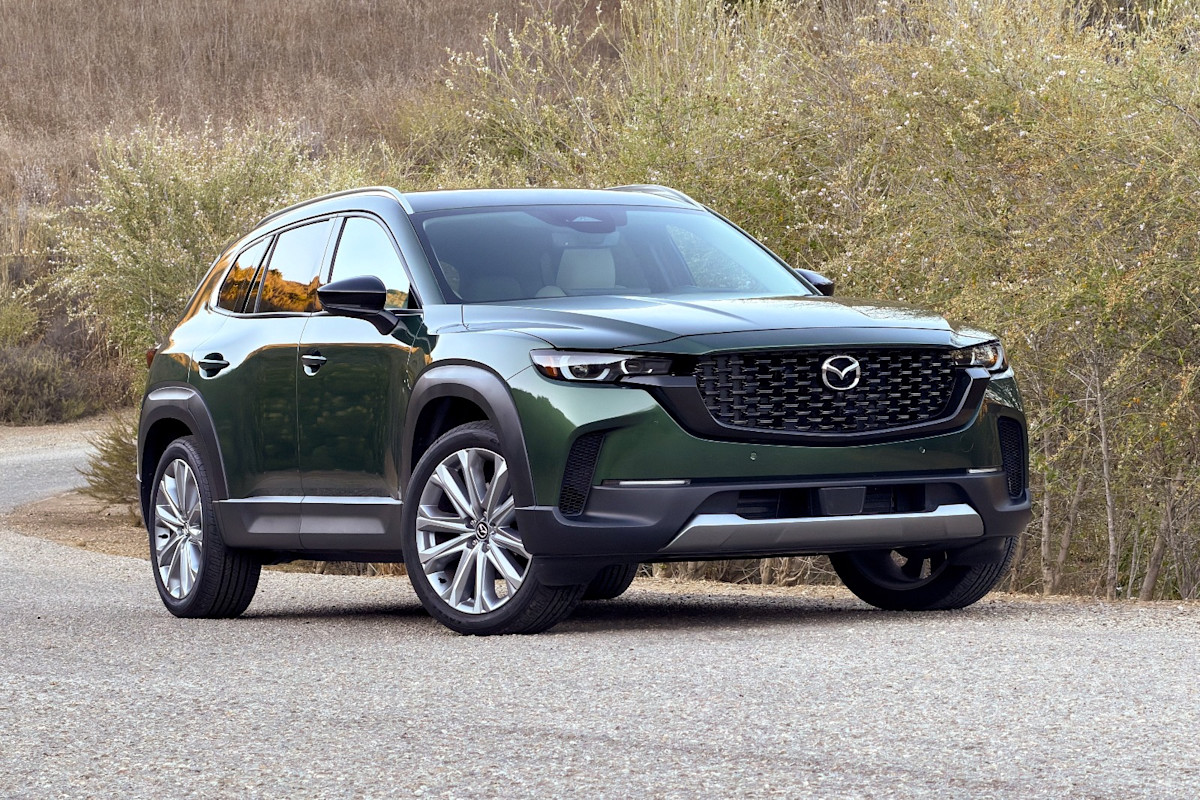
Wide and squat, the low-slung CX-50 hunkers down on the road and seems more like a lifted wagon than an SUV, yet our test vehicle had 8.6 inches of ground clearance—just a hair less than a Subaru Forester or Outback. The body cladding is just right, as are the overall proportions, sporty styling cues, flared fenders, and appealing paint colors.
Cypress is a new green paint for 2026, and while it’s not quite as appealing as Volvo’s similar Forest Lake color, it sure comes close thanks to its subtle blue undertones. It would look particularly striking on a Miata with a tan interior, a tan top, and the polished wheels from last year’s 35th anniversary edition.
Buyers who choose the white leather interior also get 20-inch silver wheels. It’s a throwback to the era before black and machined finishes, and we are so here for it. That white leather is terrific, too, adding a sharp contrast against the CX-50’s black dashboard, door panels, and center console.
The white surfaces, tasteful metallic accents, and quality materials lend the clean cabin an upscale look and feel that’s a class above most of the Mazda’s rivals. However, the gloss-black plastic on the center console is likely to collect a lot of dust and scratches over time, and the weird center air vent is poorly integrated.
The partially digital gauges are a model of clarity, and most controls are easy to use. Unfortunately, the Mazda Connect infotainment system requires a steep learning curve for those unfamiliar with how it works.
Performance
Every CX-50 has a 2.5-liter gasoline four-cylinder engine and AWD, which can be had with a turbocharger or a hybrid system as well as in basic naturally aspirated form.
The base 2.5 S makes 187 horsepower and 185 pound-feet of torque. It uses a six-speed automatic transmission geared to make the most of the available power, and offers a choice between Normal, Sport, and Off-Road driving modes. The EPA fuel economy rating is 26 mpg combined, and the 2.5 S is rated to tow up to 2,000 pounds.
Turbocharging boosts the power in the 2.5 Turbos, but the output depends on what type of gas you use. Pump regular into the tank, and it makes 227 hp and 310 lb-ft. Upgrade to premium fuel, and it generates 256 hp and 320 lb-ft. This engine uses the same six-speed automatic and offers identical driving modes, but it tows up to 3,500 pounds.
The official fuel economy rating for the CX-50 2.5 Turbo is 25 mpg in combined driving, but we found that to be optimistic. On our Southern California fuel economy test loop, with a 50:50 split of city and highway driving, the Turbo averaged 22.1 mpg. On the mountainous vehicle evaluation loop, the result was 18.6 mpg, although the temperature was in the mid-90s so the air conditioning was working overtime, and the i-Stop automatic engine stop/start system rarely activated.
Shoppers can avoid that poor fuel economy by choosing the CX-50 Hybrid, which is EPA-rated at 38 mpg combined. It employs proven Toyota-sourced components, including an Atkinson-cycle engine, a planetary gearset hybrid system, a nickel-metal hydride battery pack, and three electric motors that create an electronic AWD system.
Total output from the hybrid powertrain measures 219 hp, and while the immediately available electric motor torque can make the CX-50 Hybrid feel sprightly from a stop, the meager 163 lb-ft does this heavier model no favors when it comes to mid-range passing power. Normal, Power, and Trail driving modes are standard, and the tow rating is 1,500 pounds.
As we expect of a Mazda, the steering is crisp and responsive, and the suspension is tuned for flawless body control. The ride is firm, though, and downright stiff over speed bumps. Those who like a good sense of the road will enjoy it; those who don't might get used to it, but will probably need to find something else to drive. Despite its poor fuel economy, we also appreciated the satisfying power delivery of the CX-50 Turbo’s boosted engine and its well-tuned transmission.
The Meridian Edition is the CX-50 best suited for off-roading thanks to its all-terrain tires, but it otherwise amounts to little more than overlanding cosplay. In fact, the new-for-2026 2.5 S Meridian Edition offers less ground clearance (8.3 inches) than any gas-only CX-50 equipped with 20-inch wheels (8.6 inches). An Off-Road driving mode (Trail mode in the Hybrids) is standard, but this Mazda is best suited to on-road driving and dealing with inclement weather.
Form & function
Getting into and out of the CX-50 is easier than with a sedan, but it's also lower than many other crossovers, and drivers might feel as though they're sitting too low in relation to the side-window sills. Visibility is adequate, thanks in part to the huge side mirrors, but shoppers who want a vehicle with clear, unobstructed views in every direction should look elsewhere.
Like the suspension, the Mazda CX-50’s front seats feel firm, causing some discomfort during a longer trip. Our test vehicle had power-adjustable front seats with heating and ventilation, a heated steering wheel, and memory settings that made it easy for households with multiple drivers to set separate profiles for simple recall of individual preferences.
Dual-zone climate control is standard on every CX-50. Unfortunately, hot weather renders the air conditioning ineffective, and on a sunny testing day with temperatures in the mid-90s, the ventilated front seats didn’t seem to ventilate anything. It wasn’t until we approached the cooler California coastline that the climate system quit loudly blowing at top fan speed and the interior got anywhere close to chilly.
Rear-seat legroom is acceptable, foot room is generous, and the second row offers good thigh support and a comfortable backrest angle. The cushions are firm, but nobody who rode in our test vehicle complained. Passengers benefitted from air conditioning vents, USB ports, heated seat cushions, and soft front seatbacks that are friendly to the knees and shins of taller people.
Storage space is decent for this size of vehicle, but Mazda missed a few opportunities to improve in this area, such as adding trays in the armrests and a shelf on the dashboard. Aesthetics take precedence over outright practicality. Rear-seat storage space is stingy, with small storage areas in the lower door panels, a single seatback pocket, and a center armrest equipped with cupholders.
Most CX-50s have a power rear liftgate. When it’s open, it reveals a cargo area with 31.4 cubic feet of space (29.2 cubic feet in Hybrids). It can be expanded by using the two levers in the cargo compartment to release the rear seatbacks, which promptly flop down for a flat load floor and 56.3 cubic feet in every version of the CX-50.
Technology
Mazda’s gauge displays are models of impeccable clarity, and easy to reference at a glance. In the CX-50 they’re augmented by a 7-inch screen offering access to various data panels.
Artfully nestled into the top of the dashboard, a 10.25-inch infotainment screen features sophisticated graphics and logical menu structures. However, it offers touchscreen functionality only for wireless Apple CarPlay and Android Auto.
The native Mazda Connect system is operated via a control knob and a smattering of buttons (although a radio-tuning button isn’t among them) located on the center console. That design takes some acclimation, but with time, drivers get used to it.
Alexa built-in is available for conversational voice assistance, and requires users to log into their Amazon accounts. For those who don't have one, there’s also a Mazda Connect voice assistant, but we don’t recommend that because of the system’s inability to understand basic commands. It's also possible to use Apple CarPlay or Android Auto to get voice assistance for most important functions, which avoids Mazda’s rotary controller.
Wireless smartphone charging is standard, but the charger is located partially under the overhanging lip of the center armrest, which makes it easy to forget phones and tablets. Lower trim levels have an eight-speaker audio system, while others feature a satisfying 12-speaker Bose premium sound system. SiriusXM satellite radio is available, but not widely.
A head-up display is standard on the CX-50 Hybrid Premium Plus and the turbocharged models. One of our favorite things about it is that it shows drivers blind-spot warnings without them having to look away from the road. Also, our loaded test vehicle had a surround-view camera system and a front camera view for parking assistance. Drivers can manually activate the camera using a view button hidden down on the lower left side of the dashboard where they’re likely to forget it exists.
Safety
Mazda equips the CX-50 with all the driver-assist tech expected of a modern automobile. The standard i-Activesense collection of features includes adaptive cruise control with stop-and-go capability, forward-collision warning with pedestrian detection, automatic emergency braking, blind-spot monitors, rear cross-traffic alert, vehicle exit warning, lane-departure warning, lane-keep assist, a rear-seat alert system, and a driver-attention monitor. A post-collision braking system is also standard, activating to bring the CX-50 to a stop as soon as possible after an impact.
Preferred models add front and rear parking sensors, while Premium models add traffic-sign recognition and an automatic speed-limit assist feature for the adaptive cruise control. Hybrid Premium Plus and Turbo models get an adaptive front lighting system that helps the driver to better see around curves and corners.
Our Turbo Premium Plus test vehicle got the full safety enchilada, including all of that plus the aforementioned surround-view camera system with a see-through view, active blind-spot assist, cruising and traffic Support with lane centering at lower travel speeds, intersection assist with braking, front cross-traffic alert with braking, and rear automatic braking.
During testing, we observed several false forward collision warnings related to shadows on the road, which we hadn’t experienced in other Mazdas with similar tech. We did get the same false lane-departure warnings we experienced in previous Mazda test drives, though. Speed moderation when using adaptive cruise control also wasn’t 100% reliable.
The National Highway Traffic Safety Administration (NHTSA) gave the 2026 CX-50 a five-star overall rating and five-star scores in every safety test except rollover resistance, where the Mazda earned a four-star rating.
The Insurance Institute for Highway Safety (IIHS) gave the 2026 CX-50 its highest Top Safety Pick+ award, but in a new whiplash prevention test, the CX-50 earned a Poor rating.
Cost-effectiveness
Competitive prices, a rewarding driving experience, top safety ratings, and class-above design and detailing make the 2026 Mazda CX-50 a compelling choice in a compact crossover SUV.
However, cargo volume falls short of many rivals, long-distance comfort is elusive, and the infotainment system can be frustrating. Mazda also doesn’t offer compelling ownership perks, such as above-average warranty coverage, complimentary scheduled maintenance, or comprehensive connected service plans with generous trial subscriptions. The turbocharged engine is thirsty, too, but if fuel economy is a key consideration, shoppers can always choose a CX-50 Hybrid.
Overall, the 2026 CX-50 is a likeable compact crossover for those who strongly value design and the driving experience.

What owners say
Trims & specs
Base MSRP N/A | Seating N/A |
Engine N/A | Cargo Capacity N/A |
Combined MPG N/A | Drivetrain N/A |
Base MSRP N/A | Seating N/A |
Engine N/A | Cargo Capacity N/A |
Combined MPG N/A | Drivetrain N/A |
Base MSRP N/A | Seating N/A |
Engine N/A | Cargo Capacity N/A |
Combined MPG N/A | Drivetrain N/A |
Base MSRP N/A | Seating N/A |
Engine N/A | Cargo Capacity N/A |
Combined MPG N/A | Drivetrain N/A |
Base MSRP $40,450 | Seating 5 |
Engine 2.5L 219 hp I4 Hybrid | Cargo Capacity 29.2 cu ft |
Combined MPG 38 | Drivetrain AWD |
Base MSRP $38,150 | Seating 5 |
Engine 2.5L 219 hp I4 Hybrid | Cargo Capacity 29.2 cu ft |
Combined MPG 38 | Drivetrain AWD |
Base MSRP $34,900 | Seating 5 |
Engine 2.5L 187 hp I4 | Cargo Capacity 31.4 cu ft |
Combined MPG 27 | Drivetrain AWD |
Base MSRP $37,900 | Seating 5 |
Engine 2.5L 256 hp I4 | Cargo Capacity 31.4 cu ft |
Combined MPG 26 | Drivetrain AWD |
Base MSRP N/A | Seating N/A |
Engine N/A | Cargo Capacity N/A |
Combined MPG N/A | Drivetrain N/A |
Base MSRP $33,150 | Seating 5 |
Engine 2.5L 187 hp I4 | Cargo Capacity 31.4 cu ft |
Combined MPG 27 | Drivetrain AWD |
Base MSRP $40,400 | Seating 5 |
Engine 2.5L 256 hp I4 | Cargo Capacity 31.4 cu ft |
Combined MPG 26 | Drivetrain AWD |
Base MSRP $34,750 | Seating 5 |
Engine 2.5L 219 hp I4 Hybrid | Cargo Capacity 29.2 cu ft |
Combined MPG 38 | Drivetrain AWD |
Base MSRP N/A | Seating N/A |
Engine N/A | Cargo Capacity N/A |
Combined MPG N/A | Drivetrain N/A |
Base MSRP $32,400 | Seating 5 |
Engine 2.5L 187 hp I4 | Cargo Capacity 31.4 cu ft |
Combined MPG 27 | Drivetrain AWD |
Base MSRP $42,900 | Seating 5 |
Engine N/A | Cargo Capacity 31.4 cu ft |
Combined MPG N/A | Drivetrain N/A |
Base MSRP $29,900 | Seating 5 |
Engine N/A | Cargo Capacity 31.4 cu ft |
Combined MPG N/A | Drivetrain N/A |


Pricing trends
MSRP range
$29,900 - $42,900
Current avg. market price
$31,597
Trending down by 2.7% this month
May 2026 - October 2026


