2026 Lincoln Aviator Reviews, Pricing & Specs


Pros & cons
What we like
Smooth ride
Cossetting interior
Decent towing capacity
What to consider
Awkward handling
Poor third-row comfort
It’s a pricey version of a Ford Explorer
Expert review
The 2026 Lincoln Aviator expands on the strengths of the Ford Explorer on which it’s based, while also introducing some compromises.
The Ford Explorer appeals for its ability to haul the family while also towing a trailer. Its rear-wheel-drive (RWD) platform gives it a sporty character for a three-row SUV, and the top models are powerful. A gilded version of the Explorer, the Lincoln Aviator keeps the Ford’s more potent optional engine, while introducing far more interior quality and luxury. However, like other Lincolns, it sacrifices sportiness for a comfortable ride.
Verdict: The Ford Explorer’s towing capability and interior space are appealing, but for buyers who want a more comfortable and relaxing cabin, as well as more tech and style, the Lincoln Aviator is the step-up choice. Buyers who opt for the Dynamic Handling package can recapture some of the Ford’s body control, too.
out of 10 expert review
Look & feel
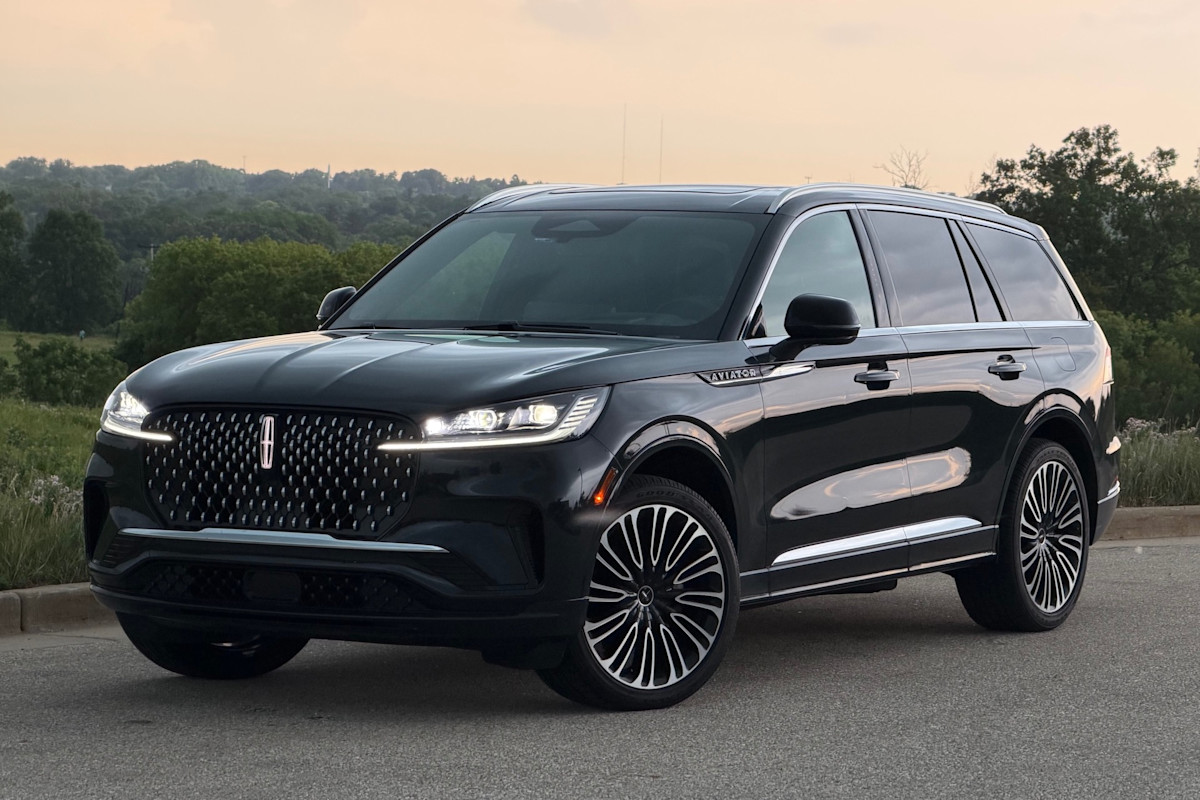
The Aviator is essentially a gilded Ford Explorer, but that’s OK because the RWD unibody platform gives it a premium feel. The exterior design is certainly premium, with the elegant look of a long dash-to-axle ratio, a slightly raked profile, restrained character lines, and big 20–22-inch wheels to fill the wells.
The Aviator’s reverse-horseshoe grille is rendered in black with chrome jewelry in the shape of the Lincoln logo. It’s flanked by LED headlights with LED light signatures that underline the headlights and poke into the grille. Along the sides, an “Aviator” badge straddles the front fender and door as a piece of body jewelry. The flanks are subtly sculpted for a chunky look, and the rear features a full-width LED taillight below a roof spoiler up top and “Lincoln” lettering under the window.
As elegant as the exterior is, the interior is the Aviator's main attraction, especially in Black Label trim. The base Premiere trim has synthetic leather upholstery, while the Reserve gets leather upholstery in a choice of black, gray, bronze, or chocolate brown. The Black Label features upgraded leather offered in three themes that also encompass trim materials and some design elements. All of the interior themes are essentially curated designs, each with a different appeal. The Flight theme combines tan leather with dark aluminum trim, while the Moonbeam theme uses off-white leather with Moon Ash wood.
The Invitation theme that decorated our test vehicle has Savannah (black) leather with brown contrast stitching and seat piping, open-pore Khaya wood trim, and a synthetic suede black headliner. The wood trim has an etched block pattern, and material quality is top-notch across the board.
Performance
The Aviator aims to make passengers comfortable, full stop. From a dynamic standpoint, that means very little character. It's placid, with plenty of power and an emphasis on ride quality over handling.
Every Aviator is powered by a twin-turbocharged 3.0-liter V6 that makes 383 horsepower and 415 pound-feet of torque. The power flows through a smooth 10-speed automatic transmission to the rear or all four wheels. The all-wheel-drive (AWD) system is optional on the Premiere and Reserve, and standard on the Black Label.
The engine is strong and smooth, and both it and the transmission stay in the background most of the time. However, the Aviator can hit 60 mph from a stop in less than six seconds, and passing is a worry-free proposition. The transmission’s shifts are always smooth, and the powertrain only perks up modestly in the sportiest Excite driving mode.
The Aviator rides on a short-arm, long-arm front suspension and a multi-link independent rear suspension, with adaptive dampers at each corner. Even in Excite mode, which stiffens things up a little, those dampers are tuned for a smooth, forgiving ride. Like other Lincolns, though, the ride is also mushy, with considerable body lean through corners, while the heavy, slow steering makes the Aviator feel somewhat ponderous.
Lincoln offers an optional Air Glide suspension with four-corner air springs that lower the ride height by 0.6 inch in Excite mode. While our test car didn’t have Air Glide, the additional control it adds is worth the $2,500 option price for the Dynamic Handling package. Air Glide can also raise the ground clearance by 1.2 inches in the Deep Conditions mode to make it easier to get through snow or to clear obstacles in the minimal amount of off-roading buyers are likely to do.
The Aviator also comes standard with a Class III trailer tow package, and can tow a decent 5,000 pounds. That’s down from a maximum of 5,600 pounds in the Explorer, but both totals are good enough for a midsize boat or camper.
Form & function
The base Premiere trim has a 10-way power-adjustable driver’s seat with memory, an eight-way power front passenger seat, heated and ventilated front seats, a heated steering wheel, and tri-zone automatic climate control.
The Reserve adds a power tilt/telescoping steering column and quad-zone automatic climate control. The real comfort, though, comes in the Black Label trim, courtesy of a 30-way power-adjustable driver’s seat with massagers, while second-row passengers also benefit from heated and ventilated seats.
No matter the trim level, the Aviator seats up to seven with a second-row bench seat, but most versions have second-row captain’s chairs that come with a mini-console. Second-row passengers have good space unless they move the seat far forward, and they can control the audio and climate settings via a 5.8-inch touchscreen located on the back of the front center console. The second-row seats slide forward and back to balance legroom among the three rows, and fold down with a simple pull of a handle on the seat bottom. They also tilt and slide forward for third row access.
That third row is inhospitable to adults. While a pair of adults can fit back there thanks to decent headroom and legroom, the latter is only acceptable because the seat bottoms sit so low that passengers have their knees around their ears. It’ll work for short jaunts, but more than a half hour back there would start to get very uncomfortable.
Cargo space is generous and easily accessible, and the Aviator has 16.9 cubic feet of space behind the third-row seats. Those seats fold up or down via power controls along the side of the cargo hold to increase cargo space to 39.9 cubic feet. With the second row folded down, cargo space maxes out at 75.9 cubic feet. That’s not as much room as some of the mainstream three-row SUVs or some luxury three-row models. The BMW X7 tops out at 90.4 cubic feet, and the Acura MDX offers up to 95 cubic feet of space.
Technology
The Aviator’s tech suite seems modern in today’s car market, but feels almost antiquated in the Lincoln lineup. A 12.4-inch digital instrument cluster is mounted in the traditional spot behind the steering wheel to go with a large 13.2-inch infotainment touchscreen that appears to grow out of the dash, and the 5.8-inch second-row touchscreen.
That would be state-of-the-art for just about any other brand, but Lincoln has adopted a full-width screen to go with a traditional center touchscreen in the Nautilus and Navigator. This format requires a flat-top steering wheel so drivers can see the instrument displays on the left side of the full-width screen. Both setups provide speedy modern tech, and while the newer layout with more screen space feels modern, we prefer the ease of the Aviator's more traditional layout.
The screens are home to the Lincoln Digital Experience, which includes access to apps such as Google Assistant and the Google Play store. Other standard tech features include a 5G Wi-Fi hotspot, remote start, digital key functionality, a satellite radio trial, eight USB ports, a universal garage door opener, and a 10-speaker audio system.
The Reserve trim brings a head-up display, a wireless phone charger, and a Revel 14-speaker audio system, while the Black Label gets a high-end Revel 28-speaker audio system.
Safety
Lincoln makes all of its safety features standard, most as part of its Lincoln Co-Pilot360 Drive 2.0 system. The standard set includes forward-collision warning with pedestrian detection and intersection assist, automatic emergency braking, lane-keep assist, lane-centering steering, high-beam assist, front and rear parking sensors, blind-spot monitors, adaptive cruise control, reverse automatic braking, a driver-attention monitor, a surround-view camera system, and four years of the BlueCruise hands-free highway driving system.
The driver-assistance features work well. The lane-centering steering keeps the Aviator in the middle of its lane without any ping-ponging back and forth between the lines. BlueCruise was fairly effective on the freeway during our test, allowing hands-free driving in select spots. However, it was confused by the various misleading markings in construction zones, though we were ready to take the wheel because we didn’t feel safe letting the vehicle steer in these areas anyway. We’ve also experienced issues with BlueCruise disengaging when it can’t see the driver’s eyes, such as when the sun shines off the driver’s glasses. BlueCruise is a good system, but GM’s Super Cruise is less easily confused, works in more places, and requires the driver to take back the wheel less frequently.
The 2026 Lincoln Aviator does well in crash tests, but has incomplete scores. It earns a perfect five out of five stars from the NHTSA and top “Good” scores in the small front overlap, updated moderate front overlap, and updated side crash tests from the IIHS, along with a “Good” score for its pedestrian front crash prevention system. However, without a rating for its headlights it can’t qualify for a Top Safety Pick or Top Safety Pick+ award.
Cost-effectiveness
The 2026 Lincoln Aviator is offered in Premiere, Reserve, and Black Label trim levels. At the time of writing, the Premiere started at $58,605 including a mandatory $1,695 destination fee. The Reserve ups the price to $68,425, and the Black Label runs $87,605.
Buyers shouldn't expect good fuel economy from any version, as the Aviator is EPA-rated at 17 mpg city, 25 mpg highway, and 20 mpg combined. That’s not always easy to achieve, either. We averaged just 17 mpg over 147 miles of mixed city and highway driving.
We’d recommend going with a Reserve for real leather upholstery, LED fog lights, ambient lighting, quad-zone automatic climate control, a power tilt/telescoping steering column, a head-up display, a Revel 14-speaker audio system, a wireless phone charger, and the larger 21-inch wheels. Yet another reason to choose the Reserve is the option of the $2,500 Dynamic Handling package. Add another $2,500 for AWD, and our recommended Aviator runs $73,425.
The Black Label is the most luxurious variant, but its curated cabin and materials come with a big upcharge. It also comes standard with the super-comfortable 30-way power-adjustable driver’s seat, heated and ventilated rear seats, standard AWD, and 22-inch wheels. It’s the plushest Aviator by far, but not the best buy of the lineup.

What owners say
Trims & specs
Base MSRP $66,730 | Seating 7 |
Engine 3.0L 400 hp V6 | Cargo Capacity 16.5 cu ft |
Combined MPG 21 | Drivetrain RWD |
Base MSRP $69,230 | Seating 7 |
Engine 3.0L 400 hp V6 | Cargo Capacity 16.5 cu ft |
Combined MPG 21 | Drivetrain AWD |
Base MSRP $60,080 | Seating 7 |
Engine 3.0L 400 hp V6 | Cargo Capacity 16.5 cu ft |
Combined MPG 21 | Drivetrain AWD |
Base MSRP $85,910 | Seating 7 |
Engine 3.0L 400 hp V6 | Cargo Capacity 16.5 cu ft |
Combined MPG 21 | Drivetrain AWD |
Base MSRP $56,910 | Seating 6 |
Engine 3.0L 400 hp V6 | Cargo Capacity 16.5 cu ft |
Combined MPG 21 | Drivetrain RWD |
Base MSRP $59,410 | Seating 6 |
Engine 3.0L 400 hp V6 | Cargo Capacity 16.5 cu ft |
Combined MPG 21 | Drivetrain AWD |
Base MSRP $57,580 | Seating 7 |
Engine 3.0L 400 hp V6 | Cargo Capacity 16.5 cu ft |
Combined MPG 21 | Drivetrain RWD |


Pricing trends
MSRP range
$56,910 - $85,910
Current avg. market price
$63,407
Trending down by 0.7% this month
May 2026 - October 2026


