2026 Lexus RZ Reviews, Pricing & Specs


Pros & cons
What we like
Plenty of cargo space
Impressive safety tech
Appealing price range
What to consider
Unimpressive electric range
Uncomfortable seats
Poor ergonomic design
Expert review
Lexus sells one electric SUV, and it’s the 2026 RZ.
The 2026 Lexus RZ lineup sees several updates, including a new battery, improved motors, more estimated range, and shorter charge times. There's also a new RZ 550e F Sport model, featuring a substantial increase in horsepower, new M Mode manual shifting technology, and sporty styling. The RZ 350e and RZ 450e complete the lineup.
Verdict: This year’s enhancements make the 2026 RZ more competitive, but it isn’t a ground-breaking electric vehicle. Lexus loyalists may find it appealing, but rivals offer more.
out of 10 expert review
Look & feel
Six versions of the 2026 Lexus RZ are available, priced from $47,395 to $58,395, including the $1,395 destination charge. The RZ 350e has a single-motor, front-wheel-drive (FWD) layout, and offers the most range (up to 301 miles) with the least amount of power (221 horsepower). The RZ 450e has a standard dual-motor all-wheel drive (AWD) setup with 308 hp and up to 264 miles of range. The RZ 350e is available in base and Premium trim levels, while the RZ 450e is available in those trims plus Luxury spec.
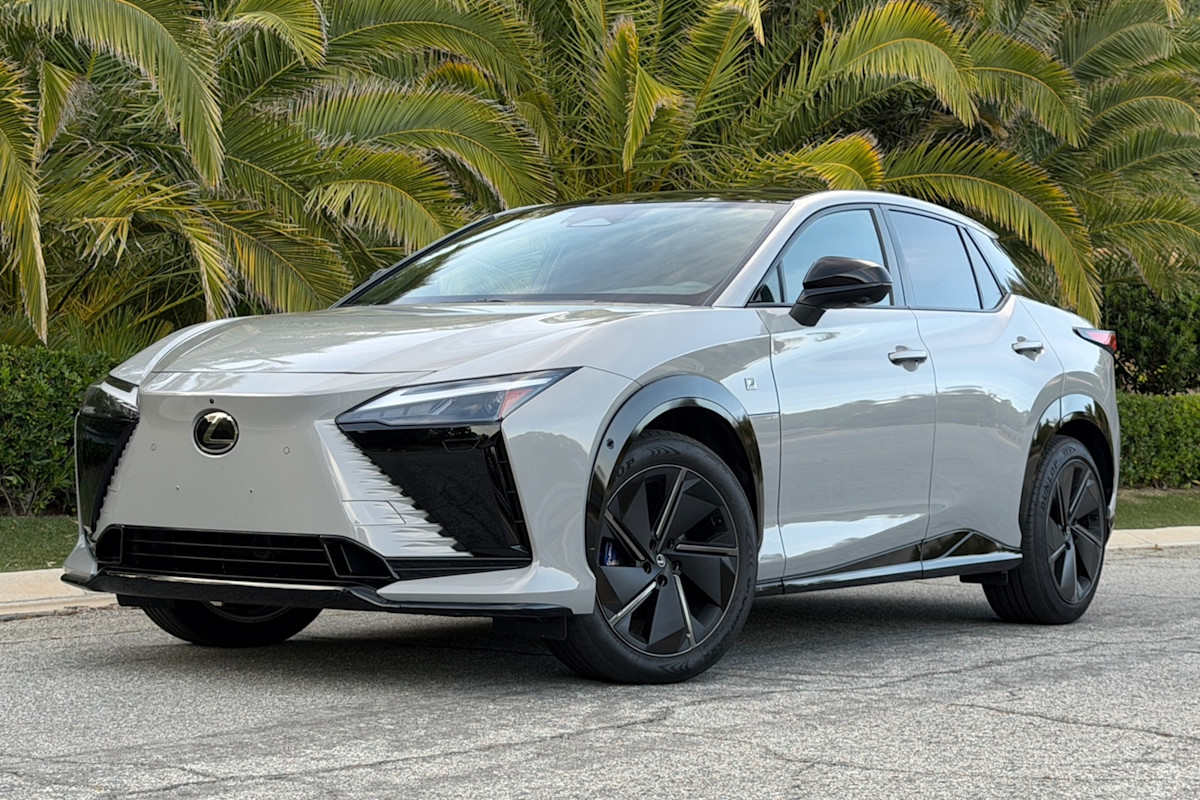
New for 2026, the RZ 550e has a more powerful AWD powertrain with 402 hp and standard F Sport trim. It looks appropriately sporty with blacked-out exterior accents, 20-inch wheels with aero covers, and available blue brake calipers. Inside, it features bolstered front seats, Black Ultrasuede upholstery and trim with blue accent stitching, aluminum pedals, and various F Sport-labeled details.
The RZ 550e F Sport is also the only version of this EV available in Wind—a new, solid light gray paint color seen in the photos of our test vehicle—which arrived from Lexus loaded with optional equipment. Upgrades included blue brake calipers, the Cold Area Package (headlamp washers and a windshield wiper de-icer), the Luxury Package, a panoramic roof shade, a carpeted cargo mat, and wheel locks, elevating the MSRP to $62,284 including the destination charge.
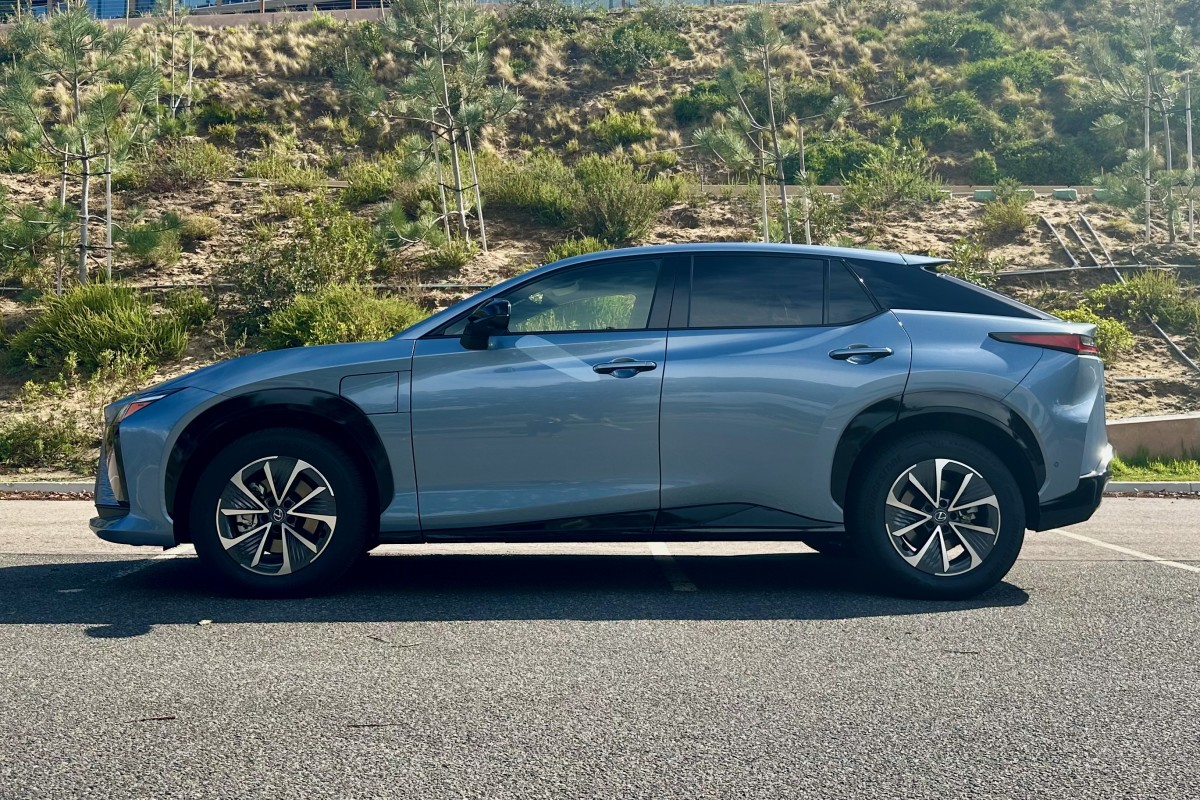
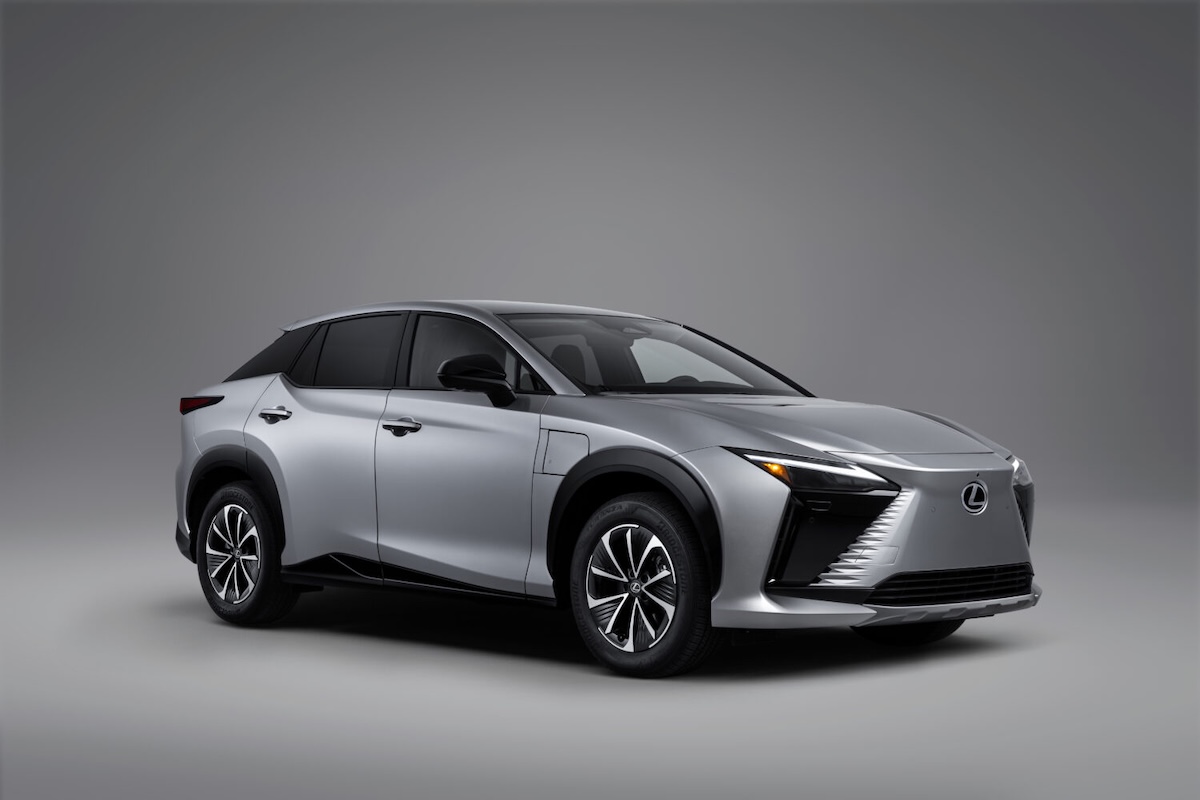
Design is subjective, and the RZ 550e is simultaneously formulaic and intriguing. Like most Lexus models, the least appealing thing about the RZ’s exterior is the front styling.
The RZ’s cabin comprises an eclectic mix of old-school switchgear, frustratingly minimalist touch-sensing controls, and modern displays, with hints of inexpensive materials, such as cheap turn signal stalks.
But the most offensive things about the RZ’s interior are the detestable unmarked dual-function steering wheel controls, which we found extremely distracting. They force the driver to coordinate fingertip touch-and-press actions with a visual guide shown on the already small and crammed digital instrumentation panel or head-up display (where applicable). Because of the dual-functionality design, they might not be set for the function you want. If there is a good reason to cross a Lexus RZ off a shopping list, the ridiculous steering wheel controls are it.
It’s not as though Lexus is afraid to use tried-and-true analog switchgear, either. For example, on the upper left side of the dashboard, there is a button marked ODO, which—no surprises—resets the trip odometer, so drivers don't need to hunt around in a digital menu to perform that task.
Changing the radio station is more difficult. Lexus provides a volume knob and volume buttons on the steering wheel, but there is no quick and easy way to tune down one station, say, from Alt Nation to SiriusXMU on satellite radio.
Performance
The big news for the 2026 RZ is its performance. Every model benefits from a new lithium-ion battery pack with more capacity and an updated cooling system, more powerful electric motors, and more range. Range estimates now run from 229 to 301 miles, depending on the model. That’s a major increase from the 196-266 miles of the 2025 RZ.
Furthermore, the RZ switches to a North American Charging Standard (NACS) port for Tesla Supercharger compatibility, though it still takes about 30 minutes to juice the RZ from 10% to 80% when DC fast charging. Lexus also upgraded the RZ’s Level 2 AC charging capacity for speedier home charging with an 11-kilowatt onboard charger, replacing 2025’s 7-kW unit.
Lexus has revised the RZ’s Direct4 AWD system to distribute power anywhere from 80% to the front wheels to 100% to the rears. The Range driving mode is designed for maximum efficiency, while Direct4 locks the power split evenly between the front and rear wheels. Structural fortifications aim to improve steering feel and response, revised suspension tuning promises upgraded ride and handling qualities, and extra sound-deadening materials further quieten the RZ’s cabin.
Our 2026 RZ test car had a 4.1-second 0-60 mph time, according to Lexus, but the trade-off is an EPA-estimated range of 229 miles at a consumption rate of 35 kWh/100 miles. We observed 32 kWh/100 miles, beating the EPA estimate.
The 2026 RZ 550e introduces a new M Mode. It’s a manual shift program that Lexus says can provide a sportier, more responsive, and more engaging driving experience. The automaker claims it simulates engine and exhaust sounds, but if our car sounded like this, we’d rush right over to the dealership to find out what was wrong.
We dismissed M Mode as a gimmick, and not a particularly satisfying one. The first problem is that when using the paddle shifters to shift down, there is an audible, simulated rev-match and a higher pitched artificial engine and exhaust note—but no accompanying extra friction in the drivetrain. In other words, it sounds as though the car has changed gear, but the driver can't feel it, which is disconnected and distracting.
The second problem is that if the driver forgets that they have engaged M Mode and slows down too much, the car lugs when the driver steps on the accelerator again—just like a vehicle with a real manual gearbox. Likewise, if the driver fails to upshift as the RZ accelerates, M Mode simulates hitting a rev limiter. It all amounts to more distraction.
We wish Lexus had put the effort that went into M Mode into a proper, one-pedal drive system. The maximum regeneration setting comes close, but as speed drops into the single digits, the driver must brake to bring the RZ to a halt. The dedicated button for M Mode would be more useful for selecting drive modes (Eco, Normal, Sport, Range, and Custom are available), which otherwise requires digging into a touchscreen menu.
M Mode and regenerative braking aside, the RZ 550e has some good attributes. It’s quick in a straight line, and Direct4’s ability to split power between the wheels makes the RZ 550e feel responsive and entertaining. The staggered-width Dunlop SP Sport Maxx tires on the test vehicle provide commendable grip, and structural rigidity is remarkable.
Still, the RZ 550e is more show than go. The revised suspension is pleasantly firm on the highway and in urban settings, but on a lumpy mountain road it's too soft to eradicate unwanted body motions. The brake pedal can be mushy at times, and the steering—which is a high-tech steer-by-wire system—feels anesthetized.
Ultimately, we think the RZ 450e is a better choice. It offers a little more range with an emphasis on coddling instead of entertaining its driver, and can still hit 60 mph in 4.9 seconds, according to Lexus. If that’s not quick enough, then a new-for-2026 dealer-installed performance upgrade is available to boost the RZ 450e to 375 horsepower for 0-60 mph to 4.3 seconds.
Form & function
Our RZ 550e test car had large seat bolsters that can feel confining for bigger people. The Ultrasuede-wrapped front seats offer eight-way power adjustment, heating, and ventilation, but the snug fit, coupled with a narrow pedal box and thin padding where the driver's legs contact the interior, leads to discomfort after a couple of hours at the wheel.
Rear seat room is generous, but the bottom cushion is too low to provide more than merely adequate leg support. However, the test vehicle’s outboard seating positions were heated, the backrest angle is proper, and the Dynamic Sky panoramic glass roof is interesting. For 2026, it creates more shade in its most opaque setting and, according to Lexus, a clearer view out when switched to transparency.
Storage space could be better. There isn’t much of it on the center console surface, and accessing the tray underneath it is awkward. The RZ lacks a traditional glove compartment, but the bin beneath the center armrest is large and deep. For small items, drivers can use the little trays embedded into the front door armrests or the cupholders. Smartphones can go on the wireless charger tucked under the infotainment screen.
Open the power liftgate, and there is a 34.9 cubic-foot cargo area. That measurement includes the sizable storage well located underneath the floor, which is perfect for holding the charging cord and Combined Charging System (CCS) adapter, since the RZ lacks a front trunk. When the RZ debuted in 2023, Lexus reported a cargo space measurement of 48 cubic feet with the back seat folded down and the front passenger’s seat in a normal position, and while there isn’t an updated figure in the spec sheet, we expect that to be the case for the 2026 model.
Technology
Lexus doesn’t brag about the size of the RZ’s digital instrumentation panel, because it’s small and crammed with data. The standard infotainment touchscreen measures 14 inches, and the available head-up display measures 10 inches.
The Lexus Interface infotainment system includes wireless Apple CarPlay and Android Auto, a three-month trial subscription to SiriusXM satellite radio, and five connected services plans with generous complimentary subscriptions (except for Wi-Fi Connect, which offers only 30 days or 3GB of data before charges kick in). Drivers can also log-in to their Apple Music or Amazon Music accounts directly from the system.
Wireless smartphone charging and a 10-speaker premium sound system are also standard. Our test vehicle’s optional Luxury Package added digital key technology and a Mark Levinson surround-sound system, which delivered appealing, but not astounding, audio quality.
For those who prefer to use the native interface instead of Apple CarPlay or Android Auto, the Drive Connect services plan is key. It includes a cloud-based navigation system and a capable digital voice assistant. Amusingly, given the amount of distraction caused by the RZ’s steering wheel controls, the assistant notified us that if we wished to see more than the top five results related to a destination request, we would need to pull over to prevent driver distraction.
Physical temperature knobs are included, but other climate functions live within the infotainment system. For example, to activate the seat heating or ventilation, drivers must push the Settings menu icon to expand the climate panel, which also obscures the navigation and radio menus.
Our test car had the optional head-up display, which we found undeniably helpful, especially when trying to sort out the steering wheel controls. We also appreciated the Luxury Package’s camera-based digital rear-view mirror, which helped compensate for the poor rear visibility.
Safety
The RZ’s standard Lexus Safety System+ 3.0 (LSS+ 3.0) package includes numerous driver assistance systems. Adaptive cruise control, forward-collision warning, pedestrian detection, automatic emergency braking, lane-departure warning, lane-keep assist, traffic-sign recognition, and high-beam assist are all on the list.
So is Proactive Driving Assist (PDA), which works to ensure safe following distances and provides steering assistance to avoid obstacles even when adaptive cruise control is deactivated. While we’ve found PDA intrusive in other Toyota and Lexus vehicles, that wasn’t the case with the RZ.
Additionally, every RZ features blind-spot monitors, rear cross-traffic alert, safe exit assist, and a surround-view camera system with a transparent vehicle view. Our test vehicle’s Luxury Package added Traffic Jam Assist for hands-free driving at speeds under 25 mph, Advanced Park with Remote Park semi-autonomous parking assist technology, front cross-traffic alert with warnings shown on the head-up display, and lane-change assist.
The Traffic Jam Assist is easy enough to use, though its 25-mph limit proved too low during a Los Angeles commute. Also, we disliked the automatic curve-speed reduction feature, and on one occasion the system turned into a curve sooner than we wanted it to, crowding a vehicle in the adjacent lane. But the driver-assist tech worked well overall, and we credit Lexus for including a touch-sensitive steering wheel to monitor driver attentiveness.
The National Highway Traffic Safety Administration (NHTSA) gave the Lexus RZ 450e a five-star overall safety rating. The RZ 350e and RZ 550e did not have an overall rating at the time of writing, because they hadn’t been assessed for rollover resistance. However, both earned five-star frontal-impact and side-impact protection ratings.
Results from the Insurance Institute for Highway Safety (IIHS) were also incomplete. However, the RZ received the top “Good” rating in the small overlap frontal-impact and updated side-impact tests, and a “Good” rating for the standard front crash prevention technology.
Cost-effectiveness
Lexus RZ prices are surprisingly reasonable, ranging from $47,395 to $58,395. That’s less than rivals such as the Audi Q4 E-tron, Cadillac Optiq, and Genesis GV60. Shoppers who want a small electric crossover for less money will likely be looking at more mainstream offerings such as the Tesla Model Y.
Every RZ includes Lexus Care—a collection of ownership perks including two free scheduled maintenance visits, complimentary access to connected services, loaner vehicles when necessary, and more. However, rivals often provide similar owner benefits, and some are more appealing than Lexus's offering.
Rival EVs themselves may be a better choice than the Lexus, depending on buyers' priorities. Some have more range, some recharge faster, and some accelerate quicker. Some competitors also offer hands-free highway-speed driving capability, better audio systems, or less-aggravating controls.
Though improved, the 2026 Lexus RZ still isn’t particularly compelling. Nothing about it stands out except for the Lexus brand’s reputation for reliability. For some, especially Lexus and Toyota owners, that might be enough. Everyone else will want to explore rival EVs.

What owners say
Trims & specs
Base MSRP $48,200 | Seating 5 |
Engine N/A | Cargo Capacity 34.9 cu ft |
Combined MPG N/A | Drivetrain N/A |
Base MSRP $57,000 | Seating 5 |
Engine N/A | Cargo Capacity 34.9 cu ft |
Combined MPG N/A | Drivetrain N/A |
Base MSRP N/A | Seating N/A |
Engine N/A | Cargo Capacity N/A |
Combined MPG N/A | Drivetrain N/A |
Base MSRP $46,000 | Seating 5 |
Engine N/A | Cargo Capacity 34.1 cu ft |
Combined MPG N/A | Drivetrain N/A |
Base MSRP $49,500 | Seating 5 |
Engine N/A | Cargo Capacity 34.1 cu ft |
Combined MPG N/A | Drivetrain N/A |
Base MSRP N/A | Seating N/A |
Engine N/A | Cargo Capacity N/A |
Combined MPG N/A | Drivetrain N/A |
Base MSRP $51,700 | Seating 5 |
Engine N/A | Cargo Capacity 34.9 cu ft |
Combined MPG N/A | Drivetrain N/A |
Base MSRP $57,000 | Seating 5 |
Engine N/A | Cargo Capacity 34.9 cu ft |
Combined MPG N/A | Drivetrain N/A |
Base MSRP N/A | Seating N/A |
Engine N/A | Cargo Capacity N/A |
Combined MPG N/A | Drivetrain N/A |