2026 Ford Mustang Mach-E Reviews, Pricing & Specs


Pros & cons
What we like
Stylish
Practical
Good power
What to consider
Busy ride
A little too pricey
Laggy infotainment system
Expert review
The 2026 Ford Mustang Mach-E attacks the electric SUV segment with good looks and practicality.
Every automaker needs a successful electric SUV, and the best way to go about that is to make it look good. Ford’s bread-and-butter electric SUV does that by borrowing design elements from the legendary Mustang coupe and convertible, teaming them with a roomy interior and useful electric driving range. Offered in a variety of trims, the Mach-E works as a practical daily driver and can be had with big-time power and even as a rally-inspired trail beast.
Verdict: The Ford Mustang Mach-E’s appealing looks are backed up by a practical interior, a viable range, and a variety of trim levels. It doesn’t charge as quickly or go as far as some rivals and the ride could be better, but the Mach-E offers style in a market sadly lacking it.
out of 10 expert review
Look & feel
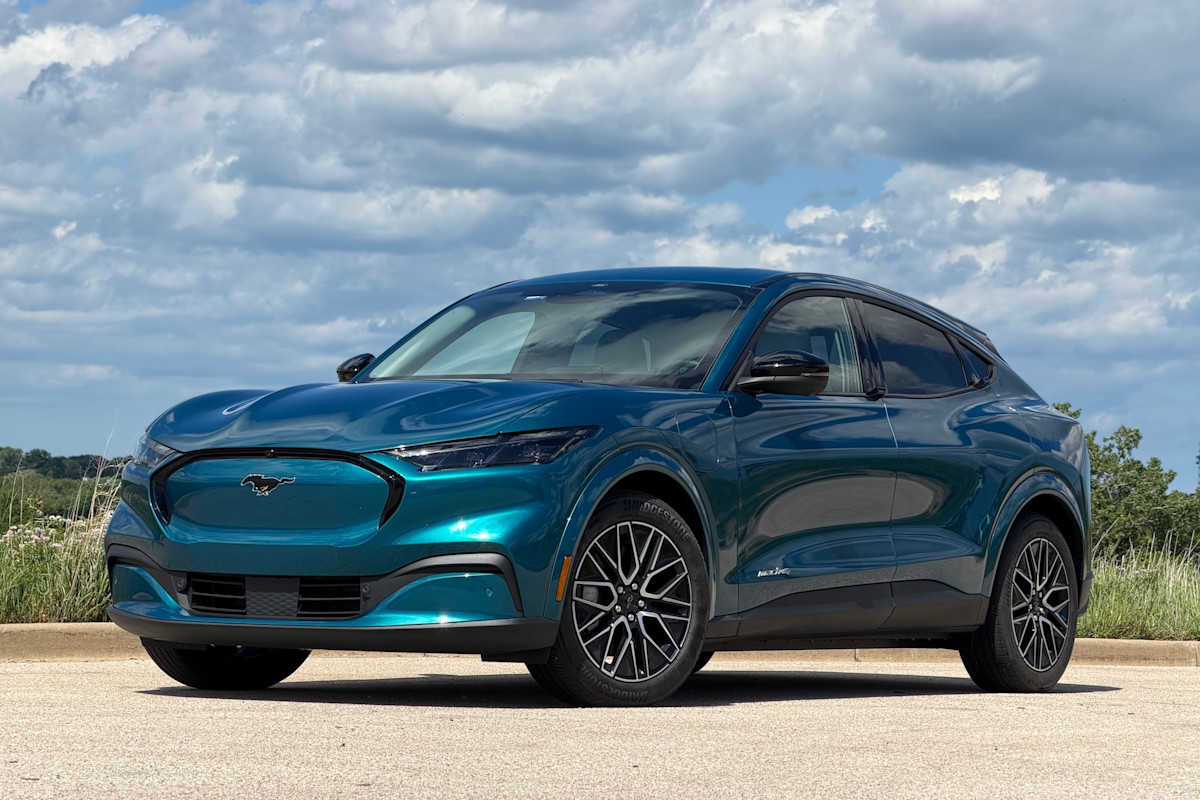
The Mach-E stands out with Mustang-inspired looks that set it above the average crossover SUV, be it gas-powered or electric. Up front is the familiar Mustang grille (though it’s not a grille, just an insert) and squinting headlights. The sculpted Mustang design continues along the sides but diverges from the legendary coupe and convertible with an SUV-like two-box shape. However, a sloped roofline provides an SUV-coupe-like profile along the lines of the BMW X6 to continue the sporty theme. At the rear, the Mach-E gets a roof spoiler as well as the familiar Mustang sequential three-bar taillights. Ford outfits most Mach-E models with 19-inch alloy wheels, but the GT trim gets 20s. For an even sportier look, dual hood stripes are available on every trim.
The Rally trim sports a standard black roof, black wheel arches and side cladding, and white or black dish-style wheels inspired by various Ford rally cars of old. Those who want it to look like a rally car right from the factory floor can add a taller rear spoiler taken from the 2016-2018 Ford Focus RS and “Mach-E Rally” door graphics. A clear film on the lower body sides protects against rock chips for those who aim to fulfill the Mach-E's off-road destiny.
While synthetic leather comes standard, it looks like the real thing. The doors, dash face, and center console get the same material smartly rendered with contrast stitching. The tops of the doors have a different soft-touch material, while the dash sports an attractive cloth as well as a fake carbon fiber that looks sporty, even if it isn’t real.
The GT has sport seats with bigger bolsters and blue and gray or silver contrast stitching, depending on the upholstery color. For the Mach-E Rally, Ford adds aluminum pedals, “Mach-E Rally” logos on the front seats, and bits of white trim. Ambient lighting brightens things up in all but the base Select trim.
Performance
The Mach-E offers a varied range of powertrain options. It starts with a single-motor, rear-wheel-drive (RWD) powertrain that makes 264 horsepower, uses a 73-kilowatt-hour battery pack (Ford calls this the Standard battery), and offers 260 miles of range. Adding a second motor with the Standard battery ups output to 325 hp but lowers the range to 240 miles. An Extended Range battery is also available and increases the range to 320 miles with the single motor or 300 miles with dual motors. These dual-motor powertrains, offered for the base Select and step-up Premium, trims make 325-370 horsepower.
The Mach-E GT has a dual-motor powertrain, which produces 480 hp with 280 miles of range. The Rally has the same dual-motor powertrain, but its range is 255 miles. Our 2026 test vehicle was a Premium model with dual motors and the extended-range battery, giving it 370 hp, 500 pound-feet of torque, and 300 miles of range.
The Mach-E may carry the Mustang name and offer good power, but that power arrives very differently than in the traditional V8 coupe and convertible. The immediate torque of the electric motors makes the Mach-E rocket from a stop if drivers get hard into the throttle, and our test car hit 60 mph in less than five seconds. Power doesn’t build like it does with a gas engine, though, and the Mustang’s 5.0-liter V8 has more pull as the speeds increase and better passing punch at freeway speeds.
The Mach-E GT turns up the wick on power and speed, thanks not only to 480 hp but to 600 lb-ft of torque that unlocks a 3.8-second 0-60 mph time. A Performance Upgrade increases torque to 700 lb-ft as an option for the GT and comes standard with the Rally. With it, the GT hits 60 in just 3.3 seconds and the Rally in 3.4 seconds.
Drivers can choose the sound that accompanies the power through the touchscreen. A Whisper mode has just a hint of engine whine, and that becomes slightly more noticeable in Engage mode, which is effectively Normal mode. The top Unbridled mode sharpens the throttle response and adds a bit of a spaceship whirr to the soundtrack. Ford says that's an enhanced version of the natural sound of the motors, but it seems more digital and artificial.
The Mach-E can coast like it has a gas engine, but a toggle on the touchscreen enables one-pedal driving that slows the vehicle when drivers let off the throttle. The transition from regenerative to friction braking is seamless, and the brakes never feel grabby or unpredictable as they can in other EVs.
The Mach-E has 5.7 inches of ground clearance, and the battery pack is 5.9 inches thick, so drivers have a typical crossover seating position. This means there's some body lean from the driver’s seat, though the Mach-E handles quite well, with dull but quick and direct steering, agile moves courtesy of the low center of gravity, and a willingness to rotate after some initial understeer—a tendency to push forward rather than turn. The all-wheel-drive (AWD) system creates a rear-drive bias and rear-axle electronic torque vectoring enhances its willingness to rotate.
There is room for improvement with the ride, though, mostly in the rear. Somewhere between damping and a lack of sound deadening, the Mach-E noticeably drums over broken pavement and that only gets worse with the stiffer tuning of the GT. Otherwise, bumps don’t pound through enough to make passengers uncomfortable.
Both the GT and Rally get stronger Brembo brakes. A Performance and Handling package adds magnetic dampers as well as the additional torque to the GT and comes standard on the Rally. The GT rides lower than other Mach-E models, while the Rally sits a little higher while also adding underbody protection for the front and rear motors. The suspension tune and higher ground clearance give the Rally a little more body lean, but it rides better and is tuned for a playful character. A RallySport mode loosens the stability control to let the rear hang out for better power through turns on gravel roads and even in the mud.
Form & function
Like other electric SUVs, the Mustang Mach-E has a wheelbase that's longer than that of an equivalent gas-powered vehicle, which makes it spacious inside. The Mach-E will serve a couple or family like a typical compact or midsize two-row crossover. It has good headroom and legroom in the first row, and the same goes for the second-row seat, though fitting three across is a squeeze.
Front occupants get power-adjustable front seats, while driver’s seat memory, heated and ventilated front seats, and a heated steering wheel are available at the base level and otherwise standard. The seats are comfortable, but they get sportier thanks to additional bolstering in the Mach-E GT and Rally trim levels.
Cargo space is better than the Mach-E’s sporty looks would suggest. It has 29.7 cubic feet behind the second row and that expands to a practical, but not generous, 59.7 cubic feet behind the first row with the rear seats folded flat. The Mach-E’s sloping rear roof prevents it from offering as much space as a Honda CR-V or a Toyota RAV4, though. An optional 4.8-cubic-foot front trunk provides some secure storage, and even has a drain plug to let owners fill it with ice and use it as a cooler.
Technology
Ford borrows from Tesla with its large, 15.5-inch center touchscreen that absorbs many of the controls. However, it sits portrait-style rather than horizontally. Ford also includes a 10.2-inch digital instrument cluster behind the steering wheel, though it’s not hooded as it is in most vehicles. The instrument cluster shows basic information, such as range, battery state of charge, and a speedometer.
The touchscreen’s Sync 4A software is starting to fall behind the times, as it took too long to load screens. Otherwise, however, the screen is easy to understand and operate, and can be updated over the air. Buyers also get a year of the Ford Connectivity package, which includes a 5G Wi-Fi hotspot, real-time navigation and traffic, audio and video streaming, and a voice assistant. After a year, it costs $150 annually. Wireless Apple CarPlay and Android Auto, a three-month satellite radio trial, and a digital key come standard, while a wireless charging pad, a satellite radio, and two 110-volt power outlets are optional. A non-branded six-speaker audio system is standard, and buyers can move up to a 10-speaker B&O system.
Safety
Every Mach-E gets Ford’s Co-Pilot 360 Assist+ suite of standard safety features that includes: automatic emergency braking with intersection assist and pedestrian detection, adaptive cruise control, lane-keep assist, blind-spot monitors, rear cross-traffic alert, an exit warning system, high-beam assist, a driver-attention monitor, and rear parking sensors.
Ford’s BlueCruise hands-free driver-assist system also comes standard but only for 90 days. It's available for a year for $995 with the Technology Package, which also includes a surround-view camera system, front parking sensors, and rear automatic braking. Buyers can also get BlueCruise for the life of the vehicle for a pricey $2,000.
BlueCruise is a Level 2 driver-assistance system that can handle the steering, throttle, and brakes on hundreds of thousands of miles of mapped highways. It requires the driver to pay attention to the road and take over if the system can’t for any reason, such as inclement weather, particularly sharp turns, unclear lane markings, or unmapped roads. It can also perform automatic lane changes. We generally like BlueCruise, but it can get confused when it can’t track the driver’s eyes (sometimes due to sun glare) or encounters construction zones. GM’s SuperCruise works better, but it’s still nice to drive hands-free on longer freeway jaunts with BlueCruise.
The Mach-E does well in crash tests. It earned a Top Safety Pick award from the IIHS, only missing out on the Top Safety Pick+ top honor because it hadn’t been subjected to the vehicle-to-vehicle front crash prevention test. It also got five out of five stars from the NHTSA.
Cost-effectiveness
As noted above, Ford offers the Mustang Mach-E in Select, Premium, GT, and Rally trim levels. The Select starts at $39,840, including a mandatory—and overpriced—$2,045 destination fee. Adding AWD costs another $3,000 and choosing the Extended Range battery costs $8,250 but it’s bundled with AWD so effectively costs $5,250. Premium starts at $42,640; adding AWD and the Extended Range battery costs $7,750, but buyers can get the bigger battery without AWD for $4,750. The more-powerful GT costs $55,440 and the off-road-inspired Rally $59,735.
The choice for those who want the most efficiency and the longest range is the rear-wheel drive (RWD), Extended Range version, which runs $50,390 at a minimum. Our dual-motor, Extended Range Premium trim tester came close to living up to its 300-mile range. Over 252 miles of mixed city and highway driving it averaged 3.1 miles per kWh, which was right on its 3.1 mi/kWh EPA estimate, though it was on track for a total of about 270 miles. Lighter throttle application would certainly allow the Mach-E to match its rated range.
Charging is easy but not state-of-the-art. An 11-kilowatt onboard charger lets it take in about 27 miles per hour and charge from empty to full in about 11 hours. A 400-volt electrical system limits DC fast charging to a rate of 150 kW, which can fill the battery from 10-80% in as little as 43 minutes for the larger battery. Buyers also get access to Ford’s BlueOval charging network of about 200,000 chargers. That includes Tesla Superchargers, using a NACS adapter.
We like the power, range, and creature comforts of the dual-motor, big-battery Premium trim we tested, and would recommend it to most buyers. However, we’d also be tempted by the additional power of the Rally, as well as its cool looks and better ride. No matter what Mach-E buyers choose, they will get a practical electric SUV with the swagger of the legendary Mustang.

What owners say
Trims & specs
Base MSRP $40,795 | Seating 5 |
Engine N/A | Cargo Capacity 29.7 cu ft |
Combined MPG N/A | Drivetrain N/A |
Base MSRP $37,795 | Seating 5 |
Engine N/A | Cargo Capacity 29.7 cu ft |
Combined MPG N/A | Drivetrain N/A |
Base MSRP $53,395 | Seating 5 |
Engine N/A | Cargo Capacity 29.7 cu ft |
Combined MPG N/A | Drivetrain N/A |
Base MSRP $43,595 | Seating 5 |
Engine N/A | Cargo Capacity 29.7 cu ft |
Combined MPG N/A | Drivetrain N/A |
Base MSRP $40,595 | Seating 5 |
Engine N/A | Cargo Capacity 29.7 cu ft |
Combined MPG N/A | Drivetrain N/A |


