2026 Audi Q5 Reviews, Pricing & Specs


Pros & cons
What we like
Intuitive infotainment
Refined ride and confident performance
Good amount of standard equipment
What to consider
Cheap interior materials
Ergonomic issues
High price
Expert review
Once the definitive compact luxury SUV, the Q5 suffers from a quality downgrade in this generation.
A year into its third generation, the Audi Q5 comes out swinging with screens, screens, and more screens in an attempt to hold its position as one of the bestselling compact luxury SUVs in the U.S. Audi customers and car enthusiasts, however, have panned the company's shift to a derivative exterior design and subpar interior materials while prices keep ratcheting higher. With thousands of test miles logged in Q5 models dating back to the first generation, we came to this Q5 review with an open yet highly critical mind, especially considering our Prestige test car’s roughly $65,000 asking price.
Verdict: Competent, not compelling, the Q5 meets expectations without setting the bar like it did in previous generations.
out of 10 expert review
Look & feel
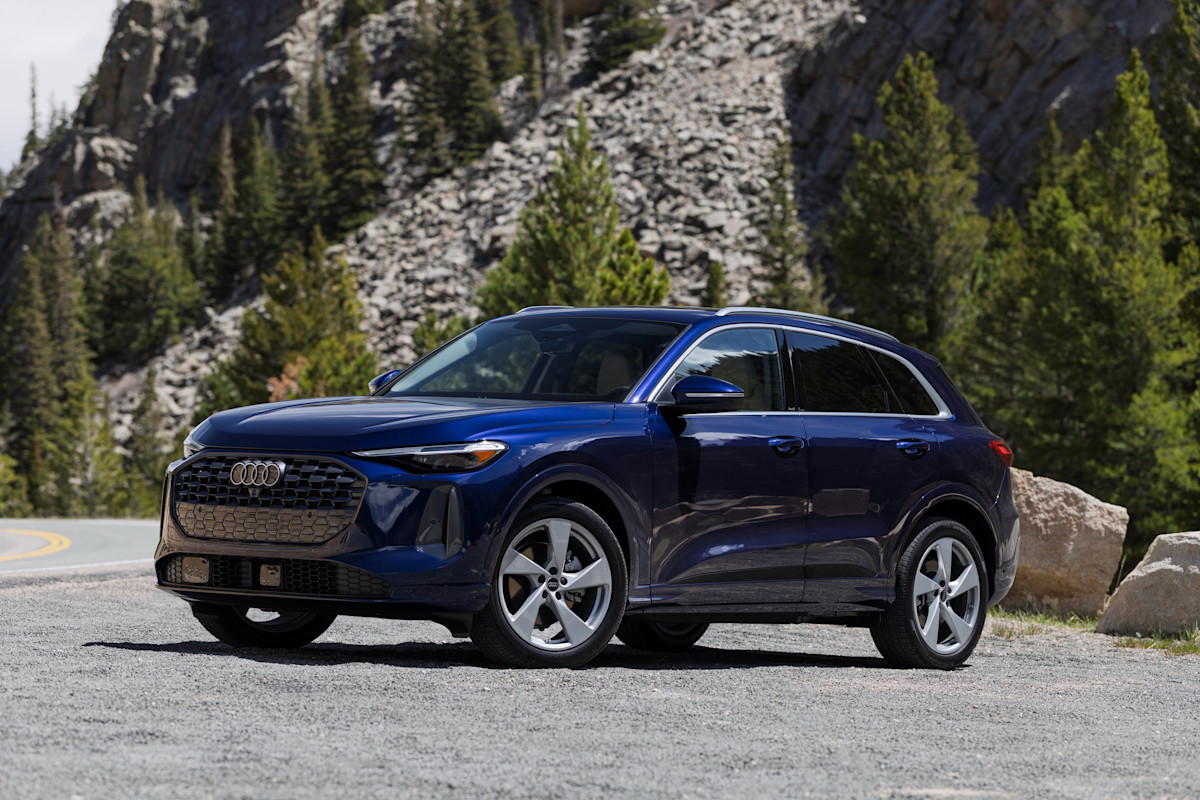
Audi's commitment to clean, classically handsome exterior design is fading across its lineup. The Q3, Q7, and the new Q9 mimic the last-generation Hyundai Santa Fe from the front and read Chevrolet Traverse from behind. Available in both regular SUV and Sportback body styles, the Q5 somewhat bucks that aesthetic. The headlights are thinner and set deeper into the body, while a wider grille and tall side intakes dominate the fascia. The front is the most unique and recognizably Audi styling feature, and the company did well to integrate the radar, sonar, and camera equipment within the upper and lower grilles.
Our test car’s District Green paint set against the S Line Black Optic Package, which darkens all the chrome trim and the Audi emblem, was particularly striking. But the grille's honeycomb design, while alluring from afar, loses its luster when viewed up close. It's a mishmash of glossy and matte plastic, and the chunky, protruding bits in the top half do the Audi emblem no favors.
The rear bumper—where the honeycomb texture is inset within a gloss surround—looks better but still comes off as cheap. At least there are real exhaust tips instead of faux appliques, and like all Audis, the exterior lighting is exceptionally sharp. However, the thin rear lightbar is another element that could pass on any number of cars, as opposed to the separated twin-light design that always defined the Q5. The side proportions, too, have been compromised to basicness. The previous-generation Q5 had a taller roof that played well against its short wheelbase, like viewing a designer handbag with its handles raised. Now the roof is lower and the rear slopes ever so slightly, creating an unusual ratio of glass to body panels.
The interior is equal parts offensive and tasteful. On the plus side, the seats are perfectly sculpted, delicately stitched, and covered in durable leather. The four-spoke steering wheel is another fine touch—a nod to the early 1990s and a prime example of clean, functional design (and for 2026, the touch-sensitive buttons are replaced with real buttons and scroll wheels). The column stalks are weighty, the window switches have a satisfying resistance, and the doors—despite a secondary electronic latch that sometimes requires an extra pull of the handle—close with a solid thunk. The angles of the dash, the wood trim, and the center console with its leatherette and aluminum trim are all fine elements.
It's the abundance of shiny black plastic and the disjointed trio of screens that ruin the Q5's interior. The displays appear disconnected, as their rectangular shapes are nestled between thick, oddly protruding screen bezels. The passenger display (standard on the Prestige) may be fun to play with for a while, but it's highly reflective and becomes an oily, smudgy mess after a few swipes. Audi also doesn't try to cover up the lack of a screen on the lower Premium and Premium Plus trims; it's the same shiny black plastic, but entirely blank.
Performance
One thing we can't do is come at Audi for the way its cars drive, because dynamics are this brand's hallmark. Every Q5 gets a 2.0-liter turbocharged inline-four with one power output, eliminating the confusing numeric designations of the last generation. At 268 horsepower and 295 pound-feet of torque, the engine is comparable to any turbo 2.0-liter in the segment. Turbo lag and vibration are kept to an absolute minimum, and the sound is appropriately muted.
Audi's quattro all-wheel drive (AWD) and a seven-speed dual-clutch automatic transmission are standard. The dual-clutch design is more appropriate for performance vehicles, where consistent heavy throttle use makes them a better match. In the more sedate Q5, there is a delay upon pressing the accelerator pedal from a stop and some lurching at parking lot speeds. The SQ5, which we review separately, has a turbocharged V6 that pairs much better with the Q5's transmission.
Rock-solid stability, a hushed cabin, and a comfortable ride make the Q5 worthy of the Audi badge. The steering is light and delivers a modicum of feel, while the suspension is adept at transferring body motions calmly and securely. The Prestige trim has air springs which can raise the body 1.2 inches in Offroad mode or drop it at highway speeds or when parked. The only other car in this class with air springs is the Volvo XC60 Ultimate, but really, air springs do not benefit either car dynamically and we didn’t notice any improvement in ride quality. The Q5 actually felt like it had steel springs.
The Q5 boasts EPA-rated fuel economy of 21 mpg city, 29 mpg highway, and 24 mpg combined. This is competitive in the class, which is good, because Audi no longer offers a plug-in hybrid powertrain as it did with the previous-generation Q5.
Form & function
Headroom and legroom are average for the compact SUV class, as is the cargo space at 27.6 cubic feet behind the rear seats and 56.9 cubic feet when folded. The rear seats manually recline and are split 40/20/40. Audi's standard panoramic sunroof, which seems ordinary now, was a luxury very few automakers offered 15 years ago when the original Q5 became one of the very first cars to bring it mainstream. It's as wide and expansive as ever and hardly impedes on headroom for rear-seat passengers. Sightlines are good in all directions. Towing capacity also outpaces the competition at 4,400 pounds and even rivals many midsize crossovers.
Heated eight-way power front seats, leather upholstery, wood and aluminum trim, an integrated garage door opener, auto-dimming power-fold mirrors, three-zone climate, power tilt/telescope steering column, 18-inch wheels, and remote start are all standard. The Premium Plus adds roof rails, a dashcam, animations for the exterior LED lights, 19-inch wheels, ambient lighting across the dash that can animate turn signals and other warnings, and a surround-view camera system. Prestige adds ventilated front seats with extra bolstering, heated rear seats, rear window shades, OLED taillights, acoustic laminated front windows, a head-up display, and more.
There are, however, daily inconveniences with a Q5. Since all the climate controls are in the touchscreen, drivers have to wait until the software boots up to adjust anything, and during our test, the fan controls would not appear for several seconds after the climate menu loaded. A revised user interface has cleaned up some of the menu complexity for 2026, and thankfully, the typefaces, type spacing, graphics, and legibility are all very good and easy to adjust while driving or parked. The cameras are also extremely sharp.
But the instrument panel is unimpressive, which is an odd thing to say about Audi since the company was first to market with a fully digital instrument cluster. Customization is now limited, and there is no way to display the usual two-dial layout with a speedometer and tachometer. While the left and right portions of the screen can show varying information, it’s limited. The audio menu, for example, shows only album art without any song title or artist information. Previous iterations offered full-screen maps, but that was eliminated with the Q5’s 2025-model-year redesign.
The driver's door is also awkward. The pull handle is excessively wide, so smaller hands will have a tough time grabbing the entire handle when the door is extended outward. Each of the door release pulls have shallow recesses, again making it difficult for more than a couple of fingers to grip the pull. Worse, on the driver’s door, instead of a door lock switch near the door pull—where it's located on all the other doors—it's on a pad combined with the headlight controls.
Audi's old cruise control stalk remains exactly as it was, and just as before, it's hard to use compared to the more conventional placement of these controls directly on the steering wheel. The gear selector, brought over from Audi's electric models, is overly complicated.
Technology
A 14.5-inch touchscreen and an 11.9-inch digital instrument cluster come standard. On Prestige trims, a third 10.9-inch touchscreen takes over the passenger area. That screen largely mimics the functions on the main touchscreen and allows for setting navigation, controlling the stereo, and playing videos over streaming apps. Wireless Apple CarPlay and Android Auto are supported, and Audi uses Google built-in apps. The Bang & Olufsen stereo has 755 watts and 19 speakers. As expected, it sounds good.
While there is no hands-free driving capability, both the instrument panel and head-up display have excellent depictions of the current road and traffic. In our tests, the Q5 correctly depicted exit and entrance ramps on highways as the vehicle was passing them, in real time, plus it showed accurate renderings of vehicles across multiple lanes and depicted how the highways were divided (i.e. two lanes on both sides, etc). This is an excellent use of technology.
The Park Assist Pro feature on the Prestige, which can back up or drive the car forward using the key fob from outside the car, is also impressive. So are the eight lighting signatures for the headlights and taillights that can be selected in the main touchscreen. Audi Connect Care is standard and includes remote start, stolen vehicle tracking, and the usual smartphone connectivity for 10 years.
Safety
Crash-test ratings for the 2026 model weren’t available at the time of writing, but the National Highway Traffic Safety Administration gave the identical 2025 model a five-star overall safety rating, with five stars in all crash tests except the rollover resistance test, where the Audi received a four-star rating. The Insurance Institute for Highway Safety gave the Q5 its highest Top Safety Pick+ award, including a top Good rating in three crash tests. A center frontal airbag and rear side airbags are standard—both of which are uncommon features.
More common driver-assistance features suc as automatic emergency braking, lane-departure warning, blind spot monitors, front and rear parking sensors, and adaptive cruise control are standard, too. Forward cross-traffic alert and braking and evasive steering assist are standard on the Premium Plus (advertised as Active Front Assist) along with lane-keep assist (part of Adaptive Cruise Assist, the semi-automated but not hands-free driving system). Rear emergency braking is available on the Prestige.
Cost-effectiveness
The 2026 Audi Q5 starts at $52,800 for the Premium trim, $55,700 for the Premium Plus, and $60,700 for the Prestige before the mandatory $1,395 destination fee. The Q5 Sportback adds about $2,000 to each trim level. Our Q5 Prestige with the S Line Black Optic Package and District Green Metallic paint rang up to $64,890 with destination.
For the first time, Audi includes three years or 30,000 miles of scheduled maintenance with every new car. This is a significant perk that matches Genesis but is beaten by BMW, which has offered four-year maintenance for well over a decade.
It is difficult to recommend a Q5 when its interior design and material quality have been so dramatically scaled back and cheapened compared to previous generations. The exterior style could get a pass if the interior held up, but for nearly 65 grand, it doesn't. The technology, space, and performance are too similar to non-premium offerings that are priced 20 grand below the Q5. There's still a lot to like about it, but there are fewer distinctive features that make this SUV stand out.

What owners say
Trims & specs
Base MSRP N/A | Seating N/A |
Engine N/A | Cargo Capacity N/A |
Combined MPG N/A | Drivetrain N/A |
Base MSRP N/A | Seating N/A |
Engine N/A | Cargo Capacity N/A |
Combined MPG N/A | Drivetrain N/A |
Base MSRP $60,700 | Seating 5 |
Engine 2.0L 268 hp I4 | Cargo Capacity 27.6 cu ft |
Combined MPG 25 | Drivetrain AWD |
Base MSRP $53,300 | Seating 5 |
Engine N/A | Cargo Capacity N/A |
Combined MPG N/A | Drivetrain N/A |
Base MSRP $55,700 | Seating 5 |
Engine 2.0L 268 hp I4 | Cargo Capacity 27.6 cu ft |
Combined MPG 25 | Drivetrain AWD |
Base MSRP $52,800 | Seating 5 |
Engine 2.0L 268 hp I4 | Cargo Capacity 27.6 cu ft |
Combined MPG 25 | Drivetrain AWD |


Pricing trends
MSRP range
$52,800 - $60,700
Current avg. market price
$51,385
Trending down by 4.1% this month
July 2026 - October 2026