2023 Chevrolet Blazer Reviews, Pricing & Specs


Pros & cons
What we like
Stylish design
Powerful engine (V6)
Wireless Apple CarPlay/Android Auto
What to consider
Fairly pedestrian performance
Poor fuel economy
Advanced safety features are not standard
Expert review
The modern Blazer is a very different kind of SUV from its predecessors, but it's well suited to the times.
The Chevrolet Blazer is one of the oldest SUV nameplates on the market, and while the current version might disappoint fans of the original, it’s very much on-trend with modern times.
Chevy launched the Blazer as truck-based off-roader, starting with the original K5 Blazer, and following that it up with a smaller S-10 Blazer based on its compact pickup truck. The Blazer was shelved in the early 2000s, then revived for the 2019 model year as a car-based crossover SUV, eschewing ruggedness for greater efficiency and on-road refinement in a shift that reflected the utility-vehicle market as a whole.
General Motors’ decision not to go all-in on nostalgia with a new off-road Blazer might seem questionable in the wake of the revived Ford Bronco, but the market for two-row midsize crossovers like the modern Blazer is even stronger, and it's filled with rival offerings like the Ford Edge, Honda Passport, Hyundai Santa Fe, Nissan Murano, Toyota Venza, and Volkswagen Atlas Cross Sport.
For 2023, notable changes include a new 10-inch touchscreen display and available wireless charging for all trim levels, some styling changes, and new wheel designs and color options. The lineup still consists of 2LT, 3LT, Premier, and RS trim levels (we checked out a Blazer RS for this review). A Chevy Blazer EV is also on the way for the 2024 model year, but this will be a completely different vehicle based on GM’s Ultium EV component set.
out of 10 expert review
Look & feel
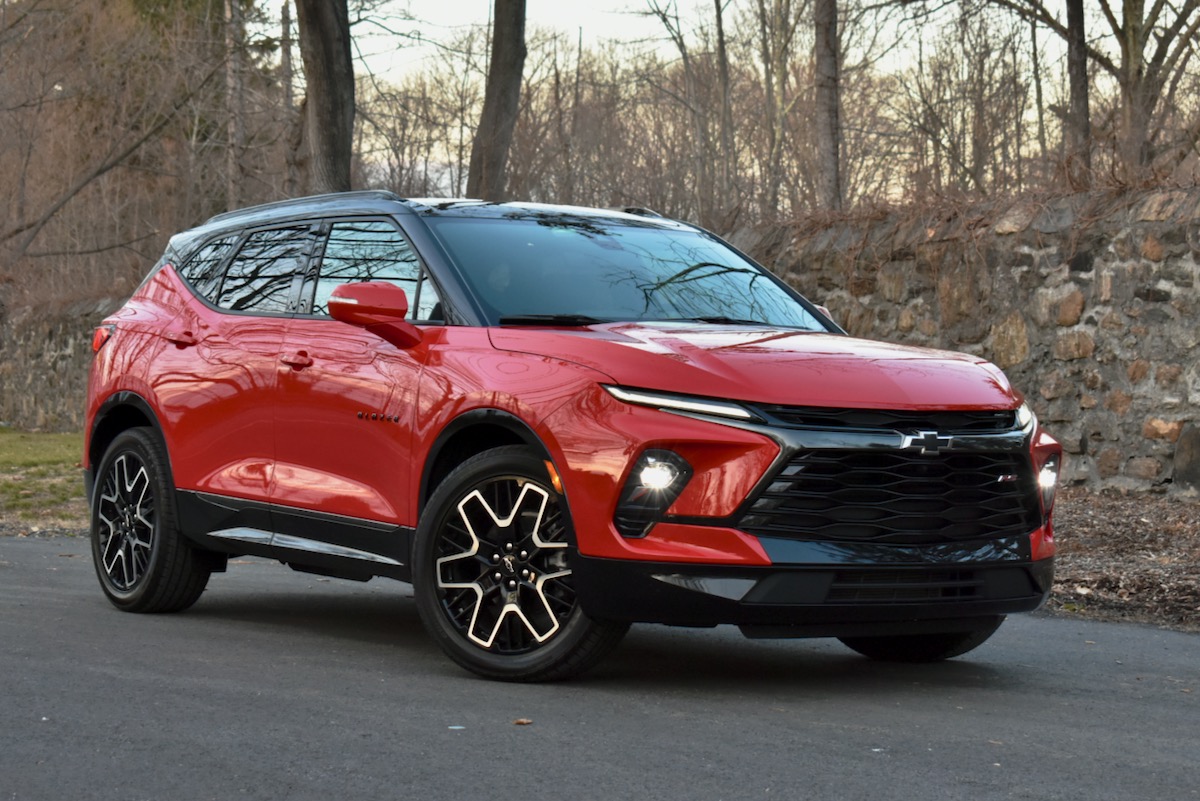
Instead of going for the rugged look of most other crossovers, Chevy applied styling cues more akin to road cars, including a low roofline with front and rear pillars leaned back for a sleek profile, and a big grille framed by stacked headlights. The Blazer still has the visual weight of a proper SUV, though, thanks to its tall ride height and body sides. Add our Blazer RS test vehicle’s blackout trim, Red Hot paint, and 21-inch wheels (with a new-for-2023 design), and you get something remarkably striking for a mainstream crossover.
The Blazer gets some small styling changes for 2023, the highlight being new taillights with unusual twisted, filament-like elements. The updates also include tweaked designs for the grille and LED headlights and daytime running lights. These changes aren’t too dramatic, but build on what was already there to keep the styling fresh. New 18-inch, 20-inch, and 21-inch wheel designs, and the addition of Sterling Gray Metallic, Copper Bronze Metallic, and Radiant Red Tintcoat to the color palette round out the changes.
The interior has a sportier aesthetic than other Chevy crossovers, with an upright dashboard and large round air vents that recall the Camaro muscle car. Cloth seats are standard, but leather upholstery is available on higher trim levels, and all models get dual-zone automatic climate control. As with the exterior, our Blazer RS’ interior was a bit more jazzed up, boasting blue trim, a splash of chrome, and a subtle dark blue and black two-tone scheme for the upholstery. We were impressed by the material quality on this high-end Blazer model as well.
Performance
Powertrain options carry over from the 2022 model year. Most Blazer models have a 2.0-liter turbocharged four-cylinder engine under their hoods, producing 228 horsepower and 258 pound-feet of torque. A naturally aspirated 3.6-liter V6 is standard on the Blazer RS and optional on the 3LT and Premier trim levels. It’s rated at 308 hp and 270 lb-ft of torque.
A nine-speed automatic transmission sits behind both engines, with standard front-wheel drive (FWD) or optional all-wheel drive (AWD). Like other GM crossovers, even AWD models default to FWD; you have to twist a knob on the center console to engage AWD. Considering that some rival crossovers will automatically switch from FWD to AWD as needed, this is an anachronism. It also requires drivers to think ahead of time and select AWD when anticipating slippery conditions, something that’s easier said than done in the real world.
We ended up leaving our V6-powered Chevrolet Blazer RS test car in AWD mode most of the time, though, to better manage the power from the bigger engine. As any Nissan Maxima driver will tell you, a big V6 and FWD is a recipe for torque steer—the sensation that the front wheels are being pulled off center during acceleration—and we did notice a bit of that with the Blazer in FWD mode.
With that V6 torque, the Blazer felt impressively quick for an ordinary crossover, and it even had a decently sporty exhaust note. In this age of downsized turbocharged engines and electrification, it was a reminder of how effective a simple naturally aspirated six-cylinder engine can be in a vehicle of this size.
Don’t mistake the Blazer for a performance SUV, though. Despite its sporty costume jewelry, our Blazer RS tester drove exactly like we expected, given its humble crossover underpinnings. Its considerable weight and top-heavy design had the expected negative impact on handling, but that’s to be expected with a crossover of this size. On the highway, standard Active Noise Cancellation and a well-tuned suspension made the Blazer a pleasant place to be, although our test car’s 21-inch wheels detracted from the ride quality a bit.
The Blazer nameplate has a lot of history in off-roading, but the 2023 Blazer is very much a car-based crossover with no rugged pretensions. The AWD system, suspension, and tires are designed for pavement, not mud, and while Chevy doesn’t list ground clearance, the Blazer’s low-hanging front bumper likely wouldn't survive long on a trail.
The Blazer’s 4,500-pound maximum towing capacity is in line with other midsize SUVs. That rating applies to V6 models with the trailering package, which is standard with AWD and optional with FWD.
Form & function
Today’s Blazer is a two-row, five-seat vehicle. This was once the default configuration for a midsize SUV, but over the years automakers have gone from shunting aside two-row models in favor of three-row SUVs, to now offering two-row and three-row alongside each other. Chevy currently does that with the Blazer and the three-row Traverse, and most other mainstream brands have equivalents to this duo.
Front-seat headroom is nearly identical to rivals like the Ford Edge, Honda Passport, and Nissan Murano. While rear-seat headroom is a bit below average, the Blazer does better in this area than the Volkswagen Atlas Cross Sport. It’s a similar story with legroom, with slightly more in front, but still a decent amount in the second row.
The Blazer offers 30.5 cubic feet of cargo space with its rear seats in place and 64.2 cubic feet with the rear seats folded—which puts it behind most rivals. For reference, the Honda Passport offers 41.2 cubic feet with its rear seats up, and 77.7 cubic feet with the rear seats folded, while the aging Nissan Murano can fit 32.1 cubic feet of stuff behind its second-row seats and accommodate 67 cubic feet of cargo with the rear seats folded.
Numbers aside, the Blazer is a generously sized vehicle that feels quite spacious from behind the wheel, without being too awkward to maneuver in tight spaces. Relatively short overhangs make it easy to find the corners of the vehicle when parking, and the windshield offers an unobstructed view that contributes to that aforementioned feeling of spaciousness. We also appreciated the interior’s functional details, like the placement of USB ports between the large round center-stack air vents, and how you twist the outer rings of those vents to raise or lower the temperature—a nice alternative to conventional buttons.
Technology
The Blazer gets a couple of tech upgrades for 2023. A 10.2-inch touchscreen is now standard on all models, and wireless device charging is now available on all trim levels. It’s standard on the RS and Premier, and an extra-cost option on the 2LT and 3LT models.
A 4.2-inch digital instrument cluster display, centered between analog gauges, is standard, while RS and Premier trim levels get an 8-inch display. Wireless Apple CarPlay and Android Auto connectivity, Bluetooth, a Wi-Fi hotspot, and SiriusXM satellite radio hookup are standard as well. RS and Premier models also have built-in navigation and an eight-speaker Bose audio system.
The infotainment system’s appearance and layout are similar to other current Chevy crossovers like the Traverse, Equinox, and Trailblazer. It works as well in the Blazer as it does in those models, with an intuitive sequence of menus that allows most functions to be reach with a minimum of touchscreen tapping. On vehicles equipped with the optional 360-degree camera system, it would be nice to have an actual button for the camera view, though.
While the Blazer isn’t the newest design in its market segment, it’s far from the oldest, and that definitely shows in the tech presentation. Our test car’s optional 8-inch instrument cluster display was a nice complement to the analog gauges flanking it, and the new-for-2023 touchscreen is among the largest in the segment, roughly matching the Hyundai Santa Fe’s biggest screen offering.
Safety
Chevy doesn’t offer its full array of safety features as standard equipment, but has expanded availability somewhat for 2023. The standard Chevy Safety Assist Package includes automatic emergency braking (with a pedestrian-braking function), a following distance indicator, forward collision warning, lane keep assist, lane departure warning, and automatic high beams.
For 2023, adaptive cruise control is now available on the Blazer 2LT and 3LT trim levels; it was previously limited to the higher-level Blazer Premier and RS models. Other optional safety features include blind spot monitoring, rear cross-traffic alert, rear park assist, a 360-degree camera system, rear camera mirror, a Safety Alert vibrating driver seat, and GM’s Teen Driver monitoring system.
With all option boxes checked, the Blazer offers a fairly comprehensive array of safety feature comparable to rival brands, although Honda and Toyota make adaptive cruise control standard equipment. And while the driver aids performed as advertised, the Blazer doesn’t expand beyond the expected array of features. It’s not available with GM’s more advanced Super Cruise system, for example.
The Insurance Institute for Highway Safety (IIHS) gave the 2023 Blazer its highest “Good” rating in all six crash-test categories, plus “Superior” and “Advanced” ratings for front-crash prevention systems in vehicle-to-vehicle and vehicle-to-pedestrian scenarios, respectively. The IIHS gave the 2023 Blazer a lower “Acceptable” rating for child-seat anchor ease of use and hasn’t published headlight ratings for this model year.
The National Highway Traffic Safety Administration (NHTSA) gave the 2023 Blazer a five-star overall safety rating, with five stars in frontal and side crash tests, and four stars in rollover testing.
Cost-effectiveness
EPA fuel-economy ratings for four-cylinder base models are 25 mpg combined (22 mpg city, 29 mpg highway) with FWD and 24 mpg combined (22 mpg city, 27 mpg highway) with AWD. The V6 engine’s great acceleration doesn’t come with too much of an efficiency penalty, as V6 models are rated at 22 mpg combined (19 mpg city, 27 mpg highway) with FWD and 21 mpg combined (19 mpg city, 26 mpg highway) with AWD.
We saw an indicated 19 mpg average in our V6 test car. If you want better gas mileage than that, consider the Toyota Venza hybrid or the Hyundai Santa Fe, which has hybrid and plug-in hybrid variants.
Chevy’s three-year, 36,000-mile, bumper-to-bumper warranty and five-year, 60,000-mile, powertrain warranty offer about average coverage for a mainstream brand.
Pricing starts at $36,495 (including a mandatory $1,395 destination charge) for a base 2LT model with FWD and the turbo-four engine, but the MSRP can balloon quickly as you move up the trim-level ladder and/or select options.
Our Blazer RS AWD test vehicle had a $46,795 starting price, while options like the Driver Confidence II Package (which includes adaptive cruise control, Safety Alert seat, surround-view camera system, and enhanced automatic emergency braking), Enhanced Convenience Package (heated and ventilated front seats, heated outboard rear seats, power-adjustable steering column, driver memory system), 21-inch wheels, and a black roof brought the as-tested price to $50,865 with destination.
Overall, the Blazer offers distinctive styling, while showing competence in the areas of technology and practicality. It’s not as exciting to drive as the styling might suggest, and not exactly thrifty in fully loaded V6-powered form, however.

What owners say
"Overall, owners of the 2023 Chevrolet Blazer appreciate its sporty design, comfort, and power, highlighting it as a great value in the mid-size SUV category. Most liked the roomy interior and quiet ride, while some noted minor features they wished it had, such as rain-sensing wipers and audible warnings."
Excellent value, missing BLIS but that’s fine. I compared to Equinox and RAV4. I found Chevy Blazer to be best all around for comfort and value.
June 30, 2025Great SUV, Classy, lots of power, very comfortable and quiet . Lots of room for passengers . The seats are large , not small like most other mid size SUVs. Comparable to the Ford Edge but a little nicer . Only thing missing is audible warnings .
June 9, 2024Sporty tough looking car,no 3rd row seats,just the right size v6 308 hp,dual exhaust,rs package,,yes it is a good value,missing nothing,only problem is how long it takes to get one after ordering
February 24, 2023What owners say
Excellent value, missing BLIS but that’s fine. I compared to Equinox and RAV4. I found Chevy Blazer to be best all around for comfort and value.
June 30, 2025Great SUV, Classy, lots of power, very comfortable and quiet . Lots of room for passengers . The seats are large , not small like most other mid size SUVs. Comparable to the Ford Edge but a little nicer . Only thing missing is audible warnings .
June 9, 2024Sporty tough looking car,no 3rd row seats,just the right size v6 308 hp,dual exhaust,rs package,,yes it is a good value,missing nothing,only problem is how long it takes to get one after ordering
February 24, 2023Very good features- the only other thing I would have liked would be rain-sensing wipers.
December 6, 2022I enjoy the safety features which include full visual points around the car. There is a camera for the rear view mirror if your cargo area is so full you cant see out the back. Love the look and the feel of the vehicle.
January 23, 2024Trims & specs
Base MSRP $39,300 | Seating 5 |
Engine 2.0L 228 hp I4 | Cargo Capacity 30.5 cu ft |
Combined MPG 25 | Drivetrain FWD |
Base MSRP $35,100 | Seating 5 |
Engine 2.0L 228 hp I4 | Cargo Capacity 30.5 cu ft |
Combined MPG 25 | Drivetrain FWD |
Base MSRP $42,800 | Seating 5 |
Engine 2.0L 228 hp I4 | Cargo Capacity 30.5 cu ft |
Combined MPG 25 | Drivetrain FWD |
Base MSRP $42,000 | Seating 5 |
Engine 2.0L 228 hp I4 | Cargo Capacity 30.5 cu ft |
Combined MPG 24 | Drivetrain AWD |
Base MSRP $42,800 | Seating 5 |
Engine 3.6L 308 hp V6 | Cargo Capacity 30.5 cu ft |
Combined MPG 23 | Drivetrain FWD |
Base MSRP $37,800 | Seating 5 |
Engine 2.0L 228 hp I4 | Cargo Capacity 30.5 cu ft |
Combined MPG 24 | Drivetrain AWD |
Base MSRP $45,700 | Seating 5 |
Engine 2.0L 228 hp I4 | Cargo Capacity 30.5 cu ft |
Combined MPG 24 | Drivetrain AWD |
Base MSRP $45,700 | Seating 5 |
Engine 3.6L 308 hp V6 | Cargo Capacity 30.5 cu ft |
Combined MPG 22 | Drivetrain AWD |


Pricing trends
MSRP range
$35,100 - $45,700
Current avg. market price
$26,759
Trending down by 1.7% this month
April 2026 - October 2026


