2020 Toyota Camry Reviews, Pricing & Specs


Pros & cons
What we like
Great safety ratings
Premium interior materials
Standard advanced safety features
What to consider
Cramped back seat
Not much cargo space
Expert review
All-wheel drive and a sporty new model make the Camry fit for anyone.
If you can't beat them, join them. That seems to be Toyota's philosophy in updating the eighth generation of the Camry for the 2020 model year. This latest version of the perennial best seller debuted in 2017 as a 2018 model—and promptly lost its sales crown to Toyota's own RAV4 crossover SUV. As buyers continue to defect from cars, Toyota hopes to entice more shoppers to stick with its midsize sedan by offering all-wheel drive on the Camry for the first time since 1991. Also new for 2020 is the Camry TRD, a sportier version with a 301-horsepower V6 engine that makes its case to a buyer who might never have considered a Camry.
out of 10 expert review
Look & feel
When the Toyota Camry earned its reputation for quality, reliability, and value, it did so by being not just better than the competition, but better than it had to be. Camrys of the 1990s seemed nearly indestructible, and that they shared engineering with Toyota's ascendant Lexus brand only reinforced the idea that the Camry was something special. More recently, however, the Camry has been dogged by a different reputation, as Toyota's ubiquitous sedan has seemed cheap and behind the times compared to competitors like the Honda Accord and Hyundai Sonata. Yet, with this current generation, a renewed attention to detail has elevated the car's quality and appeal to put the Camry back on the right track.
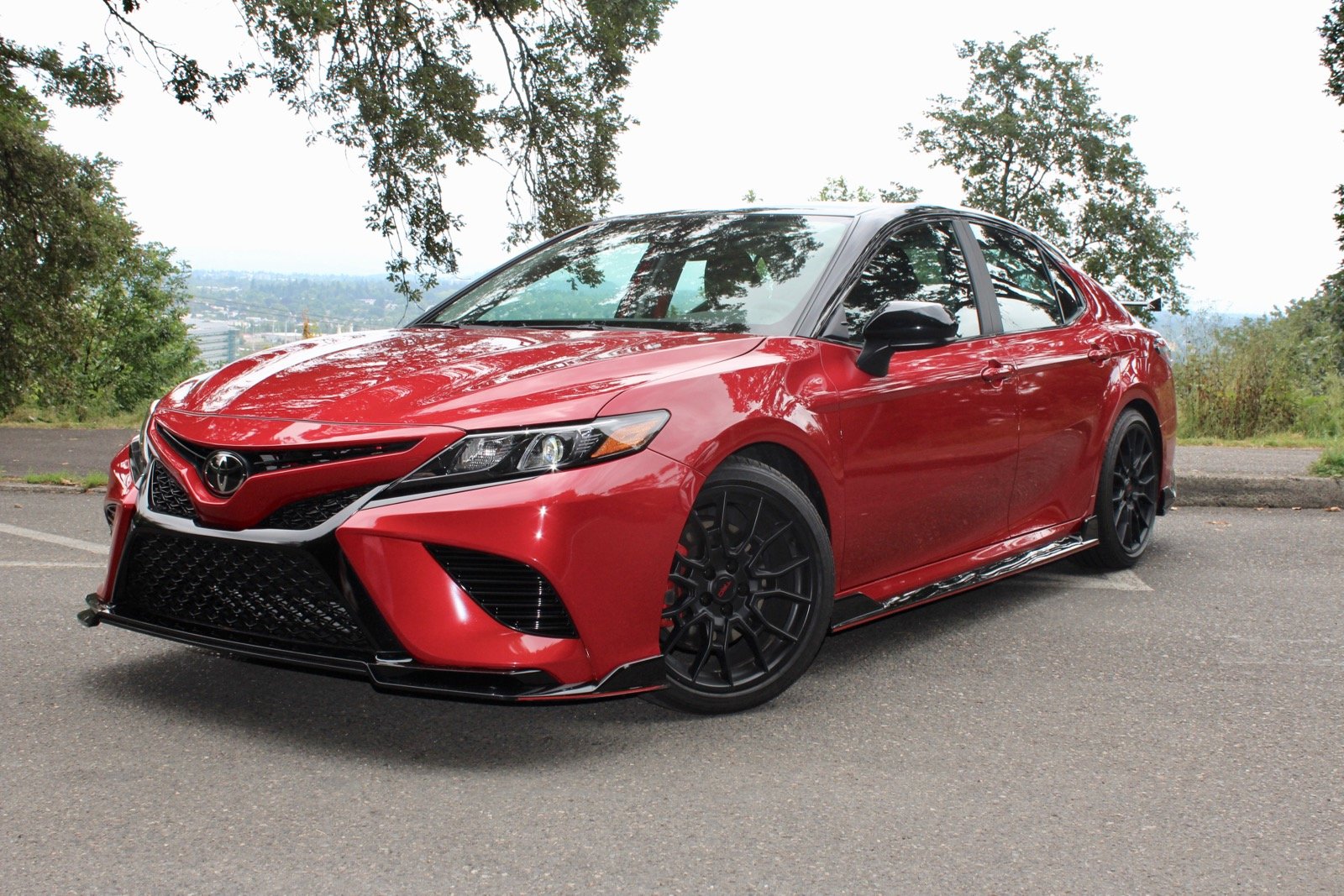
This starts with the styling, which is expressive in a way no Camry has ever been. While not every Camry gets the TRD model's huge wing and aerodynamic body kit, the bold front fascia and taut lines proclaim truthfully that this Camry is the sportiest yet. Some design cues seem torn from BMW's recent past: A character line that extends across the doors and bisects their handles and the upturned kink of the C-pillar bear the influence of Germany's premier constructor of sport sedans. With 14 exterior color options, including an available black roof, this edition of the Camry wants nothing more than to be fashionable.
Inside, Toyota uses uniformly nice materials that work in conjunction with the sweeping design of the driver-focused dashboard to make even the lowliest trim levels feel a cut above. The TRD model even gets red trim accents, including bright red seatbelts that wouldn't seem out of place in the cockpit of a Porsche or a Ferrari. Indeed, this is the first time you can really call the driver's seat of the Camry a "cockpit" with a straight face. Yet for all Toyota's focus on sportiness, the leather and wood in the highest Camry trim levels also reinforce the idea that a top-of-the-line Toyota is on par with an entry-level Lexus.
Of course, the Camry is not a Lexus any more than it is a BMW. But such an expectation of a mainstream sedan with a starting price of just $25,380 would be unfair. That the Camry falls short of bona fide sport sedan or luxury car is okay—at least Toyota seems to be once again trying.
Performance
The Camry comes with four distinct powertrains: a 2.5-liter four-cylinder with front-wheel drive (FWD), the same engine with all-wheel drive (AWD), a FWD 3.5-liter V6, and a hybrid powertrain. We'll cover the first three here, with the Camry hybrid model saved for a separate review.
Let's start with Toyota's tried-and-true 3.5-liter V6, which makes 301 horsepower in the Camry. This is a wonderful engine, smooth and powerful, and quick to rev, and it's used in all manner of Toyota and Lexus products. Paired here with an eight-speed automatic transmission, it does more to give the Camry real luxury aspirations than any other aspect of the car. It's the perfect choice for making a loaded Camry XLE feel like that budget Lexus. Unfortunately, its stolid and quiet qualities do not make for a particularly exciting powerplant when underhood in the Toyota Camry TRD. Even with a dual exhaust system that increases its low-end rumble, the V6 is the weak link in the TRD package.
The 2.5-liter four-cylinder, on the other hand, punches above its weight. It makes only 203 hp (206 in XSE trim), but the eight-speed automatic makes the most of those horses. Four-cylinder Camrys weigh about 150-175 pounds less than V6 models, and the lighter front end can be felt in the steering, making the sporty XSE trim nearly as much fun to drive as the brawnier TRD. The TRD's advantage lies in a specially tuned and lowered suspension that the average Camry driver will find too stiff. (In fact, owners accustomed to the Camry's usually pillow-soft ride may be surprised by just how much firmer all grades of Camry have become.) The TRD also has beefed up brakes and high-performance tires, features that will escape notice in routine street driving.
More drivers should appreciate that the Camry is now available with AWD. The technology is similar to that used on the RAV4, and it can send up to half of the 2.5-liter engine's 184 pound-feet of torque to the rear wheels when the computer detects slippery conditions. When rear-wheel traction is not needed, the rear differential gets disconnected, which minimizes the typical AWD fuel-economy penalty. The front-drive Camry has an EPA combined fuel economy rating of 31 miles per gallon in XLE and XSE trim, which drops to 28 mpg with AWD. Front-drive V6 models manage just 26 mpg, except for the TRD, which is rated at 25 mpg.
Form & function
The Camry is an easy car to get into and drive, even if you've never sat in one before. And for the millions of drivers who have, nothing in the new Camry should present much of an ergonomic challenge. Toyota still places an incongruous row of buttons on the lower dashboard to the left of the steering wheel, but most controls fall immediately to hand on the other side. The shifter, a pair of cupholders, a cell phone tray, and a reasonably sized storage bin all manage to share the center console between the front seats. The styling may make it seem like there's less room up front than in the past, but that's not so—legroom and hip room in the front have both increased from the previous generation.
The rear seat is another story. Legroom has shrunk, as has the overall passenger volume and the size of the trunk. Not by a lot, but when other competitors continue to grow the size of their cars, it has left the Camry with a tighter backseat than the Accord and a smaller cargo hold than several competitors. At just 15.1 cubic feet of cargo space, its trunk is equivalent to that of the Honda Civic, the Accord's one-size-smaller sibling.
Fortunately, the addition of AWD to the Camry didn't further compromise its trunk or passenger compartment. Although this forced Toyota to modify the floor structure and fuel tank, as well as switch to an electronic parking brake, the AWD Camry's rear seats and trunk remain unchanged from front-drive versions.
Technology
It wasn't until last year that Toyota added Apple CarPlay to most of its lineup, including the Camry. This year—finally—Android phone users will also be accommodated, as Android Auto is now standard equipment. (Ditto Amazon Alexa compatibility and a three-month trial of SiriusXM satellite radio.) Drivers will likely want to use these new features because Toyota's standard infotainment system feels dated, with low-resolution graphics and navigation software that is in every way inferior to both Google Maps and Apple Maps.
On the plus side, Toyota's touchscreen is highly functional and quick to respond to inputs. It has hard buttons for major functions that make it an ergonomic delight to use. The standard 7-inch screen on the lower trim levels feels a bit small, although Toyota does offer an optional 8-inch upgrade. A single USB-A port accommodates phone use with the system, and most models also pack a pair of USB-A charging ports in their center console. Those who want more charging capability can spec an optional Qi wireless charging pad, although USB-C ports are unavailable in the Camry.
A three-month trial of WiFi Connect will turn your Camry into a mobile hotspot, although after you burn through the complimentary 2GB of data, it will probably make more sense to just use your phone's data plan. You can also use your smartphone to lock and unlock the doors of some Camry trims, as well as start the vehicle remotely; a one-year trial of this service, called Remote Connect, is included with Camry XSE and XLE models.
Higher-trim-level Camrys have their standard 4.2-inch multi-information display (the one in the instrument panel between the speedometer and tachometer) enlarged to 7 inches. An optional 10-inch head-up display (HUD) further enhances the Toyota Camry's focus on the driver.
Safety
Toyota includes a version of its Safety Sense suite of technologies in all Camry models, but it is not quite as comprehensive as in other Toyota models. Standard equipment includes a pre-collision system with emergency braking and pedestrian detection, dynamic radar adaptive cruise control, lane-departure warning with steering assist, and automatic high beams. A one-year trial of Safety Connect, an emergency assistance service and stolen vehicle locator with automatic collision notification, is included with every Camry. Blind-spot monitoring with rear cross-traffic alert is optional. Every Camry comes with 10 airbags, as well as industry-standard features like stability control and a backup camera.
To take the backup camera one step further, Bird's Eye View is offered on higher trim levels. This technology stitches together camera images to project a 360-degree view of the space surrounding the car on its infotainment screen. It's a boon for spotting potential hazards while parking.
The National Highway Traffic Safety Administration (NHTSA) gave the 2020 Toyota Camry a five-star rating in crash tests, its highest score. The Camry also earned the best rating given by the Insurance Institute for Highway Safety (IIHS): Top Safety Pick+
There has been one NHTSA recall involving the 2020 Camry, for leaking engine coolant. It began on April 3, 2020, and potentially affects up to 44,191 cars with 2.5-liter four-cylinder engines, including other Toyotas nameplates.
Cost-effectiveness
All Camry models include ToyotaCare: free maintenance for two years or 25,000 miles, as well as roadside assistance. Standard warranties cover three-years or 36,000-miles on the vehicle, five years or 60,000 miles on the powertrain, and an unlimited-mileage corrosion warranty.
Toyota sells Camry models at MSRPs ranging between $25,000 to $40,000, meaning there is probably one for most buyers. The lowly L trim, which offers no options, is best avoided, considering $545 more gets you into a Camry LE for $25,925, which opens up equipment such as AWD ($1,400), a convenience package with blind-spot monitoring ($1,315), a moonroof ($2,215, including the convenience package), and upgraded audio system and infotainment ($3,180, including the other two packages).
The sportier Camry SE adds more color choices and better interior trimmings, including synthetic leather seats instead of cloth, while the SE Nightshade trim features blacked-out exterior trim and black 18-inch wheels. Both start in the $27,000 range. Cresting $30,000, the XLE and XSE are much like the LE and SE, but with more luxury equipment, such as leather upholstery, dual-zone climate control, and the audio system and infotainment upgrade. Then there are the V6 models, starting with the Camry TRD at $32,125. The XLE V6 jumps to $35,535 and the XSE V6 starts at a whopping $36,085.
The Camry is one of the last remaining midsize sedans to offer a V6, but it's hard to recommend those models given their higher initial cost and operating expenses. The EPA estimates that fueling a V6 Camry will cost $1,250 per year, while a front-drive XLE or XSE four-cylinder would trim $200 from that budget. Even with the AWD drivetrain, a four-cylinder XLE or XSE will likely save $100 each year, according to the EPA. (It calculates these numbers based on driving 15,000 miles per year, with 55 percent of the driving on the highway.) The TRD is a nonstarter to anyone other than the most enthusiastic Toyota fanboys.
If we had to pick one car that hits the sweet spot of price and amenities, it would be a four-cylinder XLE with the moonroof package for $31,470 (or $33,020 with AWD). This is a lot of car for a lot less than the average retail price of a new vehicle. It may not be as value-laden as a Hyundai Sonata, as fun to drive as a Honda Accord, or as spectacular to look at as a Mazda 6, but it is certainly the best Camry Toyota has sold in years.

What owners say
"Overall, drivers love the 2020 Toyota Camry for its reliability, comfort, and great fuel economy. Many appreciate its stylish design and smooth ride. However, some owners desire more horsepower and advanced options like all-wheel drive. Additionally, a few mentioned learning to navigate the newer technology features."
The car was in great condition and well valued!
January 26, 2023So far this site second Camry we have purchased for 2 of our daughters after high school graduation. They have performed well. No issues at all. They both had well over 100k miles when purchased.
August 21, 2024Great car! Very spacious in the inside & great features.
November 20, 2021What owners say
The car was in great condition and well valued!
January 26, 2023So far this site second Camry we have purchased for 2 of our daughters after high school graduation. They have performed well. No issues at all. They both had well over 100k miles when purchased.
August 21, 2024Great car! Very spacious in the inside & great features.
November 20, 2021The best car I have ever owned, comfortable , fast and fuel efficient.
March 19, 2021Great looking car and it rides like a dream. Love it
August 14, 2020I love this car and was a great value! I would recommend the Camry to anyone.
June 4, 2023I love this car so much! Spacious,runs great and very comfy to the daily commute!! One of the best cars I’ve ever owned!
March 25, 2021Good value, comfortable ride. Reliability of the accord and smooth ride if a Mazda 6
February 20, 2021This car is awesome for the value. I bought the SE and I’m very pleased.
December 27, 2020The 2020 Camry XSE is an outstanding vehicle. We replaced a 2000 Camry LE V6. Weve only had it for 2 days, but we had to drive 320 miles to get it home. A real pleasure to drive, but were a little behind on all the added technology and have lots more to learn. We love it! The only thing wed really like to have is a manual transmission.
December 1, 2020Trims & specs
Base MSRP $31,170 | Seating 5 |
Engine 3.5L 301 hp V6 | Cargo Capacity 15.1 cu ft |
Combined MPG 26 | Drivetrain FWD |
Base MSRP $26,870 | Seating 5 |
Engine 2.5L 203 hp I4 | Cargo Capacity 15.1 cu ft |
Combined MPG 33 | Drivetrain FWD |
Base MSRP $24,970 | Seating 5 |
Engine 2.5L 203 hp I4 | Cargo Capacity 15.1 cu ft |
Combined MPG 33 | Drivetrain FWD |
Base MSRP $24,425 | Seating 5 |
Engine 2.5L 203 hp I4 | Cargo Capacity 14.1 cu ft |
Combined MPG 34 | Drivetrain FWD |
Base MSRP $26,170 | Seating 5 |
Engine 2.5L 203 hp I4 | Cargo Capacity 15.1 cu ft |
Combined MPG 33 | Drivetrain FWD |
Base MSRP $31,405 | Seating 5 |
Engine 2.5L 205 hp I4 | Cargo Capacity 15.1 cu ft |
Combined MPG 29 | Drivetrain AWD |
Base MSRP $26,370 | Seating 5 |
Engine 2.5L 202 hp I4 | Cargo Capacity 15.1 cu ft |
Combined MPG 29 | Drivetrain AWD |
Base MSRP $27,570 | Seating 5 |
Engine 2.5L 202 hp I4 | Cargo Capacity 15.1 cu ft |
Combined MPG 29 | Drivetrain AWD |
Base MSRP $28,270 | Seating 5 |
Engine 2.5L 202 hp I4 | Cargo Capacity 15.1 cu ft |
Combined MPG 29 | Drivetrain AWD |
Base MSRP $30,855 | Seating 5 |
Engine 2.5L 202 hp I4 | Cargo Capacity 15.1 cu ft |
Combined MPG 29 | Drivetrain AWD |
Base MSRP $34,580 | Seating 5 |
Engine 3.5L 301 hp V6 | Cargo Capacity 15.1 cu ft |
Combined MPG 27 | Drivetrain FWD |
Base MSRP $29,455 | Seating 5 |
Engine 2.5L 203 hp I4 | Cargo Capacity 15.1 cu ft |
Combined MPG 32 | Drivetrain FWD |
Base MSRP $35,130 | Seating 5 |
Engine 3.5L 301 hp V6 | Cargo Capacity 15.1 cu ft |
Combined MPG 27 | Drivetrain FWD |
Base MSRP $30,005 | Seating 5 |
Engine 2.5L 206 hp I4 | Cargo Capacity 15.1 cu ft |
Combined MPG 32 | Drivetrain FWD |


Pricing trends
MSRP range
$24,425 - $35,130
Current avg. market price
$19,932
Trending down by 2.4% this month
April 2026 - October 2026


